
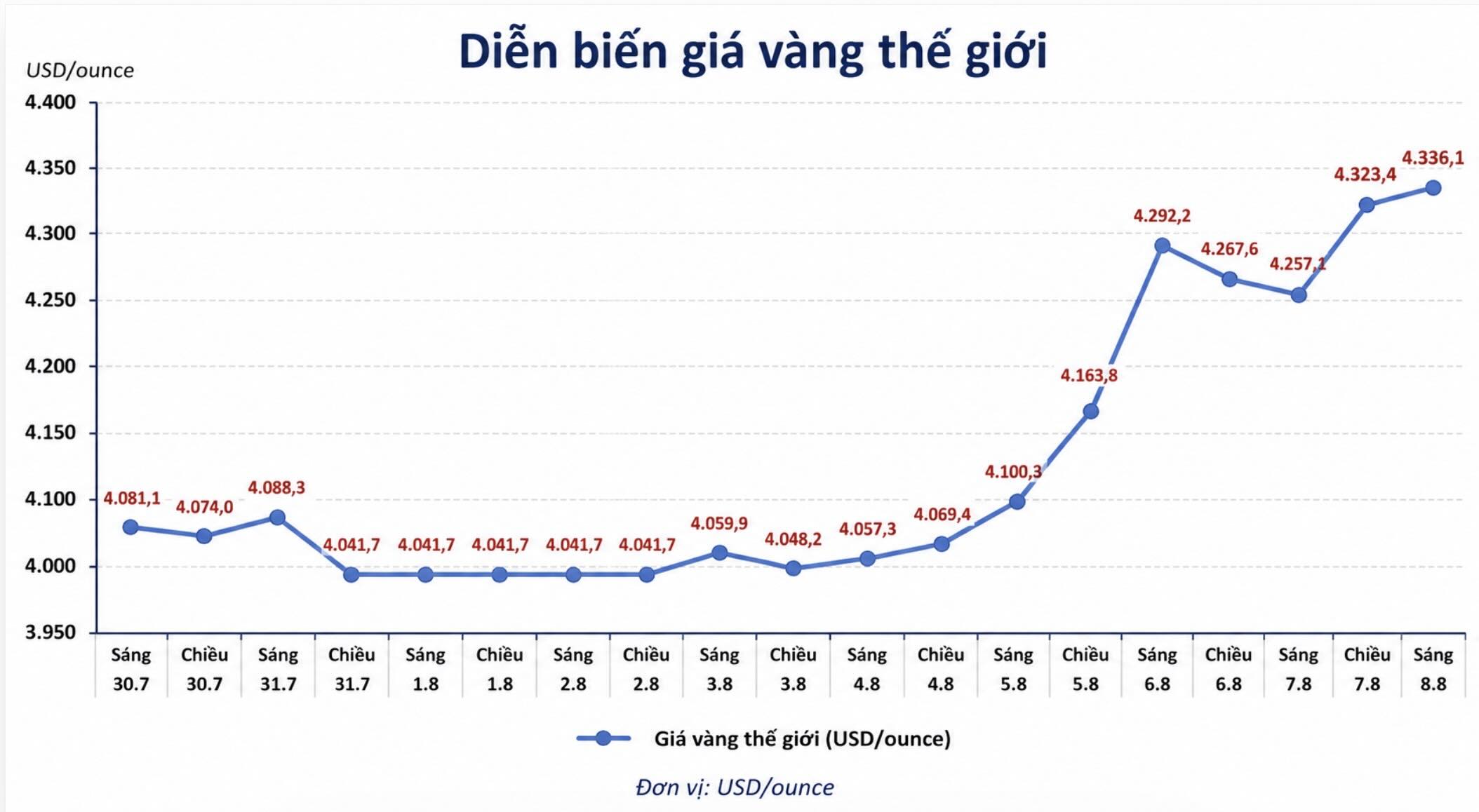
World gold prices jumped sharply last night, as the latest US jobs report forced the market to re-evaluate the monetary policy outlook of the US Federal Reserve (Fed).
At one point, spot gold was traded around 4,352.6 USD/ounce, up 2.67% in the session. After that, the buying momentum continued to be boosted, bringing the precious metal price to about 4,367.8 USD/ounce, equivalent to an increase of about 3%. Silver price also increased sharply by more than 4%, to nearly 63.97 USD/ounce.
The main driving force for gold came from the US labor market report in July. According to newly released data, the number of non-farm jobs decreased by 23,000, completely contrary to analysts' expectations of an increase of about 85,000 jobs.
Not only did July data disappoint, data from the previous two months was also significantly reduced. The number of new jobs in June was reduced from 57,000 to 20,000, while May decreased from 129,000 to 63,000. Thus, the total number of jobs in May and June was 103,000 lower than the initial report.
Despite job declines, the unemployment rate in the US decreased from 4.2% to 4.1%. However, this development does not fully reflect the improvement of the labor market, in the context that the rate of labor force participation continues to be low.
Wage growth also shows signs of slowdown. Average hourly income of private sector workers only increased by 2 cents in July, to 37.62 USD. Compared to the same period last year, average income increased by 3.2%.
The above figures quickly impacted the bond market and interest rate expectations. The yield of 10-year US government bonds fell to the region of 4.6%, after being around 4.67% right before the jobs report was released.
The market also reduced bets on the possibility that the Fed will continue to raise interest rates in September. Previously, at the meeting ending on July 29, the Fed kept the reference interest rate unchanged in the range of 3.50-3.75%. The decision was passed with 9 votes in favor and 3 members wanting to raise interest rates by another 0.25 percentage points.
Weak labor data creates a more difficult problem for the Fed. Inflation remains high, especially as energy prices are affected by tensions in the Middle East. However, if the labor market continues to weaken, the US central bank's ability to raise interest rates sharply will be limited.
This is a favorable factor for gold. Lower interest rates and real yields reduce the opportunity cost of holding non-performing assets like gold. The weakening USD after the jobs report also contributed to supporting the price of precious metals.
Besides monetary policy, developments in the Strait of Hormuz remain an important variable. Negotiation signals related to Iran may help reduce pressure on oil prices, but disagreements over control over this strategic shipping route have not been fully resolved. Geopolitical risks therefore still maintain a part of the safe-haven demand for gold.
Technically, the 4,372.4-4,450 USD/ounce zone is being considered an important resistance area. If it surpasses and maintains above this zone, gold prices may head towards the 4,494-4,500 USD/ounce area.
In the opposite direction, the 4,228.9 USD/ounce zone plays a near support role. If this level is broken, the 4,120 USD/ounce and 4,000 USD/ounce zones may become the next notable support levels.
The article only reflects market developments, not investment recommendations.


