
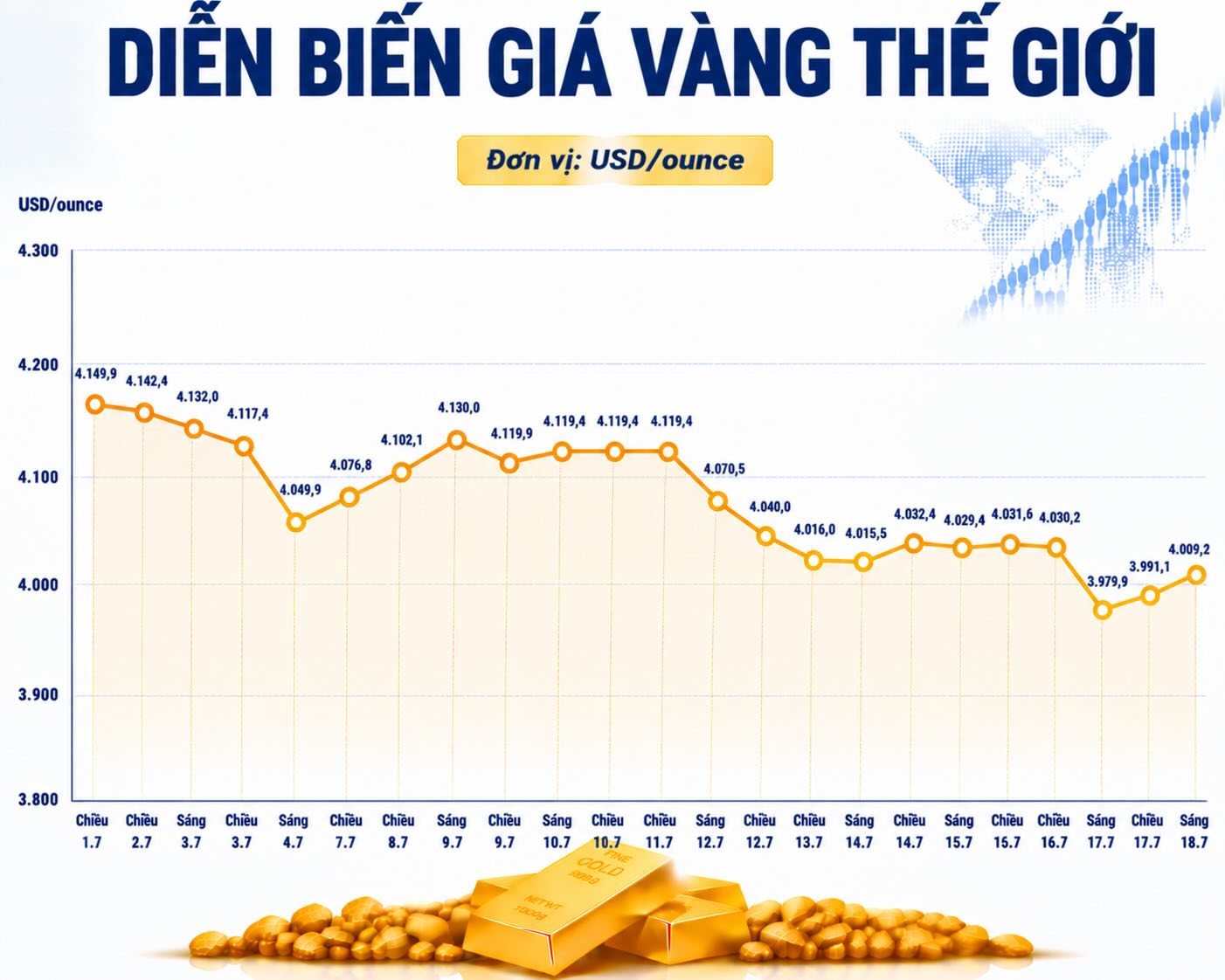
World gold prices reversed to increase in the trading session last night, regaining the important psychological threshold of 4,000 US dollars (USD)/ounce after undergoing strong selling pressure in the previous session.
In the previous trading session, spot gold prices at one point fell to about 3,970.2 USD/ounce. However, buying pressure gradually returned as the market received new information about consumer sentiment and inflation expectations in the US.
After the data was released, gold prices quickly approached the highest level in the session and surpassed the 4,000 USD/ounce mark again. This development shows that investors are still willing to buy in the low price zone, especially when the short-term inflation outlook shows signs of easing.
An important driving force supporting gold prices comes from the July preliminary report of the University of Michigan. The US consumer sentiment index reached 54.4 points, higher than the analysts' forecast of 51 points. This result also improved significantly compared to 49.5 points in June and 44.8 points in May.
Consumer sentiment increased for the second consecutive month, mainly thanks to reduced fuel price pressure at retail stations in recent weeks. Survey components all improved, in which the conditions for buying durable goods and business expectations in the coming year increased significantly.
However, the factor that the gold market paid more attention to was the expectation that inflation in the next year would fall from 4.6% to 4.2%. Although still at a high level compared to history, this adjustment reinforces the notion that price pressure in the US may be cooling down.
Decreased inflation expectations increase the possibility that the US Federal Reserve (Fed) has more room to adjust monetary policy in the coming months. Lower interest rates are often beneficial for gold because they reduce the opportunity cost of holding unprofitable assets.
Previously, gold prices had received support from June inflation figures. The US consumer price index fell 0.4%, while the producer price index for end demand fell 0.3%.
However, the market remained cautious as some other US economic indicators continued to show relatively good resistance. Retail sales increased by 0.2%, initial jobless claims fell to 208,000, and the Philadelphia regional manufacturing index rose sharply to 41.4 points.
The interweaving of cooling inflation and positive economic activity makes the expectation of a clear policy turning point from the Fed not really certain. The futures contract market currently still highly appreciates the possibility that the Fed will keep interest rates unchanged at the meeting on July 29.
Maintaining high US government bond yields also partly limits the upward momentum of precious metals. 10-year term bond yields traded around 4.53%, while 2-year term yields were near 4.12%. The USD strength index (DXY) stabilized around 100.8 points.
Besides the monetary factor, tensions in the Strait of Hormuz continue to create support for shelter needs. Transportation through this area has not been completely interrupted but is under great pressure from military conflicts and the risk of naval routes being narrowed.
Geopolitical risks caused oil prices to remain at a high level, with Brent oil trading around 86 USD/barrel and US light sweet crude oil around 80 USD/barrel. This development has a two-way impact on gold.
On the one hand, instability in the Middle East region promotes cash flow to defensive assets. On the other hand, rising oil prices may increase the risk of inflation, causing bond yields to remain high and limiting expectations of the Fed to cut interest rates soon.
Technically, gold prices regaining the 4,000 USD/ounce threshold helps reduce selling pressure in the short term. If maintained firmly above this level, gold prices may head towards the resistance zone of 4,008.7 USD/ounce, followed by 4,044 USD/ounce.
In the opposite direction, the 3.970.2 USD/ounce zone continues to play the closest supporting role. If it penetrates this area, gold prices may retreat to 3.959 USD/ounce or deeper to 3.942 USD/ounce.
In the coming sessions, the market will monitor the statements of Fed officials, changes in interest rate expectations and transport developments through the Strait of Hormuz. The possibility of gold prices maintaining above $4,000/ounce also depends on whether inflation cooling is strong enough to overwhelm the impact from oil prices and bond yields.
The article only provides information about market developments, not recommendations for buying, selling or investing in gold. Investors need to consider their financial capacity, holding targets, and risk tolerance before making a decision.


