
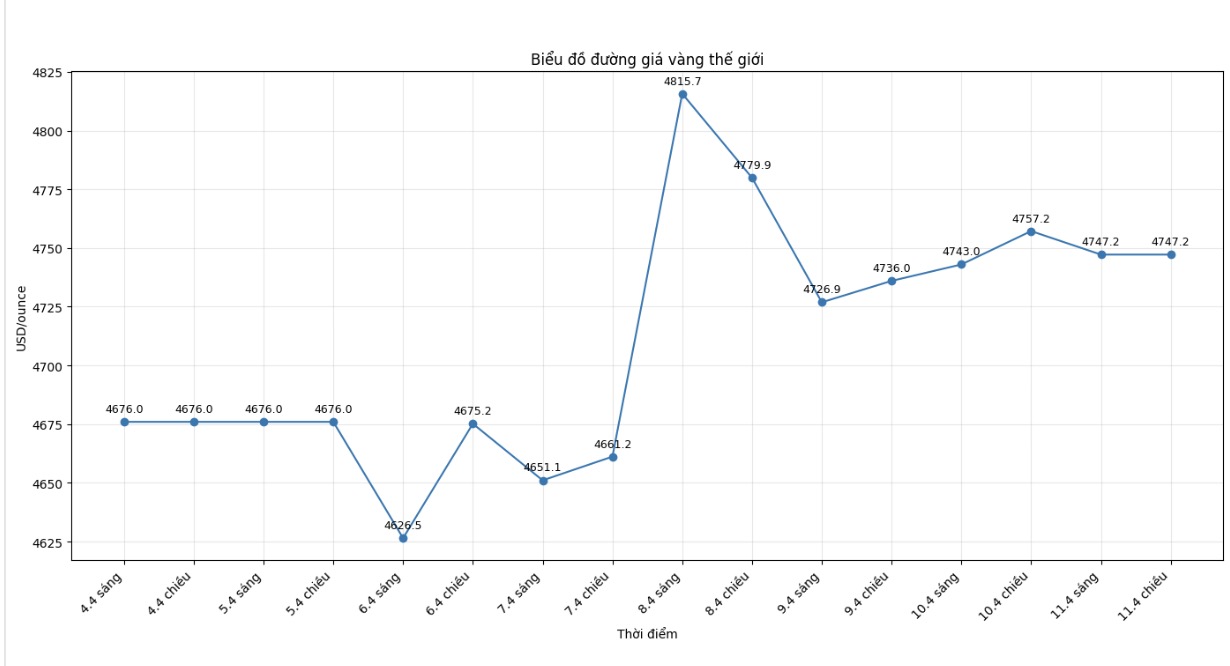
Optimism about gold began to increase from the beginning of the week, after the US and Iran reached a two-week ceasefire agreement. Immediately after this information, gold prices at one point surged above the 4,800 USD/ounce mark, but could not maintain their upward momentum.
Many analysts believe that the technical outlook for gold is brighter, but the market still faces a series of uncertainties, making it difficult for the precious metal to surpass the 5,000 USD/ounce mark next week.
Mr. Christopher Vecchio - Head of Futures and Foreign Exchange Strategy at Tastylive - said that the current ceasefire is still very fragile, and it is too early to confirm whether this is a premise for a long-term peace agreement or not.
According to him, the gold market is unlikely to break through when geopolitical instability still exists. If a clearer agreement is not reached, the risk of further asset sales to increase cash reserves may put pressure on gold prices to go down.
Although still maintaining a positive view on gold in the long term, Mr. Vecchio believes that in the short term there are not many attractive trading opportunities, especially when the market is still dominated by too many noise factors.

Sharing the same cautious view, Mr. Ole Hansen - Head of Commodity Strategy at Saxo Bank - said he was somewhat more reassured as gold prices recovered and demand from ETFs improved.
However, according to him, the market still needs more certainty that the conflict in the Middle East is really close to ending. Then, the supporting factors for gold prices may return more clearly, and may even be strengthened if weakening economic growth forces the US Federal Reserve (Fed) to consider reducing interest rates.
In the short term, analysts believe that inflation concerns continue to be the main factor dominating the diễn biến of gold prices.
According to data released by the US Bureau of Labor Statistics on Friday, the consumer price index (CPI) in March increased by 0.9%, much higher than the 0.3% increase in February. However, this figure is still lower than the 1% forecast of economists. Year-on-year, full inflation increased by 3.3%, in line with market expectations.
Although consumers are under pressure from the sharp increase in gasoline prices due to supply disruptions related to the conflict with Iran, current data shows that inflation has not spread widely and has not penetrated deeply into the entire economy.
Notably, core CPI - excluding food and energy prices - only increased by 0.2% last month. Year-on-year, core inflation increased by 2.6%, slightly up from 2.5% in February.
In addition, another not-so-positive sign for the US economy is that a preliminary survey of consumer psychology by the University of Michigan shows a sharp decline in optimism, while inflation expectations are increasing.
Ms. Roukaya Ibrahim - Director of Commodity Strategy at BCA Research - said she maintains a cautious stance on gold in the short term, as the market currently believes that inflation risk will strongly affect interest rate expectations.
However, she also emphasized that as concerns about inflation begin to negatively impact growth, gold will regain its appeal as a safe haven asset.
According to Ms. Ibrahim, at the present time, geopolitical risks are mainly creating an inflation shock, causing investors to raise expectations about the possibility of interest rate hikes, or at least reduce expectations of interest rate cuts. But if this situation persists, it will gradually turn into a growth shock, pulling yields down and creating a more favorable environment for gold.
Although the Fed is forecast to continue to maintain a neutral stance at least until the summer, TD Securities experts still believe that the possibility of interest rate cuts in the second half of the year is still present.
According to this analysis group, the Fed will be more patient because the ultimate impact of the Middle East conflict on the US economy has not yet been fully revealed. However, if inflation gradually cools down, there is still basis to expect two waves of interest rate cuts, each of 25 basis points, in the second half of 2026.
Many experts believe that gold prices will attract new growth momentum as soon as the market realizes that the Fed may prioritize supporting economic growth rather than curbing inflation.


