
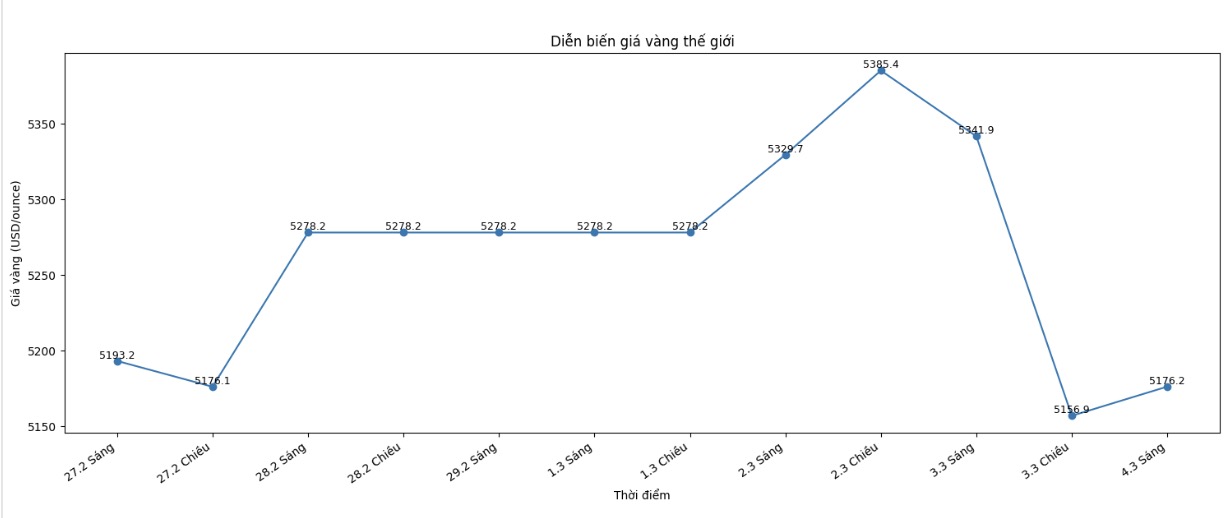
According to Ms. Rhona O'Connell - Head of Market Analysis for EMEA & Asia at StoneX, although many factors such as the war with Iran, instability related to US tariff policy and higher-than-expected US inflation are supporting gold and silver, these two precious metals are currently in a state of overbought and may need a period of adjustment.
In a report released on Monday, she said: "The geopolitical environment continues to be a strongly dominating factor for the precious metals market, especially gold and silver, although platinum and palladium are also affected by external factors.
According to Ms. O'Connell, the new and most notable development is the escalation of conflict in the Middle East. "Assaults on Iran and retaliatory actions in the region have pushed gold and silver prices up sharply, while raising oil prices to a new level. Gold and silver reflect investors' risk-avoidance, while oil reacts to the risk of supply disruption.
She added that the US Supreme Court ruling related to tariffs under the International Emergency Economic Power Act (IEEPA) also increased market instability.
In addition, the plan to impose a widespread 10% tax under Article 122 of the 1974 Commercial Act is also causing much legal debate.
Ms. O'Connell also emphasized the worrying increase in manufacturing inflation, as the US producer price index (PPI) recorded the largest monthly increase since January 2025, which is also a factor supporting gold prices.

For silver, ETFs have recorded quite large capital withdrawals, while on the CFTC market, some new buy positions have appeared along with the activity of closing selling positions. However, the net buying position is currently only at 1,395 tons, equivalent to 29% of the average of the past 12 months.
On the COMEX exchange, silver inventories have decreased sharply in recent weeks. Currently, the treasury is at 11,207 tons, down 5,323 tons compared to the end of September and is returning to the 9,000 – 10,000 tons range, which is considered a more normal level.
Ms. O'Connell said this could help reduce market volatility, while easing pressure on the silver market in London.
Meanwhile, gold inventories have decreased by 91 tons (equivalent to 8%) since the beginning of the year, down to 1,036 tons, 11% lower than the average for the whole year 2025.
From the above factors, she believes that there are currently not many surplus speculative positions on exchanges for both gold and silver, which reflects the profit-taking activity in silver in January and the gradual decline in positions on COMEX.
This can be viewed in two ways: One is that the market is currently less pressured to sell when prices increase; two is that investors believe that precious metal prices have increased excessively" - she wrote.
According to her, the answer may lie in the combination of both factors.
Currently, gold prices are at the peak of an upward trend and the RSI index is approaching the 70 threshold, while silver is at a Fibonacci retreat after a strong correction.
A combination of these factors shows that gold and silver may have increased enough in the past period and need time to relieve overbought status. However, the room for price reduction is considered not large. If there is no further geopolitical escalation, the market may enter a breakout phase" - Ms. O'Connell said.
She also believes that in the current sensitive context, the strength of gold and silver can still be maintained until the situation stabilizes again. Until then, the market is likely to maintain a risk-avoidance mentality.


