
World gold prices remained high in the first trading session of the week as the market continued to monitor the tense developments between the US and Iran, while waiting for a series of important US economic data.
At the time of writing the article (1:03 AM on May 12 - Vietnam time), world gold prices were listed around the threshold of 4,722.7 USD/ounce, slightly up compared to the previous session.
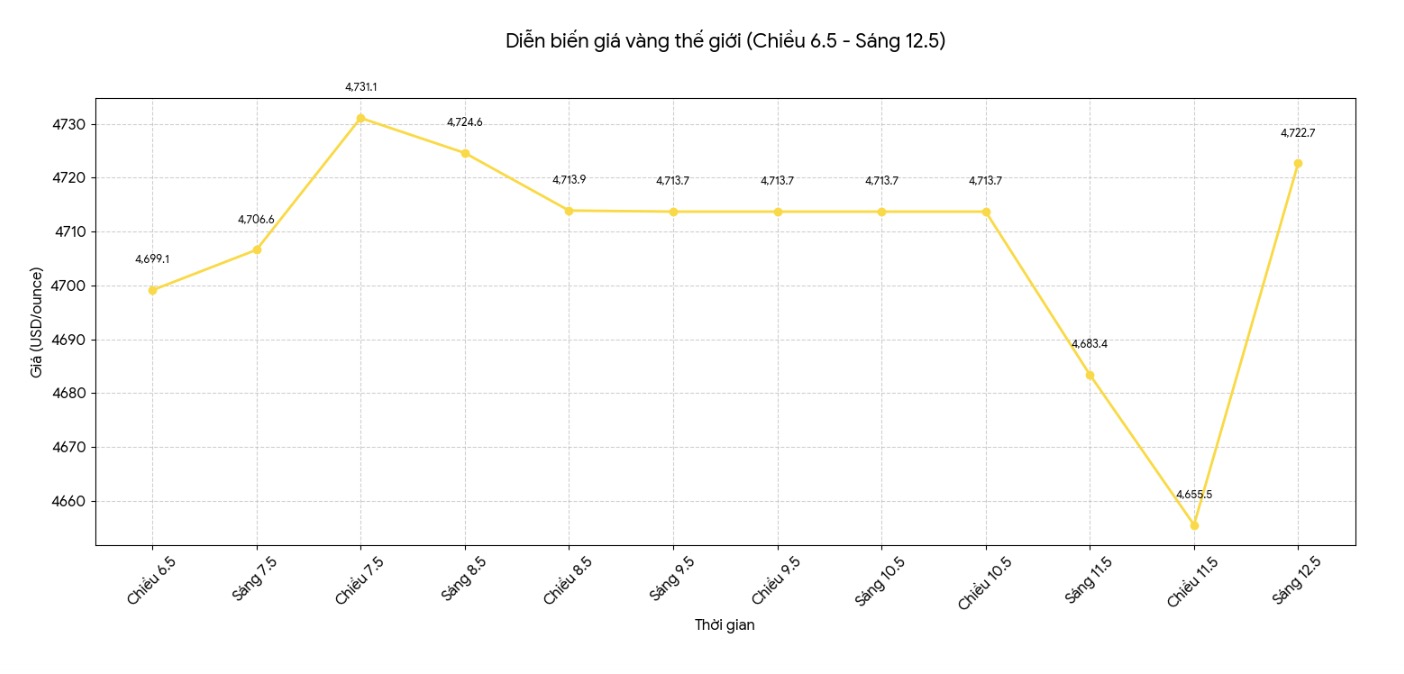
The precious metals market in the context of strong oil prices recovering after signals showing that efforts to promote peace talks between the US and Iran have not been able to help trade through the Strait of Hormuz return to stability as expected.
Brent oil prices increased by about 3%, to around 104.32 USD/barrel. US WTI oil also increased by more than 3%, trading nearly 98.4 USD/barrel after both oils fell sharply last week thanks to expectations of reaching an agreement.
The upward momentum of crude oil continues to worry investors about prolonged inflationary pressure, thereby increasing the attractiveness of gold as a risk hedging asset.
This week, the market paid special attention to the US consumer price index (CPI) and core CPI data for April, expected to be released on May 13 US time. According to forecasts, the overall CPI may increase by 0.6% per month and 3.7% per year, while the core CPI is expected to increase by 0.3% per month and 2.7% per year.
In addition to inflation, the market also monitors the health of the US economy through the April inventory sales report.
The US National Association of Realtors (NAR) said that existing home sales in April increased by 0.2%, reaching an annual seasonally adjusted rate of about 4.02 million units. However, this result is still lower than analysts' forecast of 4.05 million units.
This development shows that the US real estate market shows signs of improvement but the recovery momentum is still quite slow. This makes investors maintain a cautious sentiment about the prospects of US economic growth, thereby supporting the demand to hold gold as a safe asset.
According to the report, home sales increased in the Midwest and South of the United States, stable in the Northeast but decreased in the West. Compared to the same period last year, sales increased in the South, remained flat in the West and decreased in the remaining two regions.

NAR's chief economist - Mr. Lawrence Yun, said that improved housing affordability has partly supported the real estate market, although the US economy still sends many mixed signals.
He believes that mortgage interest rates are currently lower than the same period last year, while the average income growth rate is exceeding the increase in house prices. These factors may help reduce concerns about economic recession, thereby partially limiting the upward momentum of gold in the short term.
However, housing supply is still limited. The situation of many people bargaining to buy one real estate still appears, although it is no longer as stressful as a few years ago. The time housing is on the market is also longer, showing that buyers are cautious about major financial decisions.
According to analysts, the fact that buyers are still hesitant reflects psychological concerns about prolonged high interest rates and unstable economic prospects. This is a factor that continues to support gold prices to maintain in the high zone.
In the financial market, the USD index continued to increase slightly, while the yield of 10-year US Treasury bonds fluctuated around 4.4%. The strengthening USD along with high yields increased the opportunity cost of holding gold, thereby putting pressure on the precious metal in the short term.


