
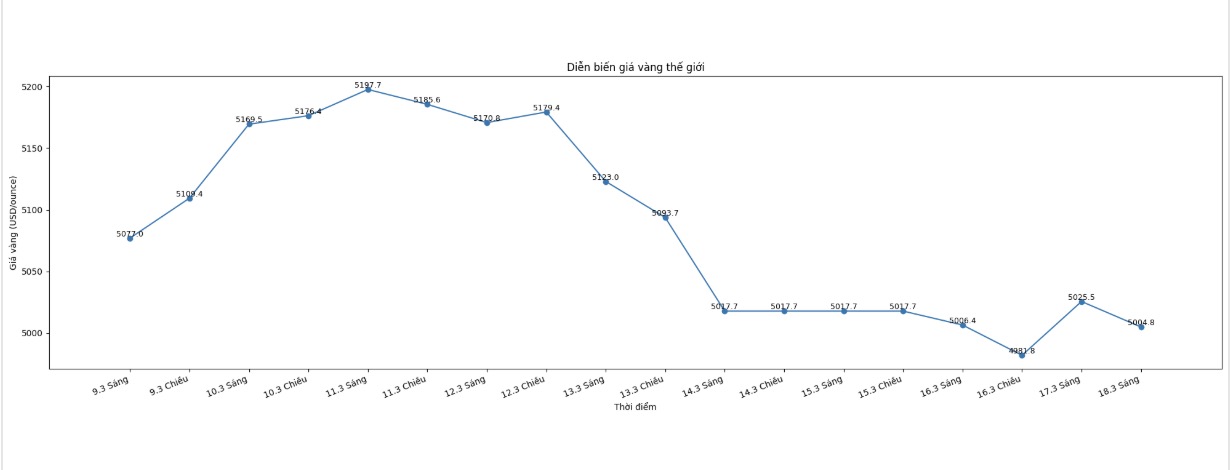
In an interview with Kitco News, Mr. Daniel Pavilonis - senior commodity broker at RJO Futures (a commodity and derivatives brokerage company based in the US) said that as the Iran conflict enters its third week, gold prices continue to hold steady around the support level of 5,000 USD/ounce.
However, the market is still looking for answers about the duration and extent of the war. If investors believe that the conflict will be worse and last longer than the US 6-week forecast, this could cause both the stock market and the precious metals to fall sharply.
Mr. Pavilonis believes that gold and silver will continue to fluctuate in line with the stock market - which is moving in the opposite direction to US Treasury bond yields and he predicts stocks will soon fall.
“All metal elements are linked to energy and are influenced by the yield curve, especially 10-year bond yields. As long as yields continue to rise, gold and silver will be under downward pressure," he said.
According to him, the next few days will be very important as the market can see more clearly the scale and developments of the conflict.
“It seems that the US is deploying Marines to the Middle East, with the ability to deploy forces on land. But in the opposite direction, there is information that Indian oil tankers have passed through the strait.
At least one ship has passed through and possibly more, even Chinese ships. If so, most of the oil is still circulating through this area and that could help cool down the market," he said.
Mr. Pavilonis said that if interest rates continue to rise due to rising oil and energy prices due to the risk of supply disruption to Europe and Asia, precious metals will decrease accordingly.
If yields fall, gold and silver may rise, pulling stocks up. But when oil rises sharply again, things may turn down again," he said.
He also said that the tense developments in the Middle East could create a double impact: both disrupting oil supplies and forcing some countries in the region to restructure their asset portfolios, including US Treasury bonds and USD-denominated assets.
In my opinion, this is a factor to watch" - he said - "Oil-dependent economies often invest in US bonds, stocks and gold. When it is necessary to increase liquidity to cope with risks, they can sell off some of these assets.
Mr. Pavilonis said that the current fluctuations also partly reflect pressure on security and financial stability in the region.
The core factor is still the level of stability" - he said - "If risks increase, capital flows may shift and affect the demand for holding international financial assets.
In that context, he predicts that the stock market and precious metals may continue to be under pressure.
Stocks and gold are trending in the same direction, especially silver. The stock market is weakening and is likely to enter a new wave of decline. If this scenario occurs, oil prices may return to the peak zone," he said.
The market may still fluctuate before stabilizing again. The possibility of gold falling to around 4,200 USD/ounce is possible" - he said.


