
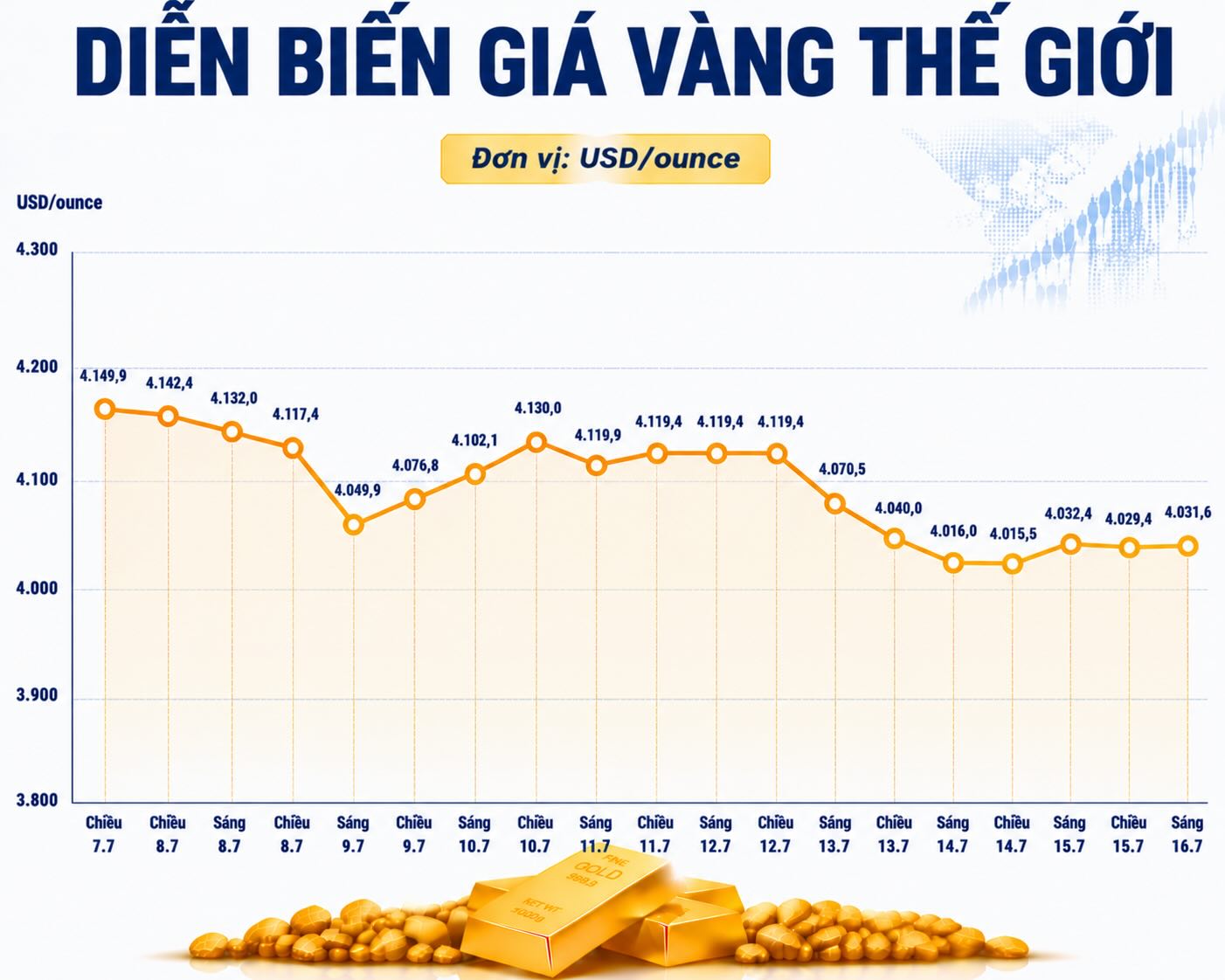
World gold prices increased slightly in the trading session on July 15, but could not form a clear breakthrough even though the latest US inflation reports were lower than forecast.
In the previous trading session, gold prices fluctuated from 4,016.6 to 4,081.5 USD/ounce. The precious metal maintained above the psychological threshold of 4,000 USD but continued to be blocked before the resistance zone of 4,091-4,104 USD/ounce, then turned down.
In contrast to gold, spot silver prices fell 1.52%, to nearly 57.68 USD/ounce. Silver at one point increased to 59.2 USD/ounce but did not hold the 58 USD mark, showing that buying power in the precious metal market is still uneven.
Inflation cools down supports gold prices
The main driving force helping gold prices hold above 4,000 USD/ounce comes from positive inflation data in the US.
The consumer price index in June decreased by 0.4% compared to the previous month, marking the first decrease since 2020. The annual CPI growth rate decreased to 3.5%, from 4.2% in May. Core CPI did not increase compared to the previous month and increased by 2.6% compared to the same period.
The released production price index report then continued to reinforce the downward inflation signal. The PPI in June decreased by 0.3% compared to the previous month, of which commodity prices decreased by 1.4% and service prices increased by 0.2%. The annual PPI growth rate slowed down to 5.5%.
These figures increased expectations of a less tough monetary policy roadmap. The yield of 10-year US Treasury bonds fell to about 4.56%, while the USD index fell to around 100.52 points, down about 0.4%.
Weakening yields and the USD often create favorable conditions for gold prices. However, the increase of precious metals in the session is still quite modest, showing that the market is not completely confident that the Fed will soon move to ease monetary policy.
Oil prices complicate interest rate outlook
One of the reasons why gold prices are difficult to break through is the strong increase in crude oil. WTI oil prices traded around 71.51 USD/barrel, after increasing by more than 9% in 5 sessions.
Tensions in the Strait of Hormuz continue to increase the risk of disruption to global energy supplies. Transportation through this region remains limited and under military pressure, instead of returning to normal.
The above developments create a two-way impact on gold prices. Geopolitical risks drive demand for safe-haven assets, but rising oil prices raise concerns that inflation may return.
Higher energy costs may cause inflation expectations to remain high, forcing the US Federal Reserve (Fed) to keep interest rates high for a long time. This is a factor that limits the weakening of the USD, while reducing the attractiveness of gold - an asset that does not yield yields.
In a hearing before Congress this week, Fed Chairman Kevin Warsh reaffirmed that price stability is an important goal of the central bank. He emphasized that the Fed cannot tolerate prolonged high inflation.
Although Mr. Warsh did not give a tougher signal, the market is still considering the possibility that the Fed will continue to raise interest rates in September. This shows that the two lower-than-forecast inflation reports are not enough to completely change policy expectations.
The 4,000 USD mark continues to be a tense zone
Technically, gold prices are still under pressure as they are below the moving average of around 4,077-1,091 USD/ounce. The 4,091-4,104 USD zone is playing an important resistance against recovery efforts.
If it sustainably exceeds 4,104 USD/ounce, gold prices may head to 4,138 USD, followed by the 4,200-4,203 USD/ounce zone. Conversely, if losing the 4,000 USD mark, the price risks falling back to the support zones of 3,983 USD, 3,962 USD and 3,942 USD/ounce.
The gold market is currently struggling between two opposing forces. US inflation cools down, the USD and falling yields are supporting prices; while oil is increasing, risks in the Strait of Hormuz and the possibility of the Fed maintaining a tight policy continue to limit the recovery momentum.
In this context, the 4,000 USD/ounce mark is still an important price range that both buyers and sellers are closely monitoring. Investors need to be cautious of strong fluctuations in oil prices, bond yields, USD and geopolitical developments.


