
In the Q3 commodity outlook report, BMO Capital Markets (investment banking and capital market services division of Bank of Montreal, one of Canada's major banks) said it forecasts that the average gold price in the second half of the year will be around 4,625 USD/ounce, down 5% compared to previous forecasts.
Analysts at this bank said: "Although still believe that spot gold prices are likely to recover if low oil prices are maintained, thereby supporting demand in emerging markets.
Although gold may continue to face difficulties in the remainder of the year, BMO still maintains a positive outlook on this precious metal. The bank forecasts that gold prices may rise back to the 5,000 USD/ounce mark in Q1/2027, with an average price of about 4,200 USD/ounce in Q2 and Q3 next year.
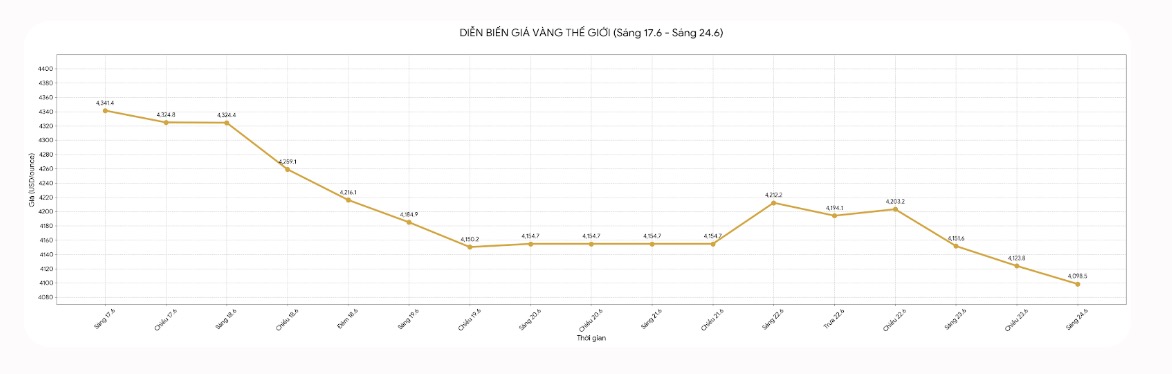
Although short-term sentiment may continue to depend on macroeconomic fluctuations and geopolitical developments, we believe that the gold industry is likely to regain momentum as conditions become more stable," the analysis team said. "Risks remain if tensions in the Middle East persist, especially the risk of energy supply disruption, affecting inflation and interest rates.
BMO also lowered the short-term outlook for silver, forecasting that the average silver price in the third quarter will only reach about 69 USD/ounce. However, the bank expects silver prices to recover slightly in the fourth quarter, to an average of about 71 USD/ounce.
BMO believes that the recovery momentum of silver may continue until early 2027, with prices peaking in the second quarter and an average of about 74.8 USD/ounce.
Silver continues to benefit from its role as a metal serving industry, as fundamental demand is supported by investment in electricity infrastructure and the ongoing electrification process," analysts said. "The market is likely to remain focused on macroeconomic factors such as interest rates, geopolitical risks, and the sustainability of industrial demand.
BMO believes that the biggest risk in the short term for gold and silver prices still comes from US monetary policy, as the market is strongly betting on the possibility of the Fed raising interest rates before the end of the year.
Although the Fed kept interest rates unchanged at its most recent monetary policy meeting, the central bank signaled support for at least one rate hike this year as the conflict in Iran caused energy prices to rise, raising concerns about inflation. Fed Chairman Kevin Warsh also emphasized the priority of maintaining price stability.
“The message from the Fed has created a wave of position adjustment in the market. The yield of US Treasury bonds with a 2-year term increased by 13 basis points - the strongest increase since April 2025, while strengthening expectations of a 0.25-percentage interest rate hike in October. Our economic group currently forecasts that 0.25-percentage interest rate cuts will take place in September and December 2027, 9 months later than the previous scenario.
Currently, the Fed's interest rate cut is still quite far away, while many economies are tending to raise interest rates, thereby creating more pressure on metals" - BMO experts said.
Despite short-term risks, BMO believes that gold is still benefiting from new demand drivers associated with the increasingly clear dedollarization trend.
USDization is due to geopolitical factors stemming from organizations having the motivation to reduce their dependence on USD, due to the risk of being punished or wanting to limit dependence on the USD trading system. In which, buying gold is often an important step" - the analysis group said.
Conversely, "de-dollarization for defense" stems from the risk of currency devaluation due to the increasing public debt.


