
Citigroup's commodity research group (a large US financial and banking group) has lowered its gold price target for the next 3 months to $4,000/ounce, from $4,300/ounce previously. Analysts believe that improved macroeconomic conditions and a less supportive demand context are the main reasons, according to a research report released on Monday.
We see little catalyst for gold prices to maintain their upward momentum in the very short term" - the report stated.
Citigroup pointed out a series of factors, including stable real yields, a stronger USD trend in the short term and weakening safe-haven compensation amid cooling geopolitical tensions.
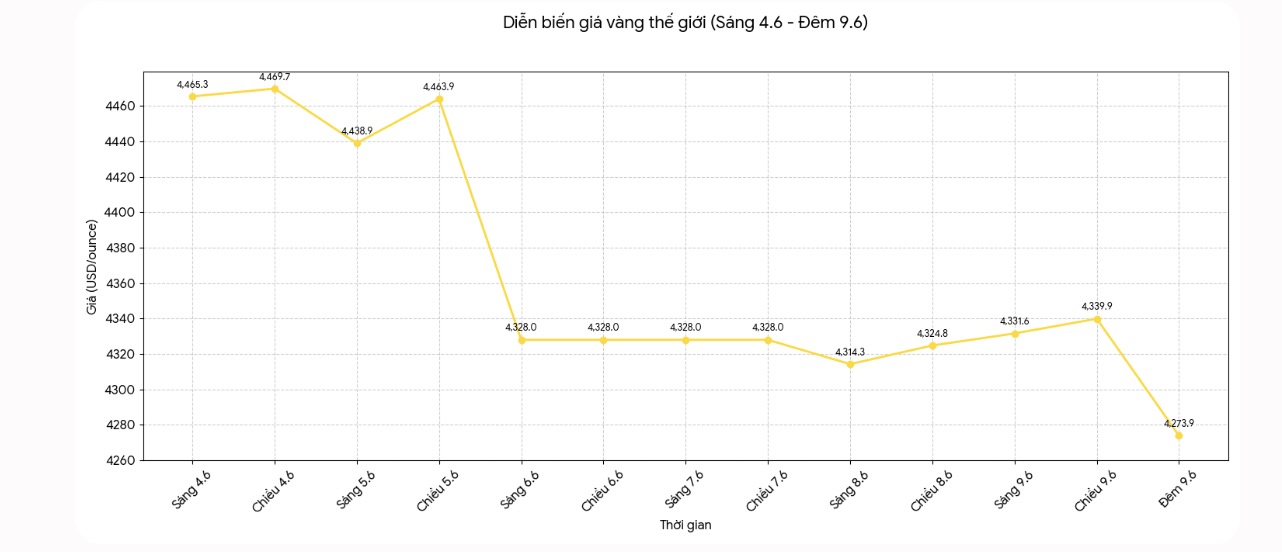
Analysts also noted that physical gold demand from central banks and capital flows into ETFs have slowed down, causing the market's upward momentum to lose momentum.
The short-term room for increase seems limited, unless a new shock appears," experts said.
Although the short-term outlook for gold is weaker, Citigroup analysts believe that gold prices are still likely to rise above $4,000/ounce in the summer if the economy weakens sharply or inflation heats up again.
Citigroup's long-term gold price forecast remains unchanged, with a 6-12 month target of $4,500/ounce, depending on whether the US Federal Reserve (Fed) shifts to a more moderate stance or geopolitical tensions increase.
The bank's gold price forecast has been adjusted down sharply since the deep market correction earlier this year. On January 13, Citigroup strategists led by Kenny Hu raised the gold price target for 0-3 months to 5,000 USD/ounce and silver to 100 USD/ounce, when forecasting that the price rise of precious metals will continue until early 2026.

Strategists then cited "increased geopolitical risks, prolonged shortages in the physical market and new incertitudes related to the Fed's independence" as reasons for raising the forecast.
Although both metals reached new historical peaks this year, Citigroup still reiterated the view that silver will outperform gold. However, the bank believes that the base metal will eventually become the focus.
Our long-standing view that silver will prevail and the rising price market of precious metals will expand to industrial metals, before industrial metals occupy a central position in the same period, has been in the right direction" - strategists wrote.
Citigroup's January outlook was based on the assumption that geopolitical tensions would cool down after the first quarter, thereby reducing demand for precious metals in the remainder of the year, in which gold is most vulnerable to downward correction. However, the bank still expects industrial metals, especially aluminum and copper, to perform positively in the second half of 2026.


