
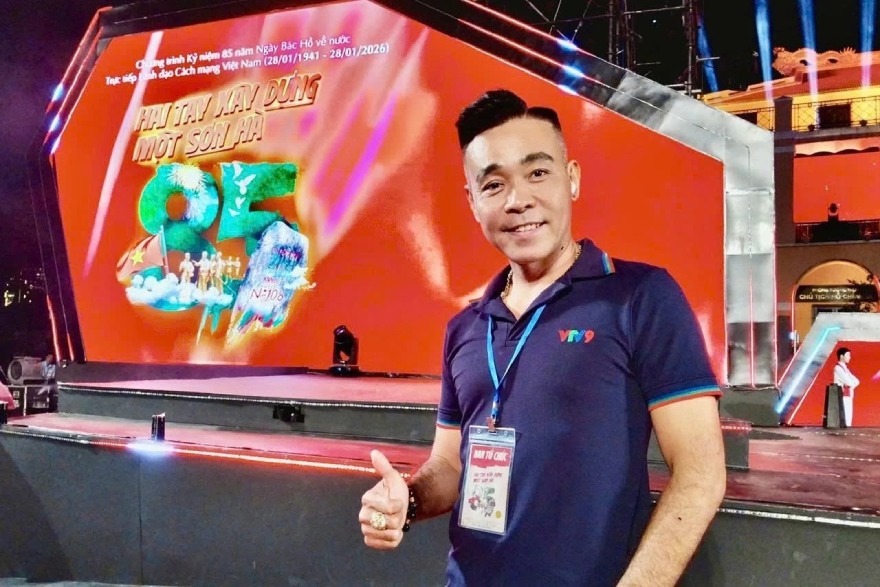
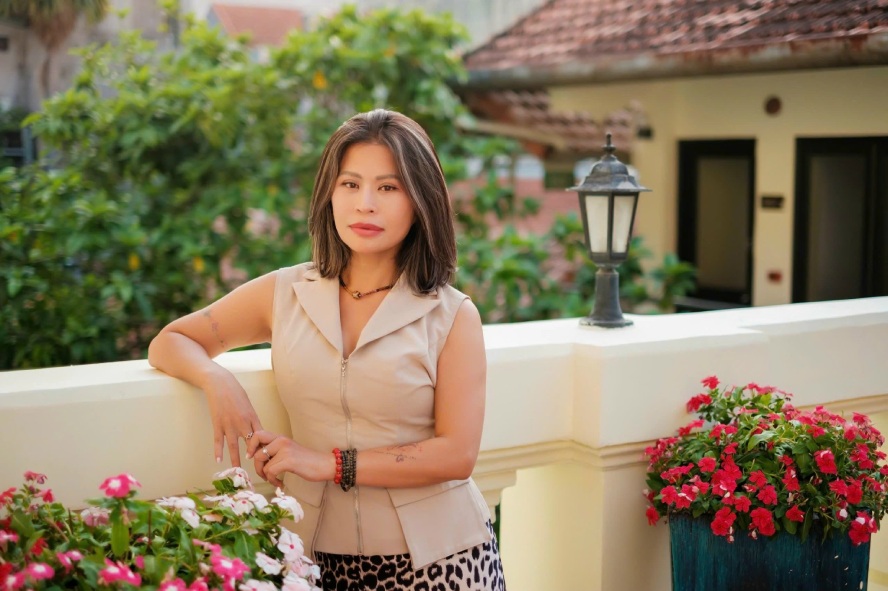
In the role of director, Nguyen Minh Hoang - Tran Hoa Yen (Director - Filming Department, Vietnam Television Center in the Southern region) shared with Thanh Nien about the process of brainstorming ideas and messages conveyed in about 90 minutes of live broadcast.
Towards truth, humanity and hope
Hello director Nguyen Minh Hoang - Tran Hoa Yen. The political art program Nghia tinh Phuong Nam - Together with children to continue life carries a meaningful message when letting kind stories not stop on stage but spread widely in life. How did you, you and your colleagues realize this idea in 90 minutes of live broadcast?
Director Nguyen Minh Hoang - Tran Hoa Yen: What we want is to bring a simple, truthful program, which is both commemorative and gratitude, and aims to call on philanthropists to accompany us. Therefore, the desire to touch the audience's emotions is always our top priority. The performances are not built like separate songs, but are connected into a general art program, with continuous scenes. The story will lead the audience from the past, present and towards the future. If we summarize the consistent spirit of the program that we want to convey, it is truthful, humane and hopeful. And if we look at the journey of the story, we want to tell about loss, companionship and continuity.
How do you connect songs and stories to create the emotional flow you desire?
Each song sung carries a message and a unique role in the emotional cord of the program. The opening part is the song "Mother loves you" which will evoke the losses of the children in stage language combined with some cinematic techniques. We choose to tell stories in memory to create emotional depth. The performance "Give your child a home" is one of the highlights of the program. Currently, we are still continuing to search for and select suitable characters to be able to bring the true story from the reportage to the stage, creating a clearer connection. Coming to "Together with children, continue life", the program begins to shift to the spirit of companionship, wishing everyone to join hands. The consistent image that we want to emphasize is hands holding each other, reaching out and exchanging hands. The next performances will gradually shift the audience's emotions from the stories they have experienced to the image of the future.
With "Living Like Flowers", we want the audience to understand that the program not only tells painful stories, but more importantly, we want to receive the joint effort of the community. Familiar props such as briefcases, books, pens... evoke very simple things: children need to go to school, to play, to live and grow up like other children. When they receive love and companionship, they can look towards a better future. In the "Compatriots" performance, the program will emphasize the spirit of connection. This is also the most difficult staging part because we want to create interaction not only between actors but also with the audience, so that even those who watch on television can feel the spirit of joint effort and sharing.
Stage is also part of the story
Open outdoor stages are an opportunity for creativity, but also a challenge. How have you and your colleagues calculated to make the ideas fully realized?
With a flat stage, the arrangement of personnel and staging will usually be quite convenient. However, the stage that we chose this time is a round stage, without a main stage or fixed highlights like many other programs. This is a rather special feature, posing many requirements in calculating the path, location and connection of the artists. Up to now, in terms of staging, we have calculated and everything is still stable. However, the actual practice and performance is still not certain, because the weather is quite erratic. From construction work, plans to welcome a large number of audiences to artist practice, there must be appropriate response plans.
For programs using LED screens, part of the content and staging intentions can be supported through images. As for this program, the story is mainly told through acting, scenes and direct connection between artists and audiences. Therefore, the stage space also becomes part of the story and message that the program wants to convey. This is a challenge for the crew, but also a special point that helps the program create closeness, authenticity and increase connection between performers and viewers.
The weather is something we cannot control, so the crew has also prepared necessary plans, from rain shelters for the audience, especially for children. Props and equipment serving the program are also calculated. However, because this is a program that carries the message of joining hands and accompanying many people, we believe that the audience will share with the program.
Why choose Park No. 1 Ly Thai To (Vuong Lai Ward) as the program venue, instead of another space in Ho Chi Minh City?
The organizers considered many locations. However, the chosen location already has its own meaning and message associated with commemorating Covid-19 victims. When the space already has such a story and meaning, if we do it well, that space also contributes to touching the audience's emotions. Therefore, for us, the stage is not only the place where the program takes place, but it is also part of the story itself.
We think the crew works quite well together. When encountering difficulties anywhere, everyone exchanges and adjusts on the spot. From the initial idea and script to the present, the organizers and the crew have developed through many different versions, perhaps nearly 30 scripts. Through each exchange, the program is further completed. That is a very normal process for a program with many layers of content and the desire to tell a complete story.
With the political art program "Nghĩa tình Phương Nam - Cùng con đi tiếp cuộc đời", what do you and your wife hope will remain in the hearts of the audience after the program ends?
We hope that the audience will see the past that was once very harsh and painful, but from those losses, we can still look towards a brighter future. With the journey "Together with our children to continue life", we hope that children will have more conditions to study, have a better living environment, grow up and later can continue to help others, just like society is joining hands with them today. Perhaps the message we want to send can be condensed as: The program may end, but we do not want the journey of love to end here!
Thank you director Nguyen Minh Hoang - Tran Hoa Yen.


