
When heritage steps out of "safe zone
For a long time, the image of National Treasures has often been associated with strictly preserved glass cabinets in major museums. These precious artifacts are seen as "historical relics", of high value but somewhat distant from contemporary life.
However, in Ho Chi Minh City, this approach is gradually changing. The fact that many artifacts from private collections are recognized as National Treasures shows a new trend: Heritage is no longer a "privilege" of public institutions, but becomes a common responsibility of the whole society.
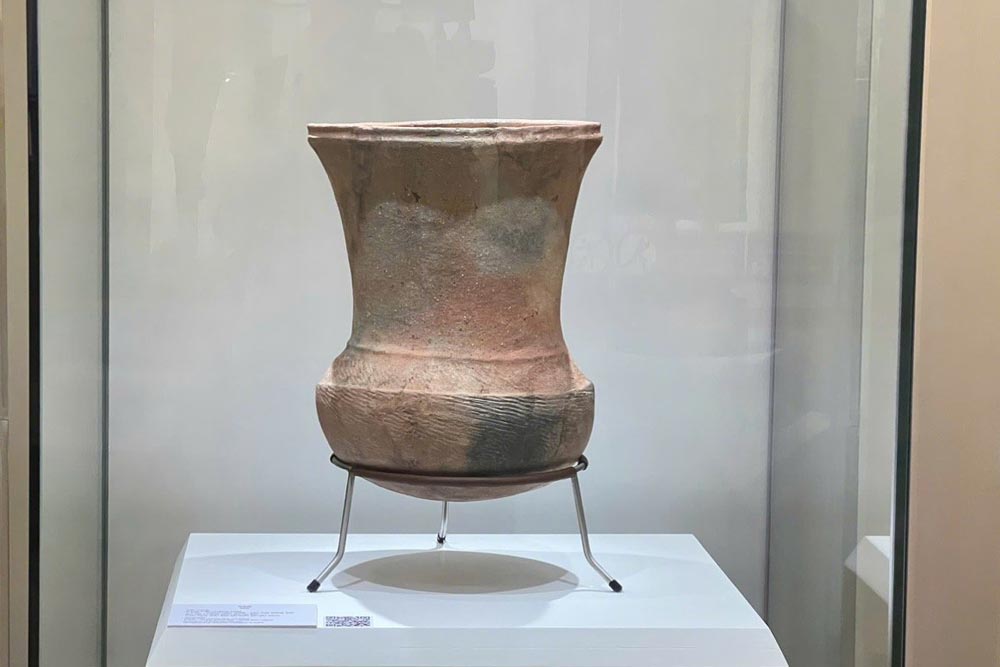
The two latest national treasures announced by Ho Chi Minh City in 2026 are Hoa Loc cultural ceramic bowls and the Tam Quan Dai De ceramic statue set, which not only have historical value, but also clearly reflect the cultural diversity of Saigon - Cho Lon land. One side is the trace of prehistoric residents, the other side is a symbol of urban religious life from the late 19th century to the early 20th century. Their presence in private collections shows that the heritage is existing in many different "living spaces", no longer confined to traditional frameworks.
In particular, the fact that for the first time 17 National Treasures, from both the museum system and individual collections, were displayed together in 2025 created a turning point. The exhibition space is not just a place to "admire", but becomes a journey of discovery, where the public can see the historical flow throughout from prehistoric times to modern times.
From a management perspective, Mr. Nguyen Minh Nhut - Deputy Director of the Ho Chi Minh City Department of Culture and Sports repeatedly emphasized that conservation cannot only be based on regulations or technology. More importantly, how to make heritage understood, loved and voluntarily protected. Then, preservation can be sustainable.
The role of socialization in heritage preservation
One of the notable points in Ho Chi Minh City is the increasingly clear participation of the private sector in conservation work.
Collectors are not only artifact keepers, but also become "bridges" between heritage and the public.
Actor Chi Bao or collector Le Thanh Nghia (the owners of national treasures) are typical examples. They do not stop at owning artifacts, but actively expand display spaces, organize exchanges, and share documents with researchers and the public. These activities help heritage escape the "static" state and become a part of cultural life.
From an expert's perspective, many opinions believe that socialization is an inevitable trend in heritage preservation. The State plays a role in orienting, building a legal framework and providing professional support, while individuals and social organizations play a spreading and creative role. This combination creates a more diverse, flexible and effective conservation ecosystem.
However, along with that are stricter requirements. When an artifact is recognized as a National Treasure, standards on preservation, security, display or transportation must be strictly followed. This requires collectors not only to have passion but also to invest heavily in resources and knowledge.
Awakening" heritage with the language of modernity
One of the big questions is: How to prevent heritage from being forgotten in modern life?
In Ho Chi Minh City, the answer is gradually forming through innovating approaches. Instead of rigid guidebooks, many units have begun to tell heritage stories with images, sounds, technology and interactive experiences.
Seminars, workshops, thematic exhibitions or experiential education activities are becoming an effective bridge between heritage and the public. In particular, young people - the object that was once considered "far from history" - are now gradually finding interest when heritage is recounted in a closer way.
Ho Chi Minh City has a great advantage in "renovating" heritage. As a dynamic city, the city can combine heritage with creative fields such as contemporary art, design, cinema or cultural tourism. At that time, heritage is not only preserved but also becomes a source of inspiration for creativity.
More importantly, "awakening" heritage does not mean changing its nature, but finding ways to make that value understood correctly and spread more widely. This is a process that requires a balance between preservation and innovation.
In the context of globalization, cultural heritage is not only meaningful within the national scope but also a "soft language" for communicating with the world.
Ho Chi Minh City, with its role as a major economic and cultural center, has many opportunities to bring heritage values to the international stage. Exhibitions, cultural events or research cooperation with foreign countries are contributing to introducing the image of a city that is not only modern but also rich in historical depth.
To make heritage truly "go far", a long-term strategy is needed. Not only stopping at displaying, it is necessary to build attractive stories that are easily accessible to the international public. At the same time, the application of digital technology is also the key to bringing heritage beyond space limits.
International attention also contributes to raising domestic awareness of heritage values. When an artifact is recognized at a global level, it is not only a source of pride but also a motivation to preserve it better.
When heritage is "awakened", it not only tells the story of history, but also contributes to shaping the identity of today's city. In the continuous flow of a young and dynamic city, these values are the fulcrum to connect the past, present and future.
And perhaps, the greatest meaning of an artifact being recognized as a national treasure is not in the title, but in the ability to continue to be told in many different ways, for many different generations. At that time, heritage is no longer a static memory, but becomes a "living memory" that is always present, always moving with social life.


