Horses in the king's tomb
In the past, horses were used for kings to ride, to fight battles or transport food and goods for the Nguyen Dynasty court. After the kings passed away, horses were also carved with stone statues, placed in front of the courtyard of the king's tomb and have existed to this day.
Stone horses appear in most Nguyen king's tombs, standing with stone elephants and court officials are also carved with stone. This is not a simple decorative element, but a part of the court's ritual arrangement. When placing stone horses in front of the tomb, the court sends the concept of loyalty and service to the king extended to the afterlife.
A noteworthy point is that the stone horse design in Hue is quite restrained. The horse is not expressed in a fast-flying or fiercely powerful posture, but stands straight, four legs firmly, head slightly bowed. The horse's face is not fierce, nor is it expressively strong. This design is consistent with the aesthetic spirit of the Nguyen Dynasty: balanced and deep.
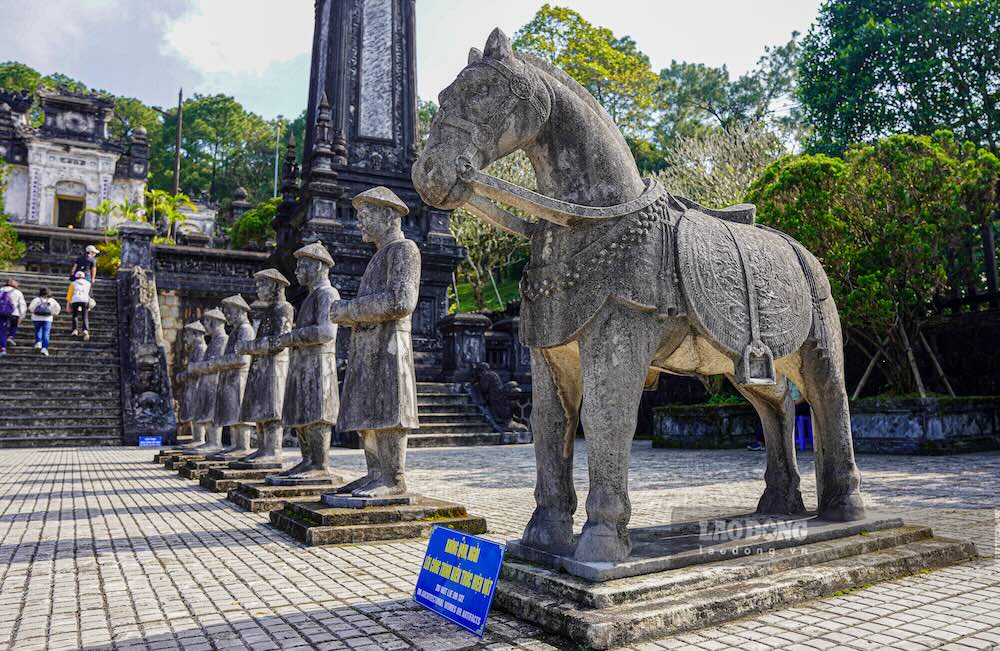
Due to compliance with general principles when building mountain tombs for emperors, the tombs of the Nguyen Dynasty kings all have tombs and worshiping communal houses. The tomb is a stele house, where the stele is erected to record the merits of the owner of the mausoleum; the worshiping communal house is the courtyard, where the emperor's successor and civil and military mandarins come to worship on holidays and rituals. This is also the space where horses participate. Each worshiping communal house has two rows of statues of civil and military mandarins and elephants, horses worshiping. In that order of arrangement, horses stand on the third row, after civil and military mandarins and equal to elephant statues.
According to researcher Tran Duc Anh Son, former Director of the Hue Royal Antiquities Museum, among the 12 zodiac animals of the 12 zodiac animals, horses are the animals that appear more in Hue's cultural and artistic life, perhaps only after dragons, the leading mascot in the four sacred animals and a symbol of the son of heaven. "Horses are present in the six mausoleums of the Nguyen Dynasty, from Gia Long mausoleum built in the early 19th century to Khai Dinh mausoleum built in the 1920s, except for Duc Duc mausoleum," Mr. Son wrote.
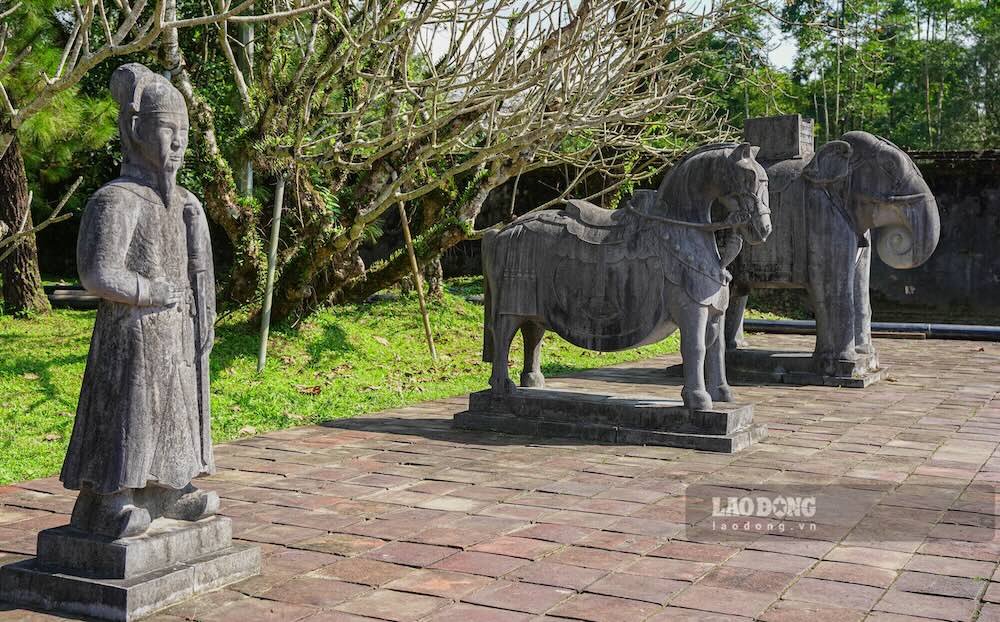
Also according to Mr. Tran Duc Anh Son, depending on each historical period and specific circumstances, the image of horses in the Nguyen king mausoleums has clear differences. Horses in the Gia Long, Minh Mang, Thieu Tri, and Khai Dinh mausoleums are carved with stone; horses in the Dong Khanh mausoleum are cast with cement. Gia Long mausoleum horses have a solid and heroic physique; Minh Mang mausoleum horses are fat, majestic, and dignified; Tu Duc mausoleum horses are short and stunted; while Dong Khanh mausoleum horses are tall and thin, somewhat weak-willed, which is considered suitable for the destiny of the king who passed away at the age of 25. Among them, the horses in Thieu Tri mausoleum are assessed as having a balanced, elegant, energetic shape and are delicately and perfectly carved.
In addition, the image of the horse also appears on the Nine Tripods at The To Temple and in the Khai Thanh Palace of King Khai Dinh's tomb.
Horses in Hue art
The dragon horse is considered a lucky animal, associated with prosperity and order. In Eastern symbolic thinking, if the dragon represents supreme power and destiny, then the horse is an image of service and perseverance. When combining these two elements, the dragon horse becomes a symbol of sublimation formed from a stable foundation.
In Hue, Long Ma does not appear as densely as dragons or phoenixes, but is still clearly present in court art and the Nguyen Dynasty symbol system. This image reflects the aspiration for a smooth-running dynasty, where strength and order go hand in hand.
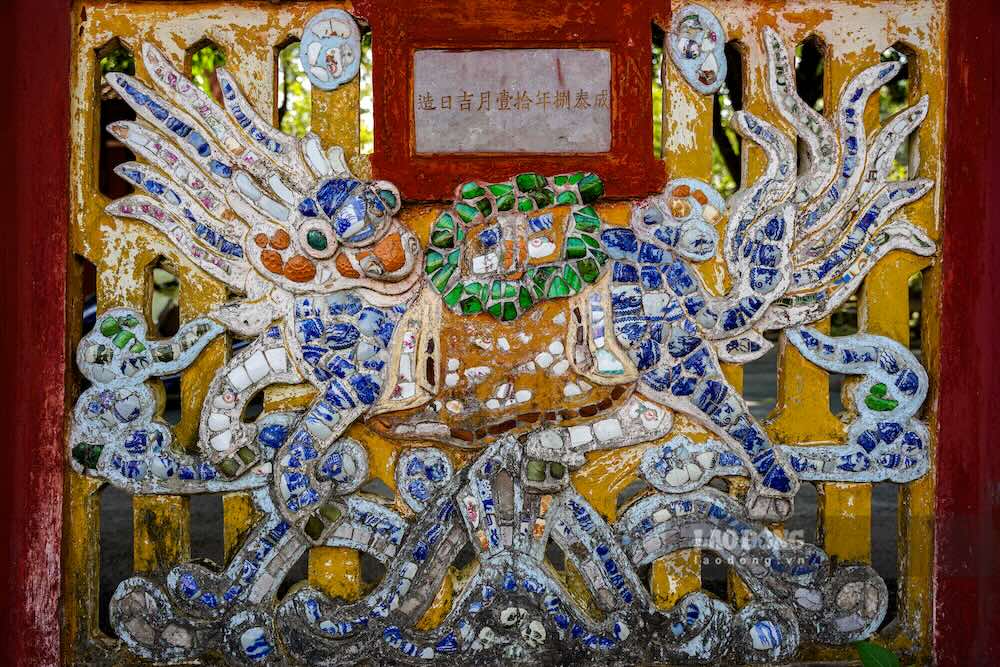
According to researcher Nguyen Xuan Hoa, former Director of the Department of Culture and Information of Thua Thien Hue province (old), Long Ma is a typical Eastern mascot, bearing the image of dragon head and horse body. Long Ma is both a symbol of knowledge and a symbol of capacity and action.
He believes that when Vietnamese people absorbed Confucianism, they also received the symbol of the dragon horse mascot. In the early stages, this image often appeared in architectural details associated with worship spaces and palace architecture. On the back of the dragon horse, there is a shape called Ha Do, making this mascot become a harmonious combination of yin and yang, between heaven and earth.
Dragons fly up vertically, symbolizing the dimension of time, in Sino-Vietnamese it is called "tung"; while horses moving on the ground horizontally are called "hoanh". The combination of the two elements of tung - hoang is considered by Vietnamese people to be a symbol of the ability to "manage the state and protect the world", bringing talent and knowledge to serve social life," Mr. Hoa analyzed.
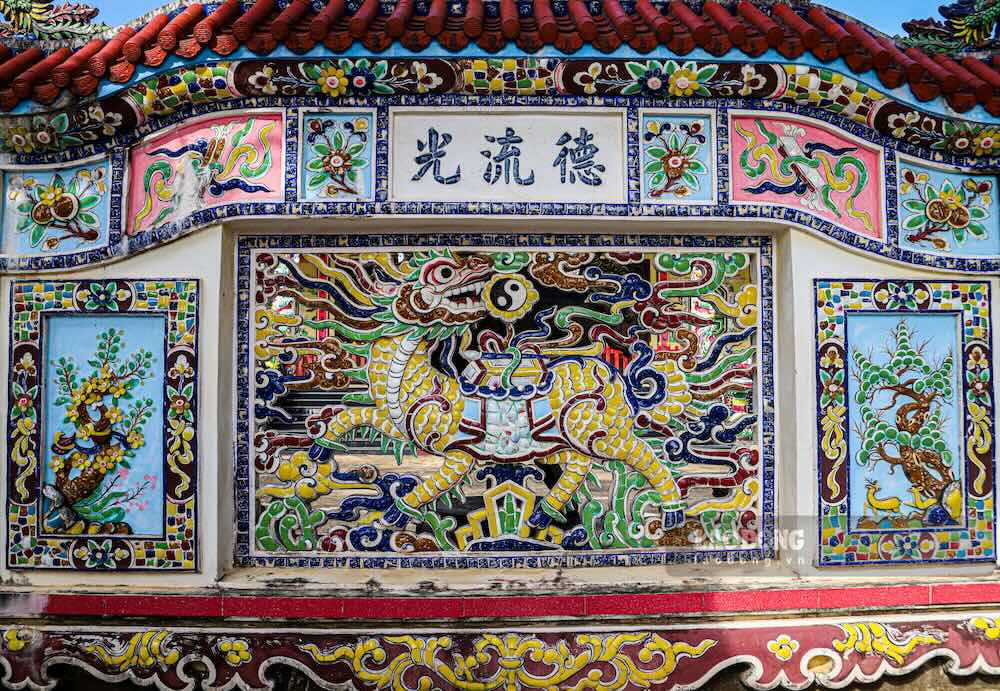
In Hue, the image of Long Ma appears quite commonly, especially in Nguyen Dynasty royal architecture. This symbol is exploited diversely, can be seen on screens, in worship spaces, even on roofs and exteriors of palace buildings. Not only limited to the royal court, Long Ma is also present on screens in people's houses, pagodas, gardens and houses in Hue.
Notably, under King Thanh Thai's reign, in 1896, when building Quoc Hoc Hue School, the court designed a very elaborate Long Ma image at the central screen of the school. Two emphasized elements are the Ha Do on Long Ma's back symbolizing knowledge and the image of Long Ma in a flying posture, expressing a desire to move and spread continuously. Through this, the court sent a message that Quoc Hoc School is not only a place to receive ancient and modern knowledge, but also a place to train action capacity, nurturing people who can contribute to society.
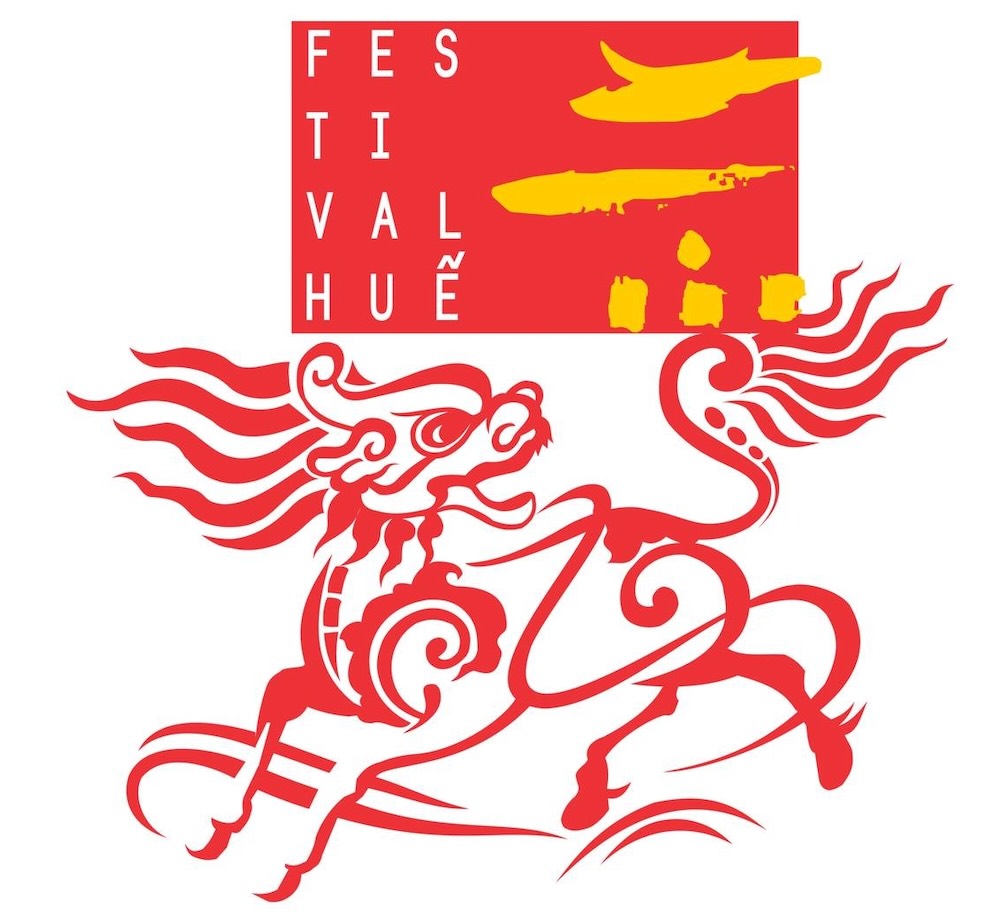
Mr. Nguyen Xuan Hoa added that since 2000, when Hue held the Hue Festival periodically every two years, the image of Long Ma was chosen as the main symbol. With its aesthetic value, cultural identity and profound symbolic meaning, Long Ma has been maintained as the official logo of the Hue Festival to this day. Since then, this image has not only existed in architectural or historical spaces, but has also become a typical cultural symbol, associated with the image of a typical festival city of Vietnam.
In the Tet atmosphere, when the pace of life temporarily slows down, symbols such as stone horses or Dragon Horses easily evoke more associations than usual. Tet is the time when people think about the beginning and the shift of fortune. Horses, with the meaning of moving forward and not standing still, become a suitable image for early year reflections; while Dragon Horses, with the meaning of good omens, add more elements of expectation for a smooth new year.