
Ngo Manh Chau (26 years old, Hanoi) has long considered watching short videos as a familiar form of entertainment.
Instead of focusing entirely on the screen, Manh Chau often opens short film content to both listen and do other work.
I often play short videos to listen while working or playing games. Initially, I thought listening while working might distract me more, but gradually it became a habit, almost indispensable every time I use a computer," Manh Chau shared.
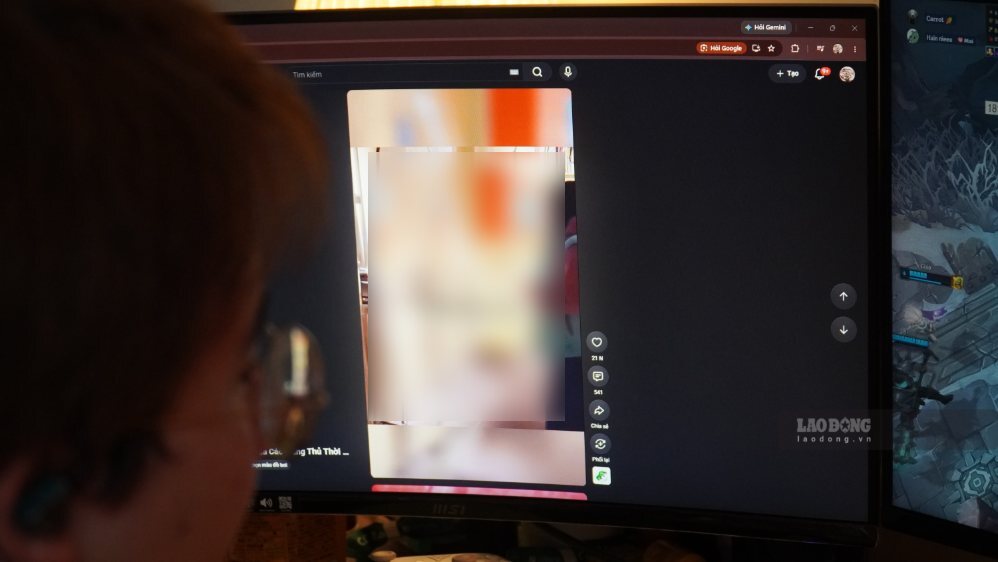
Spending about 10 hours each day watching short videos, Manh Chau believes that listening to or watching short content may help yourself relax and reduce pressure, but at the same time leads to loss of concentration and prolonged working hours.
Recognizing that, Manh Chau believes that the appeal of short videos is very large. When he doesn't hear anything, watch anything, Manh Chau feels discouraged.
Short videos often bring a feeling of excitement from the beginning because the content is fast and easy to access. But when watching a lot, I see that short videos affect deep thinking ability. When information is received in the form of short, disjointed content pieces, users easily form a quick but lacking depth way of receiving it" - Manh Chau said.
For Vo Duc Kien (22 years old, Hanoi), surfing the phone and searching for new videos has become a familiar part of daily life.
Every morning when he wakes up, before starting work, Duc Kien often spends time watching short videos on his phone.
I often turn on short videos to listen to while brushing my teeth or having breakfast. This way, I can take advantage of the morning time to both do personal work and entertain myself," Duc Kien shared.
According to Duc Kien, although many videos have relatively similar content and motifs, users are still waiting for a surprise "twint", so they still choose to watch them.
The stories are divided into many short segments, continuously creating situations that make viewers curious and want to follow until the end.
One of the most obvious consequences of indulging in watching short videos is reduced concentration.
Continuously receiving content that only lasts for a few tens of seconds makes users get used to the rapid pace of change and stimulation.
When switching to work that requires patience such as reading books, studying, writing reports or handling a complex problem, they may quickly feel bored and distracted.
According to BS. Specialist II Tran Minh Khuyen - Specialist in Psychiatry - Psychology at University Medical Center 1 Clinic - analyzed that the human brain has neurotransmitters related to feelings of happiness such as dopamine, serotonin... This is a normal biological mechanism.
However, social networking platforms with short content optimization algorithms have strongly exploited this mechanism.
Short videos of about 30 seconds to one minute, concise titles, and rush make the brain continuously experience dopamine spikes, creating a feeling of immediate pleasure.
When this phenomenon is repeated many times, users are easily drawn into continuous viewing and find it difficult to stop, similar to the mechanism for forming addictive behavior.
In fact, there are people who watch short videos continuously for one to two hours until they are tired and then stop.
According to Dr. Tran Minh Khuyen, a common manifestation in some social media addicts is that when they do not watch short, tense videos... dopamine is not stimulated, they may feel restless and uncomfortable; but when they watch it again, they feel more comfortable.
It is not necessary to completely give up phones or short videos. It is important for users to recognize when entertainment begins to affect work, sleep and relationships.
Videos that only last a few dozen seconds may seem harmless. But when hundreds, thousands of videos are followed by unconscious swipes, what is traded off is not only time but also concentration, sleep and the ability to enjoy life on screen.


