
From exogenous origins to historical and mythological imprints
Going back in time, the horse's homeland is in the Asia-Europe steppe, in which Mongolia still has wild horses that are the ancestors of domestically tamed horses.
In Vietnam, archaeological results from the metal era (around 2000 years ago) have not found horse bones, but only elephant bones. Horses in Vietnamese culture are an exogenous element, they come from Yunnan - Sichuan along the Northwest route along the Red River basin.
The earliest documents talk about horses in Vietnam during the Eastern Han Dynasty (1 - 2 centuries). Han dynasty mandarins brought some horses and carriages to Giao Chi and Giao Chau citadels. Therefore, in wartime, Dai Viet cavalry was not a strong force, but naval soldiers and statue soldiers were elite forces. The image of heroes and generals such as Hai Ba Trung, Ba Trieu, to Ly Thuong Kiet, Tran Hung Dao, Quang Trung all rode elephants and boats to battle, which has entered Vietnamese military tradition.
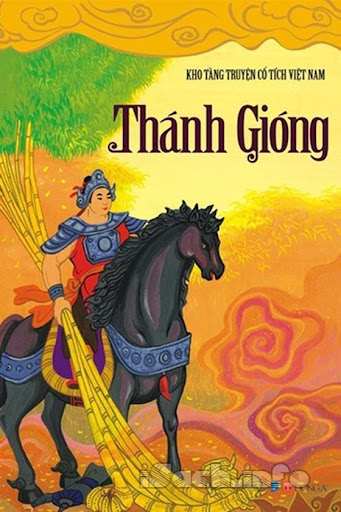
In the Vietnamese mind, horses are not associated with daily life, are friends of humans like buffaloes, attached to humans in the fields. But horses are mythologized, becoming iron horses, spraying fire, fighting invaders. The story of Phu Dong village hero Thanh Giong riding an iron horse, holding an iron rod, fighting An invaders is a strange legend, full of romance, but also the most magnificent and immortal symbol of heroism, opening the tradition of fighting foreign invaders of the Vietnamese nation.
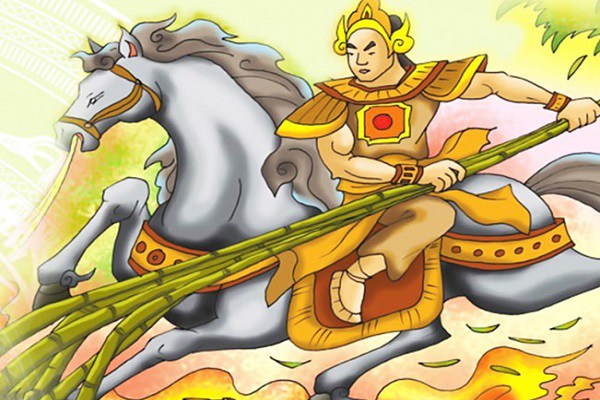
In the Giong festival, the wooden horse statue worshiped in Phu Dong Temple is a white horse. Since ancient times, the mythical thinking of mankind has used the image of horses and carriages to represent the sun, so the white horse statue in the temple also symbolizes the sun.
Giong festival takes place from morning, but it is not until 12 noon (Chinh Ngo) that villagers carry palanquins and white horse statues from the temple to the dike to perform the scene of fighting the An invaders.
The An invaders are symbolized by 28 female generals, i.e. "Nhai thap bat tu", 28 bright stars of the night sky, symbolizing darkness. Saint Giong riding a white horse to fight the An invaders symbolizes the sun dispelling darkness.
At Bach Ma Temple (Hang Buom, Hanoi), a white horse is also worshiped. Legend has it that: Ly Cong Uan moved the capital from Hoa Lu to Dai La, the king wanted to build a new citadel, but the location and shape have not been determined.
One evening when passing through the temple, he saw a god riding a white horse from inside the temple, running a round from East to West, then returning to East, and then entering the temple. The next morning, Ly Thai To ordered his army and people to follow the horse's footprints and build Thang Long citadel. The White Horse God is the symbol of the sun god.
The philosophy of yin and yang and the art of shaping horses in the sacred space
The image of the Horse became popular, appearing in the Le Dynasty (15-16 centuries) on decorative bricks, in tombs. In the Later Le Dynasty (15-18 centuries), horses were shaped simply, strongly, expressing martial spirit, associated with spirituality.
During the Nguyen Dynasty (19-20 centuries), horse statues were carved exquisitely, standardized, emphasizing rituals and court symbolism.
Especially the wooden horse statue for worship and the image of horses in wood carving became popular and familiar when the village communal house bloomed during the Le Trung Hung period (17-18 centuries).
Usually in the space of communal houses, temples, shrines, the image of worshiping horses is a pair of red and white horses with profound symbolic meanings. Red horse, the color of fire, of the sun, a strong symbol of yang energy, expressing the manifestation of divine power, symbolizing combat power, exorcism, protecting righteousness; white horse, the color of purity, nobility, and spiritual response. Red and white horses symbolize the yin and yang pair, deeply reflecting the yin and yang and five elements thinking of Vietnamese people.
In the sunny, windy and sandy Cat Hai sea area, in the Hoang Chau village communal house, a pair of red horses are worshiped, unlike other communal houses and temples that are red and white. Although only one color, this pair of horses still symbolizes the yin and yang pair through decorative patterns carved on the horse's saddle.
The Eastern armor horse is carved in relief, peeling off the symbols "Ho Phu", "Long Ma", this is the embodiment of the "yang" element, referring to the sun.
Western armor horses are carved with the symbol "Ho Phu Oe Mat Nguyet", the embodiment of the "yin" element - referring to the moon. With the pair of horses, Hoang Chau communal house is qualified to be a yin-yang pair in treatment, it reflects the desire for reproduction and growth of the people.
What makes the difference of the pair of worshiping horses in this coastal area is that in addition to the worship function, this pair of red horses also participate in the horse racing performance (pulling wooden horses) in the Xa Ma - Ruoc Kieu festival of Hoang Chau communal house on June 10th of the lunar calendar every year.
In the sacred space of the relic, the image of the horse also appears in traditional wooden sculpture. At Tay Dang communal house, Hanoi (16th century), the horse is carved standing independently on the roof pillar, with its wings reaching up, as if flying into space.
In the 17th-18th centuries, horse-shaped carvings were always associated with people such as: horse riders (Chu Quyen communal house, Hanoi), horse managers (Diem communal house, Bac Ninh), Vinh Quy Bai To - Doctors riding horses back to the village (Lien Hiep communal house, Hanoi), hunting scenes (Huong Canh communal house, Phu Tho).
The image of the Horse in the calendar and new luck of the Binh Ngo spring
Not only that, the horse also entered Vietnamese history with the can chi system, and the horse is the Ngo chi, ranked 7th in the system of 12 chi, belonging to the fire element.
The month of the horse is the month of the Horse (May according to the lunar calendar), the month with the Doan Ngo Tet (May 5th), the hottest in the year. According to ancient beliefs, people born in the year of the Horse, born in the year of the Horse, are dynamic, straightforward, strong, decisive, and in love they are sincere and intense.
So stepping into the new spring of 2026, the year of Binh Ngo, is a combination of brilliant fire and the image of a liberal horse. This is a year of constant movement, of aspiration to reach far.


