
24-hour race in data "storm
Mr. Nguyen Van Huong - Head of Weather Forecast Department, National Center for Hydro-Meteorological Forecasting - said that the work requires continuity, so forecasters at the National Center for Hydro-Meteorological Forecasting, regional and provincial stations must take turns on duty 24/24 hours. When dangerous weather patterns appear such as storms, tropical depressions, widespread heavy rain, flash floods, floods... their working intensity is immediately pushed to the maximum level.
Each peak shift begins with a huge "war" of information processing. Forecasters must continuously update the latest monitoring data from domestic and international station systems.
On the most stressful days, the frequency of news releases is pushed up continuously to 3 hours, 6 hours, even every hour, half an hour. Requiring timely adjustment according to actual developments and close coordination with disaster prevention and control agencies, the media always put forecasters in a state of extreme stress.
The biggest pressure is timeliness and reliability, because every information released directly affects the government's response decisions and the safety of the people" - Mr. Huong shared.
Behind the figures on wind force, rainfall or water level is a very large responsibility. Because just a few hours of information delay, an inaccurate assessment, the consequences may not only be professional errors.
Difficult decisions behind each news report
In fact, at many times, forecasters have to make very difficult decisions when even the most advanced models in the world cannot be unified.
Mr. Nguyen Van Huong still remembers vividly the story of storm No. 15 KOTO at the end of 2025.
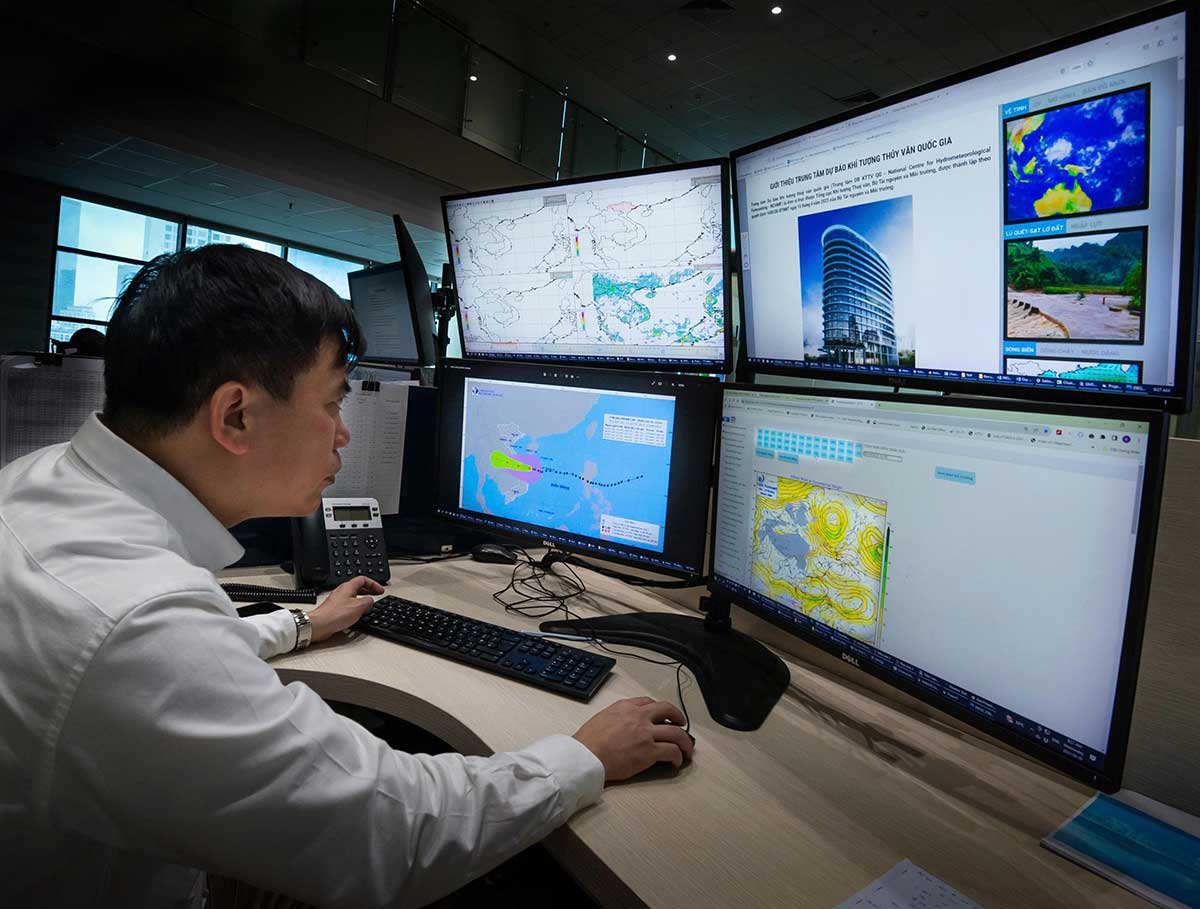
On the morning of November 25, 2015, when it was still a tropical depression over the central Philippines, most forecasting centers in the region and around the world predicted that when it entered the East Sea, the depression would strengthen into a storm. However, a very large difference appeared between meteorological centers in terms of direction of movement and intensity.
At the same time, many forecast models show the possibility of a widespread heavy to very heavy rain in the South Central provinces in the following days. That is a particularly sensitive period when this area has just experienced a historic flood with very heavy damage.
If not warned early, the damage will be multiplied; but if warned early but the storm does not come, it will cause panic for both people and disaster prevention and control forces - those who are recovering after the flood.
“Late-season storms at low latitudes are extremely unpredictable. Finally, with collective wisdom, we made the prediction that the storm will weaken at sea, with little chance of causing strong winds on land and not too heavy rain. That was a very difficult professional decision but in the end it was accurate,” Mr. Huong confided.
According to Mr. Mai Van Khiem - Director of the National Center for Hydro-Meteorological Forecasting, Department of Meteorology and Hydrology, the abnormality of the weather under the impact of climate change is creating unprecedented challenges.
Many natural disaster phenomena that were previously very rare, now appear more frequently with intensity exceeding all historical thresholds. This makes the social responsibility of forecasters heavier than ever. Each issued news bulletin is not purely a professional technical product, but a legal and technical basis for all levels of government to evacuate people, operate reservoirs, close seaports, manage livelihoods and protect assets for the people.
When a storm has a rapid intensification process, errors between numerical models are often very scattered. Forecasters must assess system deviations and calculate carefully because just adjusting the trajectory for a few tens of kilometers or changing a wind level, the entire response and population relocation plan of localities will have to change accordingly.
Forecasters must build their own iron discipline and strict operating principles. Mr. Phung Tien Dung - Head of Hydrometeorological Forecasting Department, National Center for Hydro-Meteorological Forecasting - said that if you don't know how to take care of your health and keep your mind alert, you can easily get tired, and getting tired is easy to make mistakes, especially at night or on days of prolonged storms and floods.
“Brothers have to take advantage of the right time to rest, work for about an hour and then stand up, walk around, drink water, look away to reduce eye strain, or doze off for 15-20 minutes if conditions permit to wake up” - Mr. Dung recounted his experience during the disaster season.
When AI becomes a "digital assistant
Faced with the increasingly complex natural disaster problem, Vietnam's hydrometeorological industry is also entering a period of strong transformation, promoting the application of modern technology, especially artificial intelligence (AI).
According to Mr. Mai Van Khiem, AI is no longer a experimental concept but has become a powerful "digital assistant", accompanying forecasters in both professional operation and in-depth technical aspects.
In daily operation, under the tight time pressure of emergency situations, AI participates in the standardization of professional terminology, automatically reviews spelling errors, data errors and news formatting, helping to minimize minor technical errors, and fine-tune the writing style to make it easier to understand to the public. In terms of deep expertise, AI demonstrates superior strength in many tasks.
AI automates data processing, supports forecasters to quickly write programming code to connect databases to graphics platforms, convert raw data from models into interactive maps and visual charts in a very short time.
In addition, AI assistants analyze multiple scenarios, process dozens of scenarios from major climate models around the world simultaneously, calculate probabilities and propose optimal scenarios for humans to refer to.
Experts all agree that AI will increasingly play an important role in the meteorological and hydrological industry, being a particularly important partner to help forecast faster, smarter and more effectively; but AI does not replace humans.
The nature of meteorology and hydrology is high uncertainty, especially when climate change is creating uncharacteristic phenomena beyond past data - which is the foundation of AI machine learning.
At that time, professional instinct, field experience, critical thinking in the face of monitoring data and a deep understanding of local characteristics of forecasters are the decisive factors to choose the most accurate scenario.
The optimal model in the future is clearly defined: "AI along with forecasters" - effective supporting technology, while humans are the final decision makers.
This year's disaster season is ahead. The first storms will appear in the East Sea, heavy rains will come to the river basins, and warning bulletins will continue to be broadcast day and night. Because more than anyone else, they understand that behind each bulletin is the peace of the community.


