
Unified use of adjacent land as shared infrastructure
At the working session on June 22, Mr. Nguyen Van Vien, Chairman of Thuy Nguyen Ward People's Committee, said: The new urban area project invested by CRV Real Estate Joint Stock Company is being implemented in the ward. In the process of implementation, problems arose related to the residential road adjacent to the project.
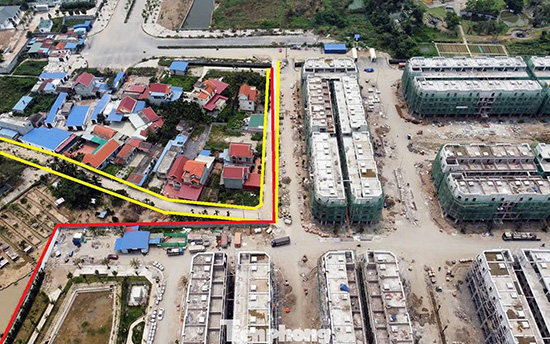
According to reflections from residents of Chan Lam residential group, at the end of March and the beginning of April 2026, the project construction unit built a concrete strip about 40cm high, stretching hundreds of meters along the boundary between the urban area and residential area. This concrete strip was built on a residential road, causing the road surface, which was originally 4-6 m wide, to be significantly narrowed, many sections are only about 80 cm wide, blocking the walkway that had existed before, causing difficulties for the daily travel and activities of households in Chan Lam residential group.
After the investor built a fence, people repeatedly petitioned the investor to demolish the concrete strip, and at the same time use a part of the sidewalk area to expand the walkway, forming a common road for both the residential area and the new urban area.
After many meetings, the local government agreed on the view of ensuring the rights of the people and requested the investor to allocate the adjacent area as shared infrastructure.
Representatives of the Economic, Infrastructure and Urban Department of Thuy Nguyen ward said that the investor has agreed to pave the sidewalk close to the residential road boundary for people to use together. However, recently the investor continued to propose a plan to plant bushes along the project boundary, causing people to worry that the residential road will return to its narrow state as before.
Concluding the meeting, the Chairman of Thuy Nguyen Ward People's Committee requested the investor not to implement the tree planting plan, ensuring that the entire sidewalk has a width of 2.8m - 8m and is used as common infrastructure between urban areas and residential areas.
Project fence causes concern when dividing 2 residential areas
In addition, people in Thuy Nguyen ward proposed that the Ward People's Committee and Hai Phong Department of Construction inspect the fence system belonging to the urban area project invested by CRV Real Estate Joint Stock Company, due to concerns that the project may affect the landscape of the area and connect traffic infrastructure with existing residential areas.
According to reports, the investor has built a 4-5m high fence system along the project's boundary, separating 2 residential areas Southeast and Chan Lam (which have been connected by a people's road for many years). In which, people are particularly interested in the wall built in front of Tuong Quang Pagoda in the Southeast residential group. This is a long-standing religious establishment that still preserves many cultural and historical values, including an ancient bell cast in the 13th year of Gia Long (1814).
People said that previously the area in front of the pagoda was an open space connecting with residential areas and rural transportation systems. However, the construction of fences is said to have changed the landscape, obscured visibility and affected the harmony between existing religious works and the new urban area.
In addition, according to reports, the fence system along the project's boundary has separated and blocked the walkway between Dong Nam residential group and Chan Lam residential group, causing travel to have to be carried out through further roundabout routes than before.
From the above reality, people propose that functional agencies publicize the detailed 1/500 scale plan, construction permits, fence design documents and related legal documents; and at the same time review the conformity of the project with the approved plan, ensuring the intercommunication and synchronization of the technical infrastructure system according to regulations.


