
On June 30, O Dien Commune Police (Hanoi City) and the Department of Administrative Management of Social Order (C06) of the Ministry of Public Security deployed a peak period to collect DNA biological samples of relatives of unidentified martyrs in the area.
This is a plan in the 500-day and night campaign to promote the search and repatriation of martyrs' remains and identify martyrs' remains, towards the 80th anniversary of War Invalids and Martyrs' Day.
Lieutenant Colonel Nguyen Huu Phong - Deputy Head of O Dien Commune Police - said that the locality currently has more than 400 martyrs whose information has not been identified. During this peak period, functional forces will organize sampling for about over 600 biological samples of relatives of martyrs.
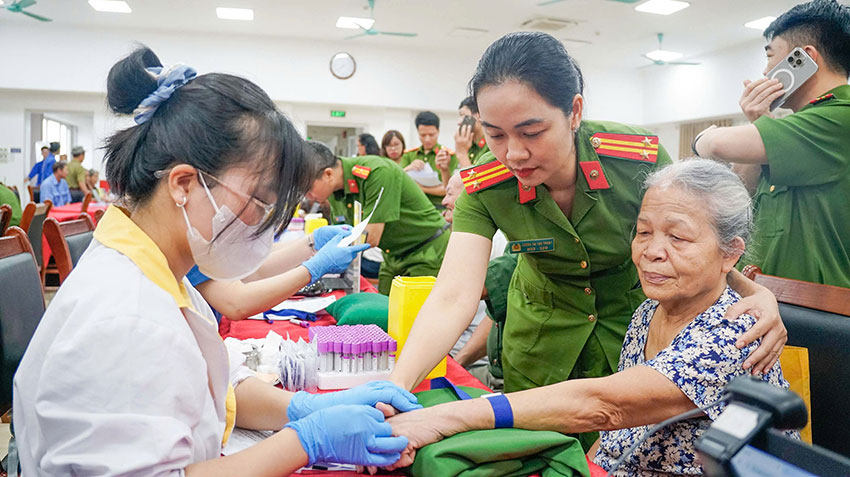
From early morning, hundreds of relatives of unidentified martyrs in O Dien commune were present. They are mainly elderly people in their families, with children, siblings or biological brothers who are martyrs who have not been identified.
Everyone hopes that through the 500-day and night campaign to promote the search and repatriation of martyrs' remains and identify martyrs' remains, families will soon have information about the martyrs they have been searching for for decades.
According to Department C06, information identification will be carried out with at least two people who are relatives of martyrs who have not identified information according to their maternal lineage.
The priority order includes: Comrade's biological mother; biological mother of the martyr's biological mother (biological grandmother of the martyr); brothers, sisters, and younger siblings of the same mother as the martyr; uncles, aunts, and aunts who are biological brothers, sisters, and younger siblings of the martyr's mother (same biological mother); brothers, siblings of the martyr's older sister, younger sister of the martyr's biological mother; children of the martyr's older sister, younger sister.
Citizens on the list invited to take samples will successively undergo the steps of collecting biological samples, starting with fingerprint sampling.
Next is the collection of blood biological samples to support DNA identification. The implementation process is carried out seriously, scientifically, ensuring convenience, accuracy, safety and compliance with regulations on personal information security.
The Deputy Head of O Dien Commune Police added that for relatives on the list who are old and unable to travel, the working group will directly go to the martyr's family to take samples.
Among them is the case of Mrs. Nguyen Thi La, this year she turned 100 years old, so functional forces organized to collect DNA samples at home. Mrs. La's relatives shared that her eldest son is martyr Dao Van Khai (died in 1974 when he was still young and unmarried).
''The family has not had the conditions to go to the place to search, only grasped the information that Uncle Khai sacrificed himself in the Southern battlefield, we hope to find his remains soon to bring them back to his homeland'', the martyr's family expressed.
According to Hanoi City Police, as of June 21, the total number of relatives whose DNA has been collected and updated to the national population data system is more than 22,460 cases. Meanwhile, relevant units have deployed the analysis and synchronization of more than 53,000 DNA data of unidentified martyrs' relatives into the database. Thereby, identifying and recognizing the identities of 25 martyrs.


