
Talking numbers and a historic campaign
For people in mountainous areas, where natural disasters and floods are always lurking, a solid home is not only an asset, but a career, a dream. That dream has now become a reality for tens of thousands of ethnic minority households in Da Nang. The campaign to eliminate temporary houses, one of the most humane and drastic policies, has truly changed the face of the border area, laying a solid foundation for a sustainable development future.
Looking back on the journey of the past 5 years, especially the period of 2021-2025, the statistics have shown the scale and stature of a historic campaign.
In the old Quang Nam province, the emulation movement "Quang Nam joins hands for the poor - No one is left behind" has mobilized huge resources, up to over 11,000 billion VND. In particular, one of the top priorities is to solve the housing problem. More than 8,100 temporary houses have been supported to be newly built and repaired. In particular, when implementing Directive No. 42 of the Prime Minister on the elimination of temporary and dilapidated houses in the period of 2023-2025, the locality has shown an extraordinary determination. With a total of 10,303 houses needing to be processed, by mid-2025, 10,253 houses had been completed, reaching an almost absolute rate of 99.51%.
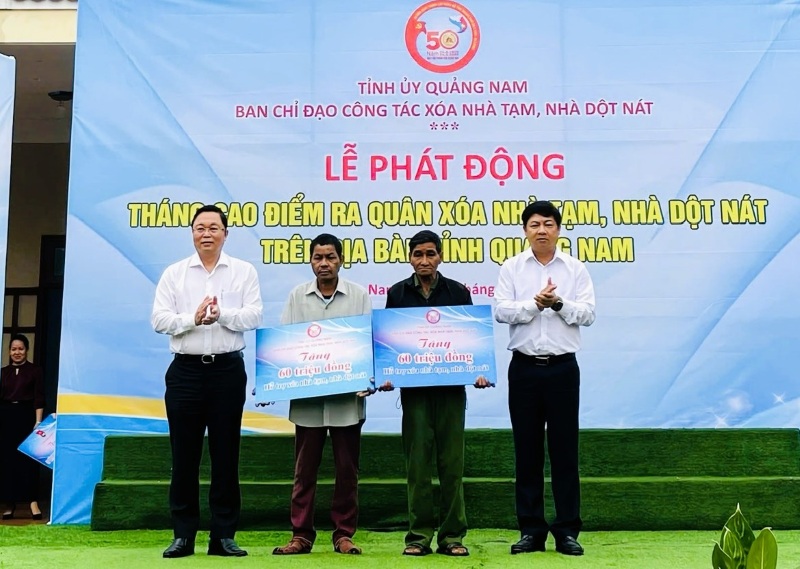
Synthesized throughout Da Nang after the merger, the campaign to eliminate temporary and dilapidated houses has completed 100% of the plan with 12,298 houses handled as of October 2025. The number of more than 12,000 shelters is not just a dry statistic. Behind that is more than 12,000 stories about the fates of life that have stepped to a new page, the smiles of the elderly, a more secure future for the children. That is the most vivid proof of a correct policy, in line with the people's hearts, demonstrating the deep concern of the Party and State for each home and each family.
Not just a roof
The goal of the campaign is not only to build walls and roof corrugated iron. The deeper and greater meaning of each new house is to bring safety, strengthen confidence and create a solid foundation for people to work with peace of mind.
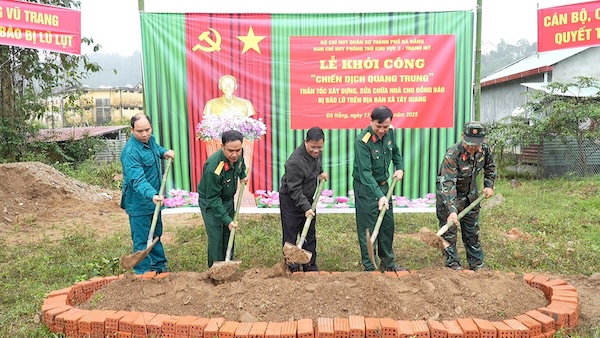
In the border commune of Tay Giang, where the risk of landslides and natural disasters is always present, the story of eliminating temporary houses is not just about building individual houses. According to Comrade Bhling Mia, Secretary of the Commune Party Committee, the government has gone a step further, in a strategic and profoundly humane manner. More than 200 billion VND has been invested to plan and build 41 safe resettlement points. This is not just a relocation, but a new living space created with planning, infrastructure, and community cohesion. More than 1,300 households have been arranged in these resettlement areas, ending their days of living in anxiety every rainy and stormy season. New spacious houses that grow close together are not only beautiful in landscape, but more importantly, they bring peace in the souls of each citizen.
When the worry about where to eat and where to live is resolved, people can wholeheartedly think about doing business and developing the economy. A solid roof is the fulcrum for them to boldly borrow capital to invest in livelihood models such as growing medicinal herbs and raising livestock. Their children have a good corner of learning, no longer having to shake during leaky nights. The health of the whole family is better guaranteed. That is the full meaning of the two words "resettlement" to move towards " career loss".
Many ways to be creative, one common goal
The success of the temporary house removal work comes from the combination of many methods and many creative approaches, but all aim at a common goal of leaving no one behind.
The first and most widely covered way is to effectively use capital from the National Target Programs. Thousands of billions of VND have been allocated, prioritizing it to poor households, near-poor households, and policy families so that they have initial resources to build or repair their houses.
The second approach, sustainable and synchronous, is the concentrated resettlement model as in Tay Giang. Instead of small-scale support, the locality has planned a new area of land, invested in infrastructure and then arranged people to live there. This approach not only solves the housing problem but also solves problems related to transportation, electricity, water, and environment, creating a civilized and modern new rural face from the beginning.
The third way is to do it, as an autonomous path and the ultimate goal of all poverty reduction policies, which is to create sustainable livelihoods so that people can build their own home. The story in Tra Linh commune is a typical example. Thanks to Ngoc Linh Sam, hundreds of households in Xu Dang and Ca Dong have had a huge source of income, completely changing their lives. They do not need to wait for support from the state to eliminate temporary houses, but build large, spacious houses themselves. This is the most profound implementation of the motto "giving fish, not fish" that many localities are aiming for.
As proposed by Mr. Le Quang Trung, Secretary of the Phuoc Hiep Commune Party Committee, helping people needs to be practical, in line with the need: "difficulty in housing helps housing, difficulties in employment helps employment". The elimination of temporary housing is to solve one of the most urgent and fundamental difficulties, creating a premise to solve other problems.
From a home to a model mountain town
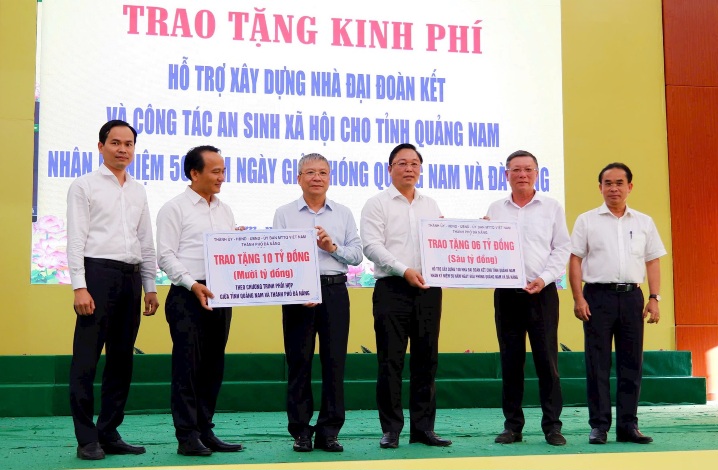
The campaign to eliminate more than 12,000 temporary houses is not an end point, but a starting point for a new journey, the journey to build an advanced new rural area, a model new rural area and further, to build model mountainous communes.
When the temporary houses were finally eliminated, the face of the countryside was truly spacious, green - clean - more beautiful. That is one of the most important criteria in the set of criteria for building new rural areas. A sturdy house is the cell of a sturdy village, a stable society.
In the vision to 2030, Da Nang sets very high goals for rural and mountainous areas, with the rate of communes meeting advanced new rural standards, increasingly increasing models, forming smart villages. All of these goals must be built on the foundation of stability. It is impossible to mention a model mountain area when people still have to live in temporary houses.
The revolution of eliminating temporary houses in Da Nang has been a resounding success. That is the result of a humane policy, a political system drastically participating from the city to the grassroots, and the joint efforts of the whole society. More than 12,000 shelters were built not only with bricks, mortar, and cement, but also with humanity, responsibility, and faith in a brighter future in the majestic land of the West.


