
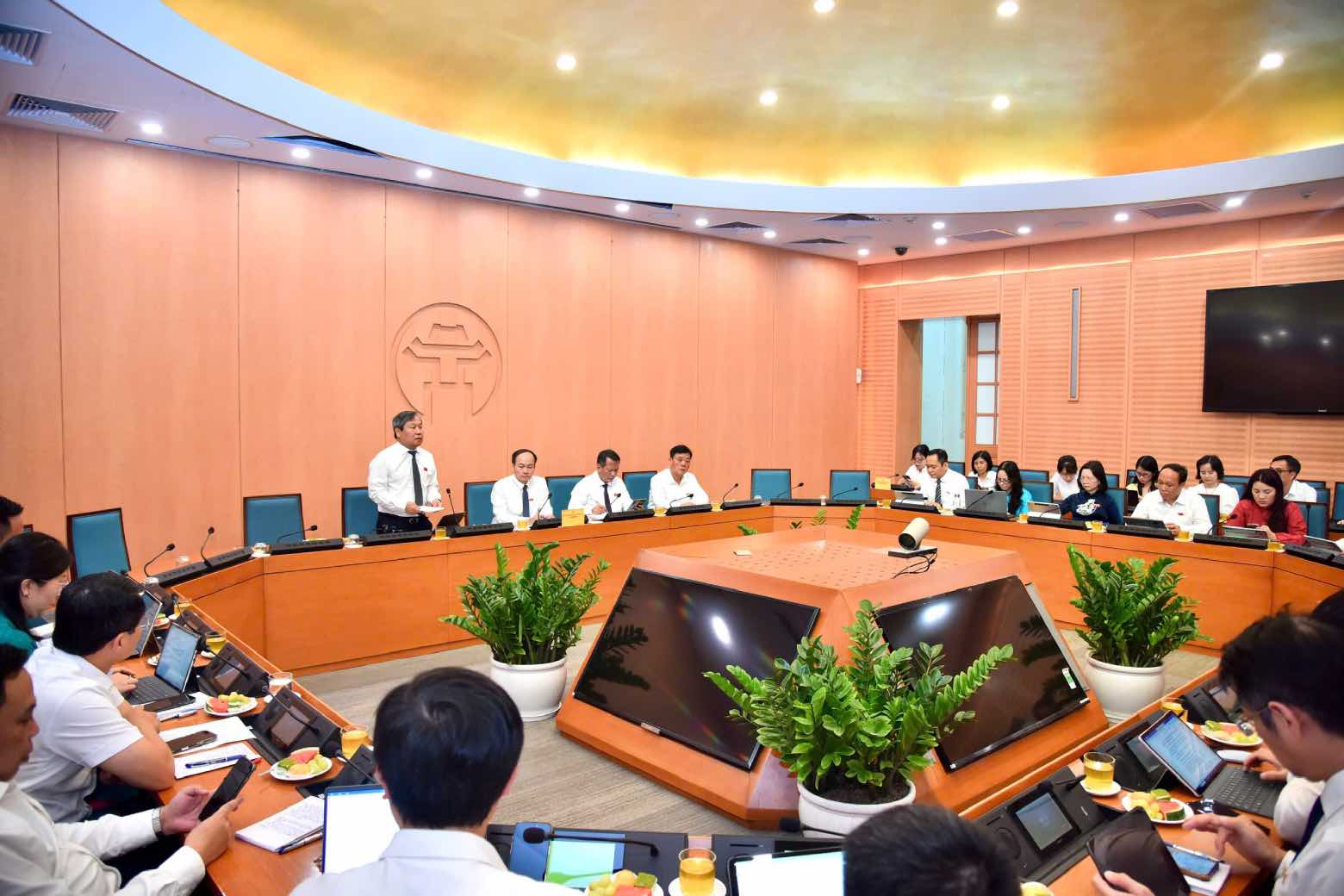
On June 2nd, the Hanoi City People's Council, XVII term, 2026-2031, held the opening session of the third session (specialized session) to consider and decide on many important contents.
Age standards for village heads and residential group leaders
Speaking at the group discussion session on draft resolutions, delegate Do Thi Lan Huong - Secretary of the Party Committee, Chairman of the People's Council of Tung Thien ward, contributed opinions to the draft Resolution on promulgating regulations on the organization and operation of villages and residential groups.
According to Ms. Huong, after implementing the arrangement of administrative units, Tung Thien ward, although named after the ward, in reality has up to 70% of the area and population being rural areas, only about 30% being urban areas.
From this reality, she believes that when building mechanisms and policies, it is necessary to consider the specific characteristics of each locality. Tung Thien ward area currently includes Xuan Son and Thanh My communes (before the arrangement). In which, Xuan Son commune is the place to place the solid waste treatment area, and is also the most difficult, low-lying and poorest area in the locality. However, currently when applying land prices and tax obligations, people in this area have to implement at a higher level than communes, leading to certain disadvantages.
Regarding the draft Resolution regulating the organization and operation of villages and residential groups, Ms. Huong said that according to Decree No. 185/2026/ND-CP of the Government, the village scale is 500 households, and the residential group is 700 households.
However, according to the city's draft resolution, the village scale is from 800 households and the residential group is from 1,000 households. Each village has a village head and deputy village head; each residential group has a residential group head and deputy head of the residential group. Specially difficult villages are arranged with a maximum of 2 deputy village heads or deputy heads of residential groups. For villages and residential groups that do not fall into the above cases, 1 deputy village head or deputy head of the residential group is arranged.
According to Ms. Huong, this regulation is not really suitable for the actual conditions of some localities.
Ms. Huong cited that for Tung Thien ward, there are residential groups expected to be arranged in the near future with an area of up to 7km2 but only about 720 households. If only based on the number of households to determine the number of deputy heads of residential groups, it is not appropriate.
In addition, for residential groups with over 1,000 households but an area of only about 0.5-1km2. Then, management will be much more convenient than residential groups with a large area of km2 but a lower number of households.
From there, she proposed that in addition to the criterion of number of households, it is necessary to study and supplement the criterion of area.
Contributing opinions on age standards for heads and deputy heads of residential groups, Ms. Huong said that through the implementation of the two-level local government model, many issues related to the capacity and qualifications of the team of Party cell secretaries and heads of residential groups in the process of performing their duties have been revealed.
According to her, the draft currently stipulates the age range from 21 to 70 years old. However, the actual conditions between urban and rural areas are very different.
In urban areas, there are many retired officials who are still healthy, capable and can participate in work at the grassroots level even though they are over 70 years old. Meanwhile, in rural areas, the source of personnel with appropriate qualifications and capacity to take on this position is not large.
If we stipulate 70 years old, we will have a lot of difficulty in arranging. Therefore, this content should prioritize people of working age, so that when we go to the grassroots level, we will be more convenient in arranging, arranging, and using it" - Ms. Huong said.
Higher regimes and policies for village heads and residential group leaders
Delegate Nguyen Minh Hong - Secretary of the Party Committee, Chairman of the People's Council of Tay Phuong commune said that the draft resolution has concretized the regulations on the number of deputy village heads and deputy heads of residential groups.
Mr. Hong said that in reality, there are large areas with difficult management conditions. However, if both population and land area criteria are applied to determine the number of officials, it will be difficult to implement in practice.
Regarding regimes and policies, Mr. Hong assessed that the support level in the draft resolution is higher than the regulations in Decree No. 185, which is in line with practical requirements.
According to him, Decree No. 185 stipulates that for villages with over 800 households or residential groups with over 1,000 households, the allowance level is calculated according to a coefficient attached to the base salary. Meanwhile, the draft resolution of Hanoi proposes a higher level of support.
Mr. Hong said that Tay Phuong commune currently has 42 villages and residential groups, all with a scale of over 500 households. According to the planned plan, the locality will arrange 21 villages and residential groups to ensure more effective operation.
The commune currently has about 102,000 people. After arrangement, there are villages with a scale of over 7,500 people. Therefore, the resolution proposing regimes and policies higher than Decree No. 185 is appropriate and shows concern for the grassroots cadre team" - Mr. Hong expressed his opinion.
Contributing opinions on the standards for village heads and residential group leaders, Mr. Hong said that the draft has further specified the provisions of Decree No. 185 when requiring people holding this title to graduate from high school or higher and have professional qualifications from intermediate level.
According to him, this regulation is suitable for current practical requirements. In the context of implementing the two-level local government model and promoting digital transformation, the team of cadres in villages and residential groups needs to have qualifications to access and effectively implement the guidelines and policies of the Party and the State.


