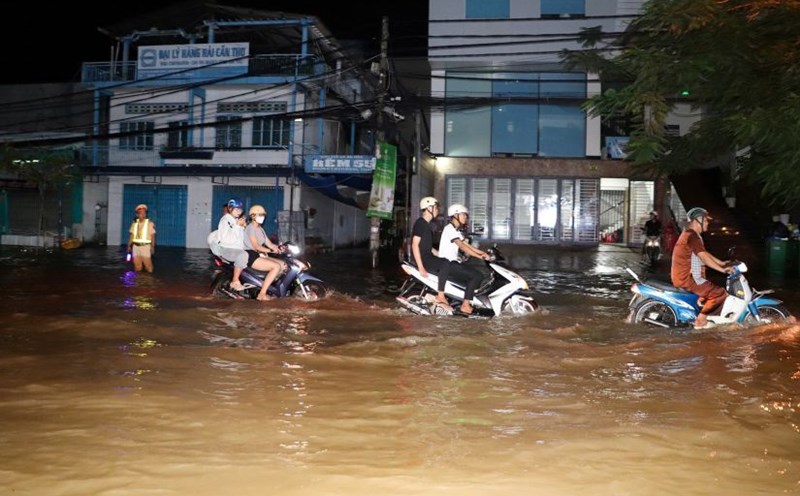
Deep flooding, large area
Recently, flooding in many urban areas in the Mekong Delta has become increasingly serious. Typically, the rain on May 27 with nearly 67 mm of rain in more than 5 hours caused about 20 roads in Can Tho City to be flooded from 10 - 30 cm. High tides on October 22 and November 6 consecutively broke records, with the water level of Hau River reaching 2.29 m and 2.35 m respectively, exceeding alert level 3, causing deep flooding in many areas, affecting people's lives.
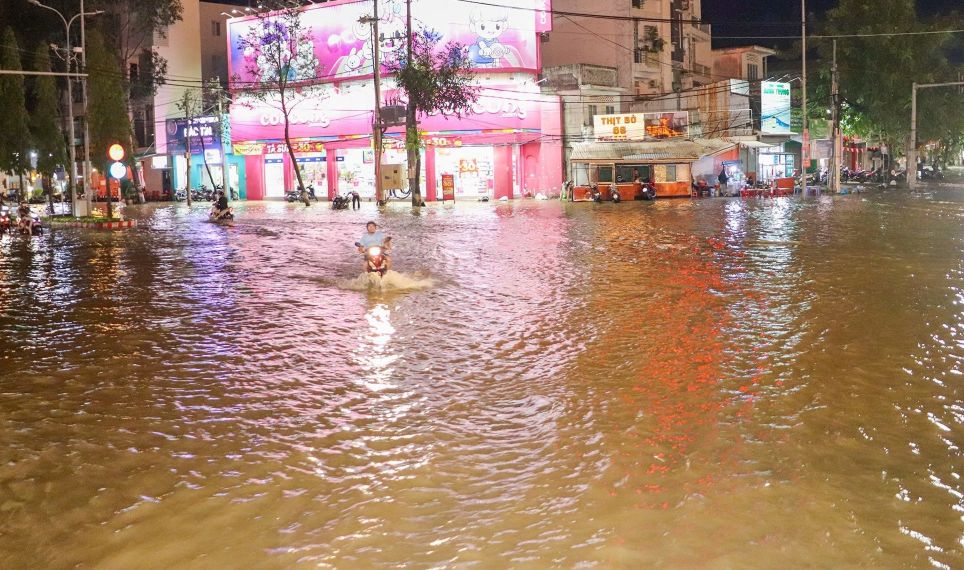
According to Associate Professor, Dr. Le Anh Tuan - Senior Lecturer of the Faculty of Environment and Natural Resources, Can Tho University - through observation and research, the flooding situation tends to become more and more severe, both in depth and area. In particular, when the flood season coincides with high tides and heavy rains, many urban areas such as Can Tho, Vinh Long, and Ca Mau are flooded, causing great difficulties for urban management as well as people's lives and activities.
"It is noteworthy that flooding no longer occurs according to the previous seasonal rules. Even before the peak tide or when the rainfall is not too heavy, many areas will still experience localized flooding," he said.

Analyzing the causes, Associate Professor, Dr. Le Anh Tuan said that climate change has caused increasingly unusual rain. At the beginning of the rainy season, the rainfall tends to decrease, but at the end of the season, there will be many heavy rains with higher intensity. In addition, the upstream flow of the Mekong River has also become unpredictable due to the impact of hydropower projects. When it rains heavily, the lakes are filled up quickly and forced to release water, creating a "domino" effect. Meanwhile, in the downstream, the Mekong Delta will have both heavy rain and the impact of high tides in the East Sea, reducing the ability to drain water.
One long-term cause is land subsidence in the Mekong Delta. According to the Associate Professor, the current sinking speed is even faster than the speed of rising sea levels. "When the soil has subsided, it is almost impossible to recover, increasing the risk of flooding," he said.
In addition, human-caused factors such as small urban drainage systems, degradation, and congestion; ponds, lakes, and rivers being encroached upon; and surface concreting have made flooding worse.
He said that some current flood prevention works are mainly local and lack synchronization. When blocking water in one area, the water will move to another area, causing that area to be heavier flooded and the drainage time will be longer. Many projects still use elevation and old data, while in reality the land has sunk significantly. Continuing to concrete and fill ponds, lakes and rivers during the construction process also made initial calculations no longer consistent with the current situation.
Prioritizing natural healing solutions
According to Associate Professor, Dr. Le Anh Tuan, before continuing to build more water prevention works, localities need to re-evaluate the entire effectiveness of the implemented projects, while updating flood maps and actual data, especially in the context of local mergers.
He said that it is necessary to prioritize "soft" solutions before applying "hard" solutions. These solutions include restoring natural low-lying areas, improving urban surface water absorption, limiting concreting, dredging rivers and canals, and expanding drainage systems. Only when these solutions are not enough will large-scale water control works be considered.
"Living with floods" is a long-standing way of life for people in the Mekong Delta. However, nature is changing faster, while humans are increasingly dependent on technical works and sometimes ignore traditional experiences.
"In my opinion, it is necessary to build a long-term, flexible strategy, based on the principle of favorable conditions. Urban planning needs to be regularly reviewed and adjusted in accordance with natural conditions and development practices," he emphasized.