
Chaotic prices on the "online market
In the days leading up to Tet, on social network platforms, money exchange services are operating rampantly. From small denominations to large denominations, from "swipe" money (used) to "new" whole series money, all are publicly advertised for transactions, accompanied by offers such as "good price", "trustworthy", "professional service".
In the role of someone who needs to exchange money, reporters contact the phone number publicly posted on social networks with an account named Phan T. On the other end of the line, the transaction recipient said that the exchange fee ranges from 3.5% to 9.5%, depending on the denomination and type of money. Notably, 20,000 VND denomination money is subject to the highest fee of up to 9.5%.

Continuing to investigate, reporters contacted another focal point with a Facebook account named Thu H. This person said that they were looking for collaborators to post articles and answer questions from customers who wanted to exchange money.
Currently, we have many ways to calculate fees. If customers exchange large quantities, from 200-300 million VND, they can participate as collaborators, then the exchange fee will be reduced by about 3-4% depending on the denomination," Ms. H said.
Public transactions at many pagoda offering points
Not only taking place on online markets, illegal money exchange activities also take place publicly at many stores near temples and pagodas.
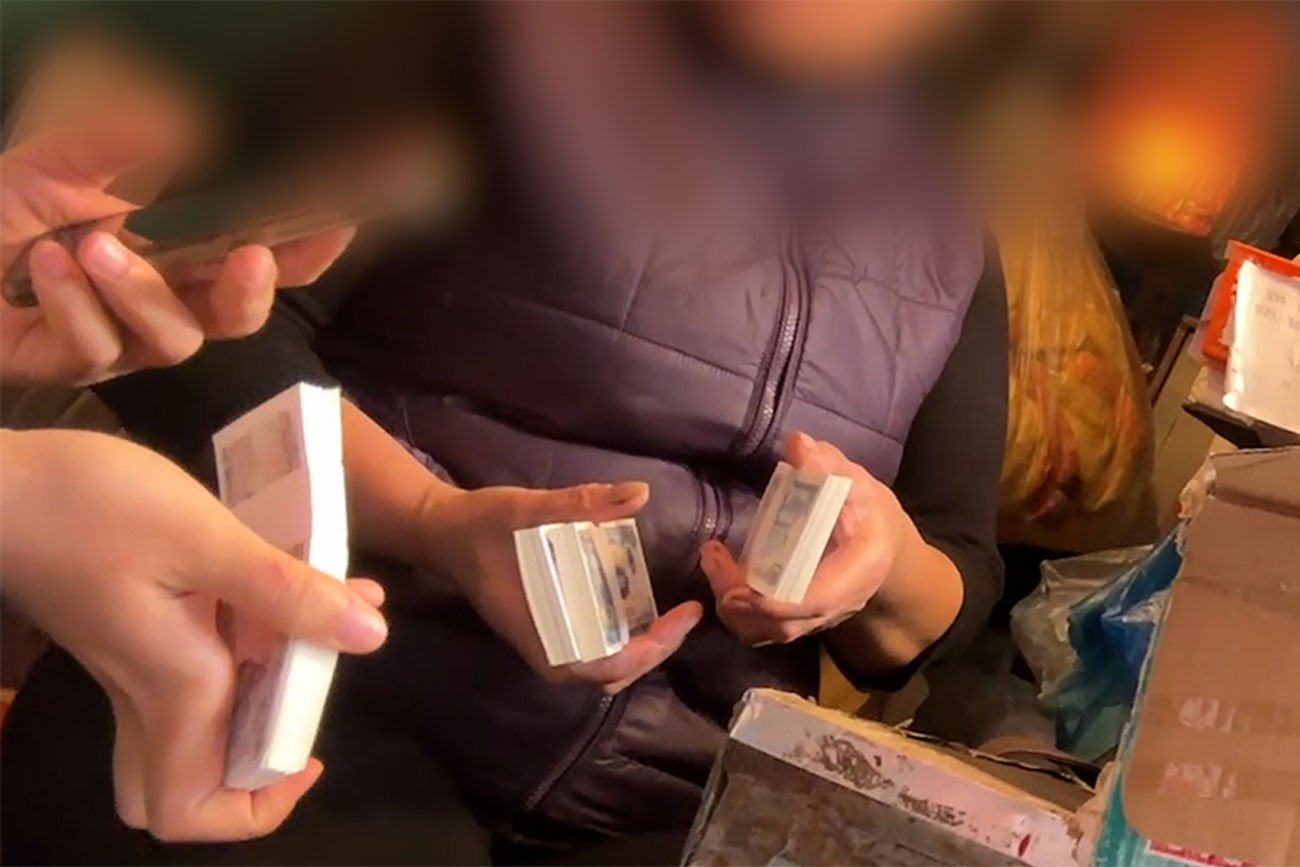
At a gift shop in Tay Ho ward (Hanoi), when a reporter suggested exchanging small change for Tet, the shop owner quickly carried a bag of money from the motorbike trunk and brought it into the store. Here, all kinds of small change were displayed, from circulated money to "new" whole series money.
The store owner said that exchanging small change at the bank is "very difficult". To always have money available with full denominations, this person must go through separate points of contact. Notably, the denomination of 50,000 VND whole series is subject to a difference fee of up to 10%, meaning that exchanging 5 million VND will have to pay an additional 500,000 VND fee. According to the store owner, the high fee is due to the sharp increase in demand for exchanging this type of money near Tet.
Not only stopping there, at the nearby store, reporters can also easily exchange small denomination money to serve the needs of going to festivals. The person directly transacting frankly said that the closer to Tet, the higher the money exchange fee is pushed up, and early exchangers will be "more economical". "I am not here with a large quantity, 2,000 VND denomination with 5,000 VND there is new money. 1 stack of 2,000 VND 100 banknotes costs 40,000 VND" - this person said.

Facing heavy penalties and the risk of fraud
Talking to reporters, lawyer Dang Van Cuong - Hanoi Bar Association - emphasized that the law does not allow individuals and organizations without functions to carry out money exchange activities for profit. In particular, exchanging new money, money that is still qualified for circulation to profit is an illegal act and may be handled according to current regulations.
According to Point a, Clause 5, Article 30 of Decree 88/2019/ND-CP, the act of carrying out money exchange not in accordance with the law will be fined from 20 to 40 million VND.
Notably, if subjects take advantage of this to mix and use counterfeit money to appropriate real money from customers, the act will be criminally handled for the crime of fraud and appropriation of property (according to Article 174 of the Penal Code). Depending on the severity of the violation, the offender may be subject to non-custodial reform for up to 3 years or imprisonment from 6 months to 3 years. In particular, in cases of appropriating property worth from 500 million VND or more, the highest penalty frame may be up to 20 years in prison or life imprisonment.
Faced with the reality that the demand for exchanging new money and small change increases sharply near the Lunar New Year, many individuals and organizations spontaneously accept exchanging money at high fees. Functional agencies warn that this activity poses a risk of fraud, circulation of counterfeit money, money that does not meet standards, and at the same time disrupts the money market.
The need to exchange money for spending and going to temples is legitimate. However, transactions outside the licensed system not only cause people to bear high difference fees but also face legal risks. This situation requires early strengthening of inspection and strict handling to restore discipline in currency circulation activities.


