Why is the sludge treatment item in the waste power project?
On December 8, 2025, the Hanoi Department of Agriculture and Environment issued Notice No. 2193/TB-SNNMT inviting participation in selecting a short list of Hanoi environmental improvement and waste incineration and power generation projects (abbreviated as waste power projects).
The time to organize investor selection is until the end of the fourth quarter of 2025.
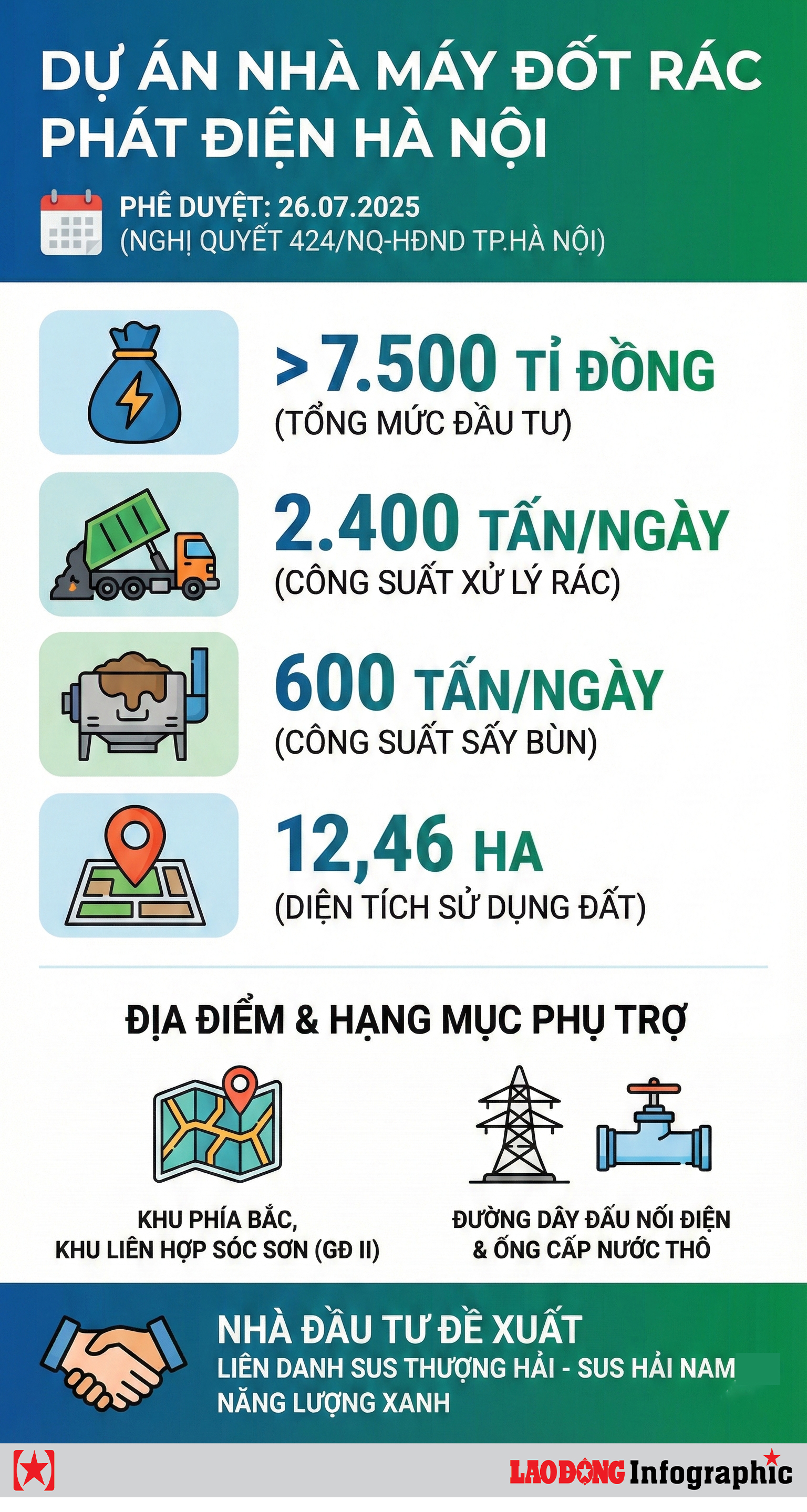
The project scale includes the following items: Building a waste incineration plant to generate electricity with a treatment capacity of 2,400 tons/day. Building a sludge drying system with a capacity of 600 tons/day. Building a power line connecting the plant to the national power system, a crude water supply pipeline and auxiliary items... with a total investment of more than 7,500 billion VND, equivalent to 310,438,000 USD.
After the Hanoi Department of Agriculture and Environment issued a notice on the waste electricity project bidding package, a Vietnamese contractor sent a petition to the department stating that the bidding package did not ensure broad competition, and did not really put economic efficiency as well as the common interests of the city first.
One of the notable points is that the contractor believes that the item of building a sludge drying system with a capacity of 600 tons/day is unnecessary.
According to the analysis of the contractor in the petition, the item of treating sludge using drying system construction technology in the world is very rarely done in many places. With non-toxic sludge in many countries, the common solution is to separate water, then bury, level the ground or reuse it as fertilizer, instead of applying complex drying technology and having to transport sludge for a very long distance (about 40-50 km as proposed).
According to the contractor, the cost of handling this option is much higher than the models being applied such as landfilling or fertilizing in some countries...
This contractor also raises the question of why the sludge treatment item must be included in the waste electricity treatment project? The inclusion of sludge treatment criteria as a prerequisite has inadvertently narrowed the scope of investor participation, losing the competitiveness of the selection process.
The selection of high-cost treatment technology is not really suitable for the actual conditions in Vietnam, with the risk of increasing the total investment, affecting the socio-economic efficiency of the project and putting pressure and disadvantage on the city budget," the contractor expressed.
Many criteria are too high
Not only proposing the sludge treatment item, this contractor also proposed that the garbage power project in Hanoi has too many high criteria.
In the notice of the Department of Agriculture and Environment, the experience criterion is the number of projects that investors participate in must have a solid waste treatment capacity scale (by incineration method) ≥ 1,440 tons/day.
In fact, in Vietnam currently, there are only 2 units that have participated in projects of equivalent scale. Among them, one is a domestic investor and one is a foreign investor.
The announcement also included the criterion of experience in treating sludge for drying sludge with a capacity of ≥ 360 tons/day (equivalent to at least 60% of the project capacity).
With this criterion, the number of investors with suitable experience is very small. In particular, in Vietnam today, no businesses meet this requirement; for international investors, the number is also only a few businesses.
This contractor believes that the above criteria have significantly narrowed the number of investors capable of meeting the requirements and proposed that city leaders review the overall bidding documents of the project. On that basis, consider canceling or requesting adjustments to inappropriate criteria so that Vietnamese businesses have sufficient capacity to participate in substantive competition.
There was a proposal to re-evaluate the necessity of the project
To clarify the issue reflected by the contractor, Lao Dong Newspaper reporters contacted Mr. Nguyen Xuan Dai, Director of Hanoi Department of Agriculture and Environment. Mr. Dai said that he had assigned Mr. Tan (Mr. Nguyen Minh Tan, Deputy Director of Hanoi Department of Agriculture and Environment) who is in charge of this content to answer.
On the afternoon of December 26, a reporter from Lao Dong Newspaper directly contacted and worked with the leaders of the Hanoi Department of Agriculture and Environment, but so far, the reporter has not received a response.
It is known that previously the Urban Committee and Hanoi City People's Council had appraisal report No. 60/BC-BDT dated June 23, 2025 on this project.
Notably, the appraisal report mentions the price of sludge treatment in the waste power project. The unit price for temporarily calculating solid waste treatment is as follows: the price of daily domestic waste treatment is 21 USD/ton, the price of old waste treated that has been buried at the site is 18 USD/ton and the price of non-hazardous sludge treatment is 49 USD/ton.
Regarding the preliminary financial plan, the tham tra report also stated that the payment method for investors is as follows: Hanoi City People's Committee is responsible for channeling to ensure the supply of solid waste (domestic solid waste, sludge for drainage) and payment to PPP project enterprises from regular expenditures according to Decision No. 31/2020/QD-UBND of Hanoi City People's Committee.
The tham tra report also proposed that the City People's Committee re-evaluate the necessity of investing in the Hanoi environmental improvement and waste burning project.
The city has a Soc Son Waste Power Plant project with a receiving capacity of up to 4,000 tons/day and night at Nam Son Waste Treatment Complex and a Seraphin Waste Power Plant project with a receiving capacity of 2,250 tons/day and night at Xuan Son Solid Waste Treatment Zone.
It's a bit of a bit of a bit of a bit of a bit of a bit.