
Ground-penetrating radar system helps save soldiers' labor
In the early days of June 2026, officers and soldiers of the Institute of Design (General Department of Logistics - Technology) and scientists of the University of Science (Vietnam National University Ho Chi Minh City) used modern specialized radar equipment to search in the area suspected of having martyrs' remains.
Under the scorching hot weather, sometimes with sudden rain, scientists and officers and soldiers still persistently scanned through each layer of soil to search for traces.
According to documents, sources and testimonies of historical witnesses collected by functional agencies, the Truong Chinh street area, belonging to Dak Cam and Kon Tum wards (Quang Ngai province) was identified as suspected to have a mass grave with about 70 - 90 sets of martyrs' remains.
Steering Committee 515 of Quang Ngai province organized a ceremony to deploy the excavation, search and repatriation of martyrs' remains in the Truong Chinh road area, and at the same time mobilized forces and vehicles to serve the search work.
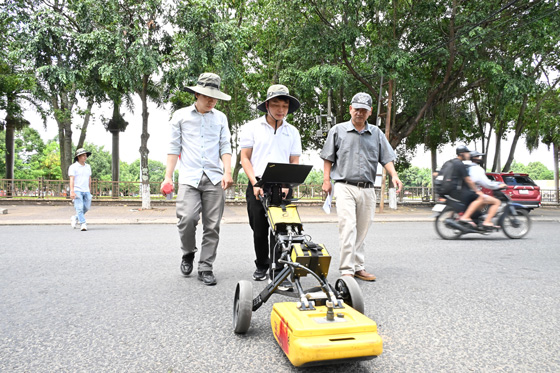
Scientists from the University of Science and Technology, along with engineers and experts, used ground-penetrating radar to search around the Truong Chinh street area, Dak Cam ward, Quang Ngai province.
The radar uses electromagnetic waves transmitted into the ground and receives reflective signals. From there, researchers can create geological slices, helping to identify structures located beneath the ground surface.
According to Assoc. Prof. Dr. Le Van Anh Cuong - Head of the Department of Geophysics, this device was once used in a project to search for martyrs' remains in the old Quang Nam province (now Da Nang City). From the results of measurement and radar zoning, functional forces have discovered some martyrs' remains.
According to experts, the use of radar helps save significant time, manpower and costs in searching for martyrs' remains. This technology is currently widely applied in many countries around the world.
Modern radar technology combines data analysis algorithms
Along with experts, scientists, officials and engineers of the Institute of Design (General Department of Logistics - Technology) also deployed IDS ground-penetrating radar equipment to detect in the Truong Chinh road area.
The IDS ground-penetrating radar device has the ability to detect and analyze foreign objects located up to 6 m deep underground. Thereby, providing the Steering Committee 515 of Quang Ngai province and search forces with important information to determine the location and appropriate excavation area, limiting the impact on underground technical infrastructure, reducing damage and saving time and effort.
In particular, engineers from the Institute of Design not only mastered the technology but also developed specialized algorithms to analyze received signals, helping to distinguish objects such as electrical cables, plastic pipes, concrete sewers or tree roots.
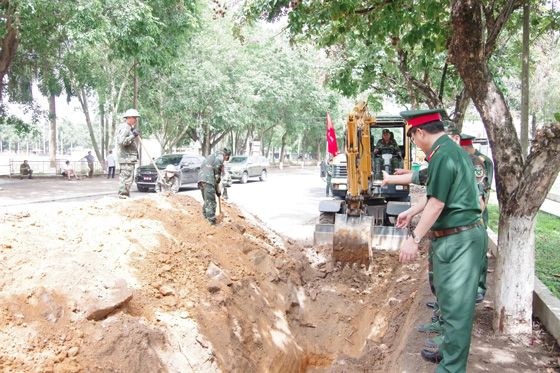
The martyrs' remains repatriation teams are making efforts to maximize the effectiveness of modern equipment, applying science and technology to soon search, repatriate and bring martyrs back to their homeland and comrades.
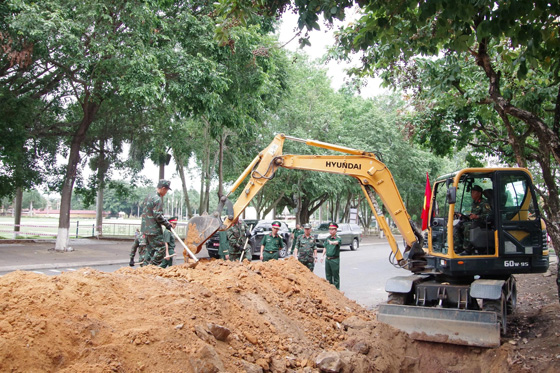
Over the past few days, officers and soldiers of Team K53 have dug many survey trenches, stripped more than 1,000m3 of soil to serve the search and repatriation of martyrs' remains in the Truong Chinh road area. The survey and search process is carried out carefully and meticulously. Each layer of soil is carefully screened to determine stratigraphic characteristics, serving the work of zoning, narrowing the scope of search and repatriation of martyrs' remains.


