
On June 28, Division 968 (Military Region 4) coordinated with the Central Sub-Institute, the Design Institute under the General Department of Logistics and Technology (Ministry of National Defense) to deploy ground-penetrating radar equipment to survey and search in 2 areas suspected of having collective martyrs' graves in Quang Tri province.
This is a modern technology that allows detection and reception of feedback waves to assess unusual signs underground from a depth of more than 6m without excavation. The application of this device helps functional agencies save time, effort and maximize accuracy in verifying suspected martyrs' remains.
The first area being surveyed is located in Tan Tuong village (Cam Lo commune, Quang Tri province), where there is a suspected mass grave containing the remains of about 20 martyrs of Special Forces Unit 31, Military Region 4, who sacrificed in the attack on the US artillery battlefield on the night of August 25, 1966.
According to information from witnesses and people of Xuan Long village (Ben Hai commune, Quang Tri province), in 1967, during the digging of a drainage ditch, people discovered this burial pit and exhumed about 20 martyrs and then buried them in 4 rows nearby. However, because the exhumation process was discovered and prevented by the US military, combined with the burial pit being flooded, the number of remaining martyrs under the pit has not been determined to date.
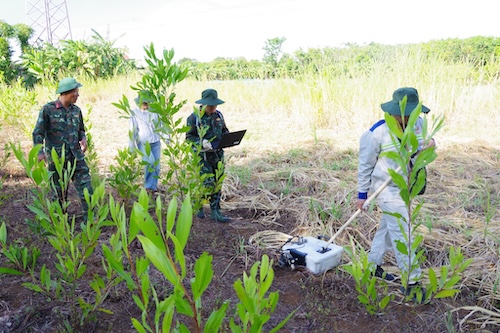
The second area detected by radar is located in An Nha village (Con Tien commune, Quang Tri province). According to information from veterans, on March 16, 1968, a platoon of Platoon 7, Company 3, Battalion 4, Regiment 52, Division 320 was secretly stationed in A-shaped bunkers when it was exposed. US tanks organized to encircle and bury the bunkers, causing many officers and soldiers to sacrifice.
Around 1983, local people while gardening discovered and exhumed 8 martyrs and artifacts such as AK rifles, information machines in an A-shaped bunker and brought them to be buried at the local Martyrs' Cemetery. Currently, this area is suspected to still have other A-shaped bunkers that have been collapsed and have not been found.
With the determination to "not miss or let information slip through" in the field areas, Division 968 and the Central Sub-Institute are conducting ground-penetrating radar scanning carefully and meticulously. All geological data collected underground will be collected for analysis and thorough comparison with historical documents and information from witnesses to accurately determine the coordinates of the burial pits, and soon bring the remains of heroic martyrs back to their homeland.


