
Sticking to the deep forest, meticulously searching for every inch of land
After more than 3 months of deployment, the campaign has collected 58 sets of martyrs' remains in Quang Tri and Laos. The forces also excavated and took samples of 721 martyrs' graves, collecting 598 samples that met the requirements for DNA testing.
To bring them back after decades of lying in deep forests and mountains, soldiers of the Team for Searching and Repatriating Martyrs' Remains of Economic - National Defense Team 337 have stayed in the border area between Vietnam and Laos.
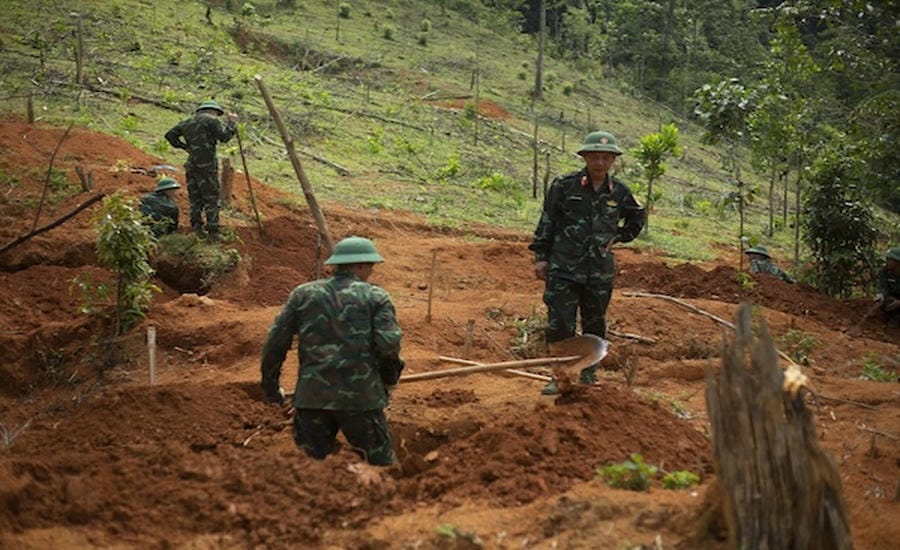
In June, the border sun is like burning fire. From 6 am, the soldiers have prepared military equipment and tools, marching into the deep forest of Cha Ly mountain to perform their duties.
Arriving at the bank of Cha Ly stream, putting aside their motorbikes, they walked across the jagged rocky fields to climb onto a steep hill. Here, the traces of a temporary cemetery from wartime have been completely erased by time and the old forest. No longer having tombstones, the Repatriation Team must rely on the rules passed down from previous generations: When buried, the graves are usually located in vertical or horizontal rows, heads facing the top of the hill and feet downstream towards the stream, each grave is about 1 to 1.2m apart.
In the middle of a steep hill, for nearly a month, soldiers have been diligently digging long rows of acupuncture points under the scorching forest sun.
Lieutenant Colonel Phan Dinh Phi - Team Leader of the Repatriation Team - shared that the excavation procedure was meticulously carried out from bottom to top. Each grave was in charge of two soldiers, one person carefully using hoes and shovels, and one person above gently rubbed each handful of red soil to carefully search for each button, hammock piece or remaining bone sample.
8 sets of martyrs' remains found in Cha Ly forest, that many times tears of happiness rolled down.
Cherishing each biological sample
According to the Steering Committee for searching, repatriating and identifying martyrs' remains of Quang Tri province, from June 8, the locality has begun to expand the excavation and collection of biological samples of martyrs' remains for DNA testing for more than 1,300 graves that have not been identified at Ba Doc Martyrs' Cemetery (Nam Trach commune).
This is the 3rd cemetery in Quang Tri to deploy biological sample collection, after Truong Son National Martyrs' Cemetery with 93 completed graves and Road 9 National Martyrs' Cemetery with 5,929 graves being sampled from June 5, 2026.
The core force is Team 584 and Team 589 under the Provincial Military Command, in coordination with the Departments of Home Affairs, Health, Public Security and local authorities.
Present at the National Martyrs' Cemetery of Road 9 on this occasion, we witnessed the extremely hard work of taking samples from the graves of martyrs whose identities have not been identified. From 6:30 AM to 5:00 PM every day, dozens of officers and soldiers of Team 584 (Political Department, Quang Tri Provincial Military Command) and doctors and nurses are divided into groups to perform their duties.
Because the graves were built solidly through many periods, soldiers had to use specialized hammers and chisels to remove the concrete blocks before raising the graves. The work requires a lot of effort but must be handled skillfully so as not to affect the remains inside. To reduce the burden, soldiers self-made a field pulley system right at the scene.
The sampling process takes place strictly through 8 steps and takes up to 16 photos from exhumation to completion to digitize data.
Lieutenant Colonel Ngo Thanh Liem - Team Leader of Team 584 - shared that although the work of chiseling concrete under the scorching sun is very strenuous, the unit always encourages officers, soldiers and doctors to promote the highest sense of responsibility, work overtime to ensure progress.
In this peak campaign, the province plans to excavate and collect DNA testing samples for more than 22,000 graves of unidentified martyrs. The forces have been thoroughly trained in the procedures of the Ministry of National Defense...
Increased search for martyrs' remains on the Vi Xuyen front
Vi Xuyen is the fiercest battlefield in the war to protect the northern border, once likened to the "castle furnace of the century". About 4,000 officers and soldiers bravely sacrificed, including many martyrs lying across the battlefield.
The Military Command of Tuyen Quang province has consolidated the Team for searching and repatriating martyrs' remains (HCLS), repatriating HCLS divided into 5 platoons, of which 3 platoons directly perform tasks at 7 key positions, including high points 685, 300, 772, A5, belonging to Thanh Thuy commune; high points 1.688, 1.800A, 1.800B belonging to Lao Chai commune; high point 1.030 belonging to Minh Tan commune... A platoon performing tasks in Tung Vai commune, receiving information from local people as a basis for comparison and search. Currently, the team has deployed searches on an area of more than 400ha; volume of excavated soil and rock more than 4,000m3; searched and repatriated 10 HCLS and 2 mass graves of martyrs. Quang Toan
Hanoi deploys DNA sampling to restore identity to heroic martyrs
On June 24, Hanoi officially deployed excavation and sampling of DNA genetic biological products for unidentified martyrs' graves.
According to a comprehensive review, Yen Vien Martyrs' Cemetery is the burial place of 1,428 graves, of which 81 graves have not been fully identified, including 11 graves that do not have any information. This time, Phu Dong commune was selected to organize the implementation before taking samples for 11 martyrs' graves that have not been completely identified for DNA testing. The Capital High Command said that the entire force is determined to strive to complete this task 3 months in advance, which is around April 2027, to practically towards the 80th anniversary of War Invalids and Martyrs' Day. Thu An
Quang Ninh strives to complete taking samples of martyrs' remains before July 10th.
Steering Committee 515 of Quang Ninh province is accelerating the progress of taking samples of remains of martyrs with missing information at cemeteries in the area, striving to complete before July 10, 2026.
According to the Steering Committee 515 of Quang Ninh province, the whole province currently manages 22 martyrs' cemeteries with 3,802 graves, of which 764 graves have not fully identified information. As of June 22, sampling has been implemented at more than 450 graves in many cemeteries. Doan Hung
Son La takes samples to identify martyrs' remains
The Steering Committee of Son La province for searching, repatriating and identifying martyrs' remains has organized DNA testing samples to identify martyrs' remains at Thuan Chau Commune Martyrs Cemetery. Thuan Chau Commune Martyrs Cemetery currently has 95 unidentified martyrs' graves. After completing the sampling, biological samples are counted, cross-checked, marked areas, sealed the scene and moved to temporary storage locations. Van Toan
An Giang deploys "Operation 500 Days and Nights" to identify martyrs
Steering Committee 515 of An Giang province has just organized an online conference to deploy the "Campaign of 500 days and nights to promote the search, repatriation and identification of martyrs' remains" and the work of taking samples and handing over samples of martyrs' remains in the province. The whole province currently has 20 martyrs' cemeteries with 35,945 graves, of which more than 30,000 graves are missing or have not been identified. According to the plan, Chau Phu Martyrs' Cemetery, Vinh Thanh Trung commune is selected as a pilot to organize taking samples, handing over samples of martyrs' remains and drawing experience before deploying synchronously throughout the province. Thu Minh


