
Hanoi is facing great pressure in the collection, transportation and treatment of construction waste when a series of key infrastructure projects are simultaneously implemented, leading to a sudden increase in the amount of waste generated.
Records of Lao Dong Newspaper reporters at the site clearance areas serving the Ring Road 2.5 project show that many houses in the land recovery area on Nhan Hoa, Chinh Kinh, Thuong Dinh, Bui Xuong Trach streets... are being urgently dismantled to hand over the site to contractors.
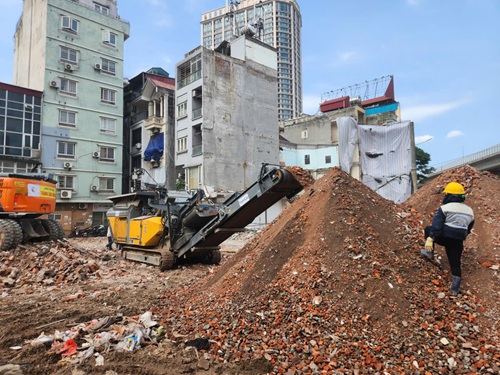
After each construction day, a large amount of construction waste continues to pile up at the construction site. Many areas have appeared "mountains" of waste including concrete, bricks, stones, steel reinforcement and construction materials. These are materials with large weights, difficult to classify and time-consuming for treatment.
Mr. Pham Trung Kien - Deputy Director of the Infrastructure Investment Project Management Board of Thanh Xuan ward said that the process of dismantling works belonging to Ring Road 2.5 project generated a large volume of solid construction waste, while the current collection points are under overload pressure. Bringing a mobile crushing line into the construction site has significantly reduced transportation volume and pressure on collection yards.
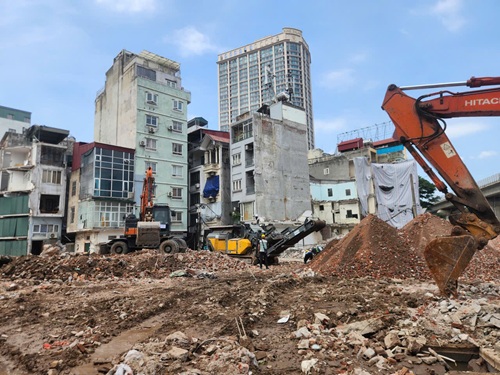
At the Tam Trinh road expansion project, most of the works within the site clearance area have been dismantled. Along with the clean site for construction, a large amount of materials after dismantling are waiting to be transported to the treatment facility.
According to a representative of the Solid Waste Management Department (Hanoi Department of Agriculture and Environment), prolonged waste accumulation not only affects urban aesthetics but also poses a potential risk of environmental pollution, affecting community health. Hanoi City will strengthen inspection of construction waste collection and transportation and strictly handle violations.
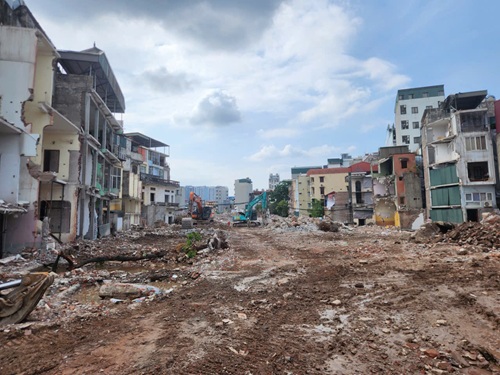
The Hanoi Department of Agriculture and Environment also said that the total amount of solid construction waste generated in the area is currently about 10,000 tons/day, 4-5 times higher than the average of about 2,100 tons/day before. The reason is that many key transport projects such as ring roads, bridges over the Red River and national highway expansion projects are being implemented simultaneously.
Currently, construction waste is transported to 4 main treatment points with a total capacity of about 1,670 tons/day. In which, Nguyen Khe landfill has a capacity of about 360 tons/day; three recycling points using grinding technology in Yen So, Phuc Loi and Thu Lam have a total capacity of about 1,310 tons/day.
After treatment, most of the waste is ground into recycled ash to serve ground leveling and infrastructure construction. However, with the volume generated up to about 10,000 tons per day, the current treatment capacity is under great pressure.
To reduce the load on the centralized treatment system, the Hanoi Department of Agriculture and Environment proposed to arrange mobile crushing lines with a capacity of about 500 tons/day right at the construction site. This solution is expected to help reduce transportation costs, limit environmental pollution and improve recycling efficiency.
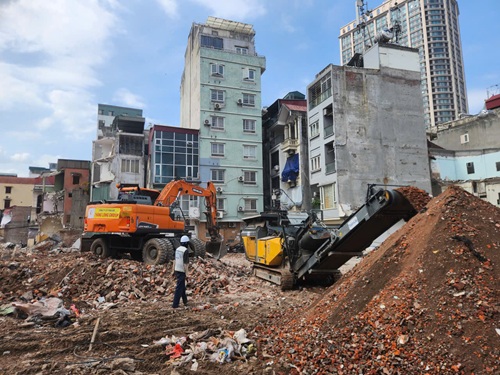
Talking to a reporter from Lao Dong Newspaper, Mr. Bui Cong Nguyen - Deputy Director of Toan Cau Production Service Joint Stock Company said that grinding waste right at the construction site helps significantly reduce the transportation volume. If leaving raw materials after demolition, it may take up to 10 truck trips to transport, but after grinding, there are only about 3 to 5 trips left. Before operating the production line, the unit always waters to limit dust generation.
According to experts, sorting and recycling construction waste right at source not only reduces pressure on collection sites but also contributes to utilizing recycled materials for construction.
The Hanoi People's Committee also requested investors and contractors to strictly implement the principle of rolling construction, ensuring environmental sanitation, covering the construction site, spraying dust and cleaning vehicles before leaving the construction site to limit the spread of dust and waste into the environment.


