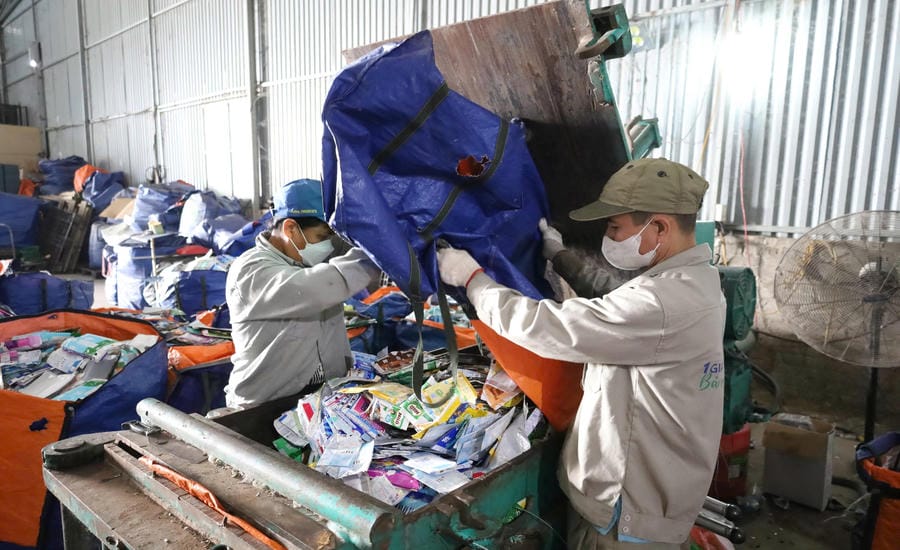
Every day, thousands of tons of scrap are collected, through many intermediaries before becoming recycled materials. When EPR is implemented, the requirement is not only the collected output but also the ability to be transparent and trace data to prove the obligation to recycle.
According to statistics from the Ministry of Agriculture and Environment, Vietnam generates about 25.3 million tons of domestic waste each year, of which about 1.8 million tons are plastic waste. However, about 60% of the waste is still treated by landfilling, putting great pressure on the environment and waste treatment systems.
The above figures show that waste is no longer just a problem of pollution treatment but needs to be seen as a reusable resource.
Mr. Tang The Cuong, Director of the Department of Environment (Ministry of Agriculture and Environment) said that the implementation of the 2020 Law on Environmental Protection and the EPR mechanism has gradually completed the legal corridor, creating momentum for the transition from a linear economic model to a circular economy, in which waste is managed and exploited as a resource for development.
The implementation of EPR in the current context is not just a simple legal compliance problem, but has become a test of the capacity and long-term vision of each business. This is also an urgent requirement to promote the circular economy as well as sustainable green development.
With that importance, the Government has issued Decree No. 110/2026/ND-CP detailing the implementation of a number of articles of the Law on Environmental Protection on the responsibility for recycling products, packaging and the responsibility for waste treatment of manufacturers and importers (EPR). According to regulations, manufacturers and importers must fulfill the responsibility for recycling products and packaging according to mandatory recycling ratios and specifications or choose to contribute financially to support recycling activities according to regulations.
According to the Vietnam Packaging Recycling Alliance (PRO Vietnam), by the end of May 2026, more than 60,000 tons of packaging had been registered for recycling responsibility, of which more than 30,000 tons had been collected and recycled in reality. This result shows the urgent need for data transparency and traceability of material flows in the recycling chain.
Mr. Nguyen Trong Minh, Director of GRAC Technology Joint Stock Company, said that currently many businesses still manage collection activities with separate invoices and documents, causing difficulties in comparing and proving recycling responsibility.
The application of digital platforms helps trace each material transfer, including information about time, location, volume and delivery unit. Data is updated throughout from collection to recycling, creating a basis for traceability of material flows and making EPR implementation transparent.
Mr. Nguyen Trong Minh said that digitalization helps connect links in the recycling chain with data, creates a basis for material flow traceability, proves EPR responsibility and supports management and supervision agencies.
When linked to data on the collection, transportation and recycling process, a plastic bottle not only ends its journey at the landfill but can also become evidence of the enterprise's implementation of recycling responsibility. This is also the foundation for the circular economy to operate more transparently, efficiently and sustainably.