
According to the Vietnam Labor Market Update Bulletin for the second quarter of 2026 announced by the Ministry of Home Affairs, the country's labor force in the first quarter of 2026 reached 53.6 million people. The number of unemployed people of working age is 1.06 million people, down 5,500 people compared to the fourth quarter of 2025 but up 21,800 people compared to the same period last year.
Notably, there are 761,500 people of working age in the country who are unemployed. This is a group that still has jobs but has working hours lower than normal and needs extra work but cannot find suitable jobs.
From the perspective of recruitment demand, job search pressure is also leaning towards the middle-aged labor group. In the first quarter of 2026, workers aged 30-39 accounted for 45.4% of the total number of job seekers, the highest among age groups, while the 20-29 age group accounted for 37.1%.
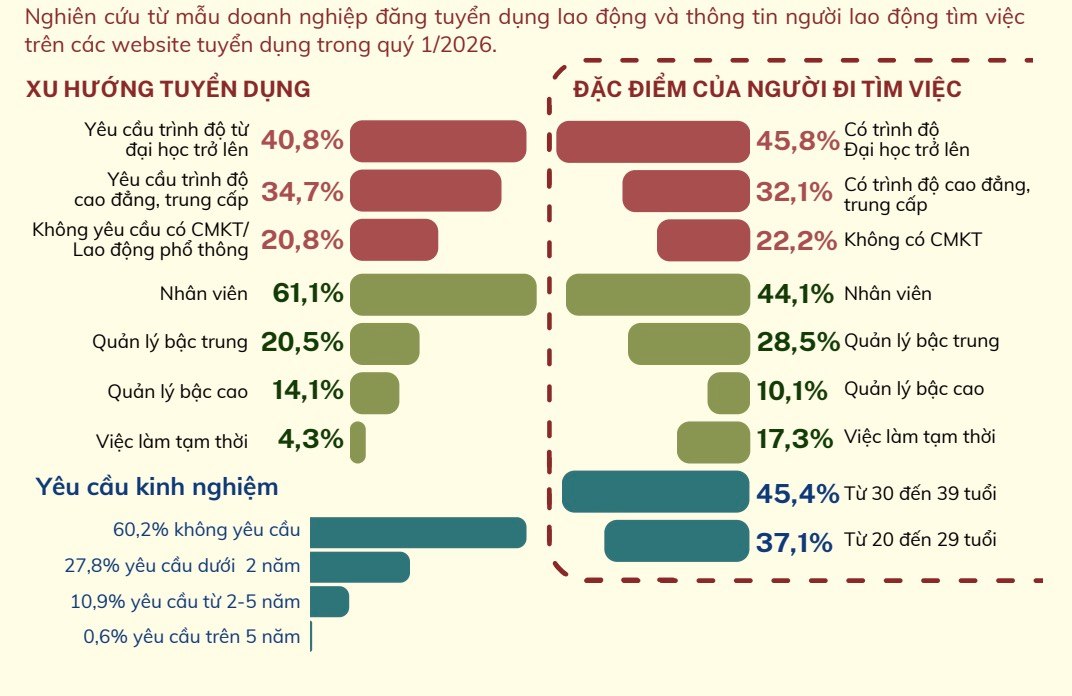
Meanwhile, TopCV's 2025-2026 Recruitment Market Report shows that for every 10 Gen X workers (born before 1980), nearly 2 people are laid off.
According to reports, many businesses are restructuring, streamlining their apparatus, reducing positions with high personnel costs or no longer suitable for new business models.
Assessing the above situation, Ms. Nguyen Thi Lan Huong - former Director of the Institute of Labor and Social Sciences (Ministry of Home Affairs) - said that behind the figure of more than 761,500 unemployed people is not simply labor supply and demand fluctuations but also reflects the "cleansing" process in traditional occupations.
According to Ms. Huong, the group of 35-45 year old workers is the group that suffers the most impact.
Ms. Huong called this a group of workers "stuck in the middle of the river" when they had to shoulder family responsibilities and face pressure to adapt to technology.
They are the people with the largest family burden but also the largest delay in digital skills. High seniority salaries while labor productivity is increasingly under competitive pressure from young workers and the accuracy of machines, AI. If personnel have to be cut, businesses often think of them first," Ms. Huong analyzed.
According to her, unlike complete unemployment, lack of jobs makes workers still have income but not enough working time to ensure their lives, while the opportunity to find more jobs is increasingly limited.
From the perspective of labor psychology, Dr. Nguyen Thuy Vu - Institute of Training and Advanced Study of Ho Chi Minh City (IFP) said that after 15-20 years of working, many people begin to look back at their career values and want to find a more suitable environment for themselves.
According to Ms. Vu, instead of just pursuing titles or salaries, many people currently prioritize the balance between work and life, mental health, time spent with family as well as the right to initiative in work.
Many people are willing to leave their management positions or stable jobs to switch to a more flexible environment where they can develop experience, control time and affirm personal values.
She also believes that before the pressure of AI and automation, many 35-45 year old workers choose to actively find new "harbors" before falling into the risk of being eliminated. They tend to switch to expert, consulting or flexible working models, and are more cautious when choosing a business.
In my opinion, 35-45-year-old workers are no longer looking for a job to try their hand at but are looking for a place to stick with for a long time. They prioritize transparent businesses with solid financial foundations, value experience and create a balanced working environment," said Dr. Nguyen Thuy Vu.


