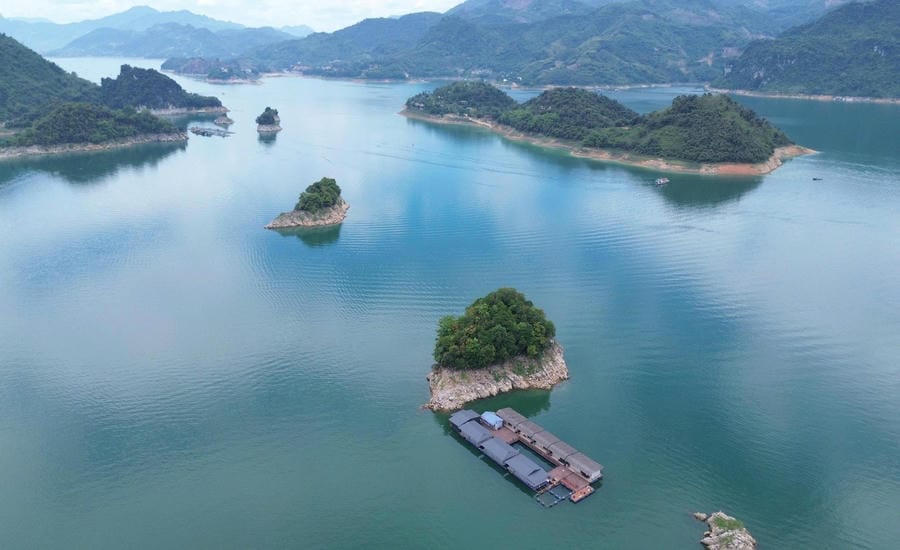
Great potential but not yet opened
On June 30, Lao Dong Newspaper organized a seminar "Tay Bac tourism development: Awakening the potential of Hoa Binh lake region". At the seminar, experts, businesses and local representatives all shared the same opinion: Hoa Binh lake region is not lacking in beauty, not lacking in potential. But this place still needs a synchronous and sustainable development strategy to turn potential into a driving force for growth.
Mr. Nguyen Xuan Tung, representative of Mit Retreat, a business that chose to invest in Da Bac district (old) very early because of trust in the long-term potential of the area. The model that the unit is pursuing is not only accommodation but also bringing local culture into every tourist experience, from architecture, cuisine to resort space.
However, according to Mr. Tung, one of the current limitations is that tourism products are still monotonous. Many tourists still do not have more destinations to explore after one or two days. Therefore, developing more experiential products, connecting destinations around the lake will contribute to extending stay time and increasing customer spending value.
Sharing the same view, Ms. Ha Thuy Hanh, Operations Director of Ngu Mai Retreat, said that the resort has just started operating but has received many room bookings. This shows that the attraction of the lake area is very clear. However, businesses still face many difficulties in infrastructure.
Electricity supply does not meet operating needs, transportation to the resort still has many construction sections, while the waste collection and treatment system is not complete. Businesses also prioritize recruiting local workers to create jobs for people, but most workers still need to be further trained in service skills and professional tourism nghiệp vụ.
From a local perspective, Ms. Ban Kim Quy, Chairwoman of Tien Phong Commune People's Committee, said that the locality has great advantages in terms of water surface, natural landscape and cultural identity of the Muong and Dao people. Many products such as spiritual tourism, ecotourism, resorts and community have been formed, but have not yet fully developed their potential.
According to Ms. Ban Kim Quy, the biggest bottleneck currently is infrastructure. Many lakeside tourist areas do not have inland waterway ports and wharves to welcome guests; lakeside roads are still being constructed for a long time, causing travel difficulties. In addition, issues related to electricity, environment and investment procedures still need to be further removed to create conditions for businesses to develop.
Need a sustainable development strategy
According to Mr. Kieu Cong Thuoc, Vice Chairman of the Vietnam Association for Cultural Industry Development, the biggest asset of the lake area is not only the landscape but also the indigenous cultural and economic ecosystem. However, these advantages have not yet been transformed into investment attraction. To develop, the locality needs a comprehensive project on the destination ecosystem, sufficient to attract long-term investors instead of fragmented development.
Accordingly, it is necessary to focus on five groups of solutions including: completing the overall plan; building a tourism brand associated with ethnic cultures; developing green resorts and community economy; investing in transportation and environmental infrastructure; and at the same time announcing a list of key projects and attractive mechanisms to attract businesses.
In particular, Mr. Thuoc emphasized that tourism development is not only about building more accommodation facilities but also about forming a value chain, in which the government creates policies, businesses develop products, and people become service providers, preserve culture and jointly benefit from tourism.
At the seminar, Mr. Bui Xuan Truong, Deputy Director of the Department of Culture, Sports and Tourism of Phu Tho province, informed that Hoa Binh Lake area is identified as a new growth pole of the tourism industry, playing a role in connecting Phu Tho with the Northwest region. To realize this goal, the province will continue to improve infrastructure, improve the quality of human resources, innovate promotion work, promote digital transformation and attract strategic investors.
Phu Tho sets a target to welcome about 20 million visitors by 2030, with tourism revenue reaching 26,500 billion VND. To achieve that goal, according to experts, the most important thing is to build a separate brand for the Hoa Binh lake area - a place developed based on natural landscapes, cultural identity and community participation. Then, the potential will truly be transformed into a driving force for sustainable development for local tourism.