
Records in Ho Chi Minh City show that thunderstorms are developing strongly on a large scale, pouring heavy rain on many areas of Ho Chi Minh City. Only after a short time, the water began to rise on Quoc Huong street.
Many sections are deeply flooded from 30-50 cm, in some places water overflows onto the sidewalks and creeps into some houses along the road. This is also an area that is often flooded every time heavy rain combined with high tides occurs.
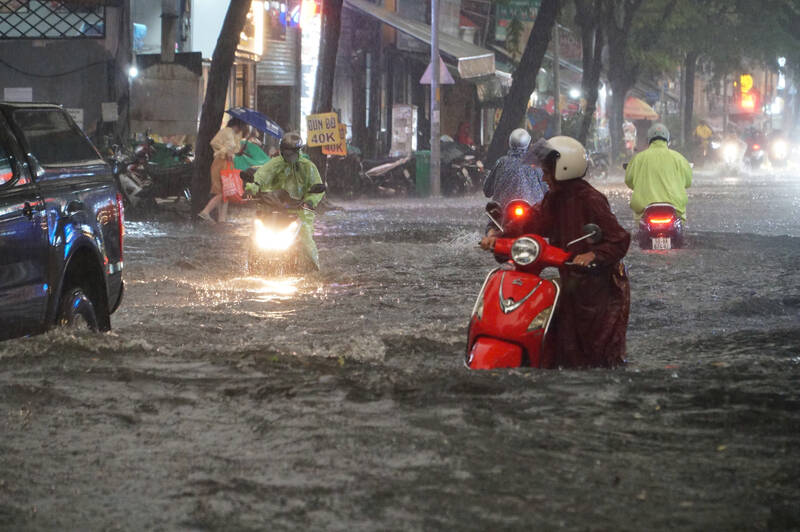
Recorded at the Quoc Huong - Thao Dien intersection area, cloudy water covered the road surface. Many cars passing through the Quoc Huong road area had to move slowly. Some cars stalled in the middle of the water, causing people to walk.
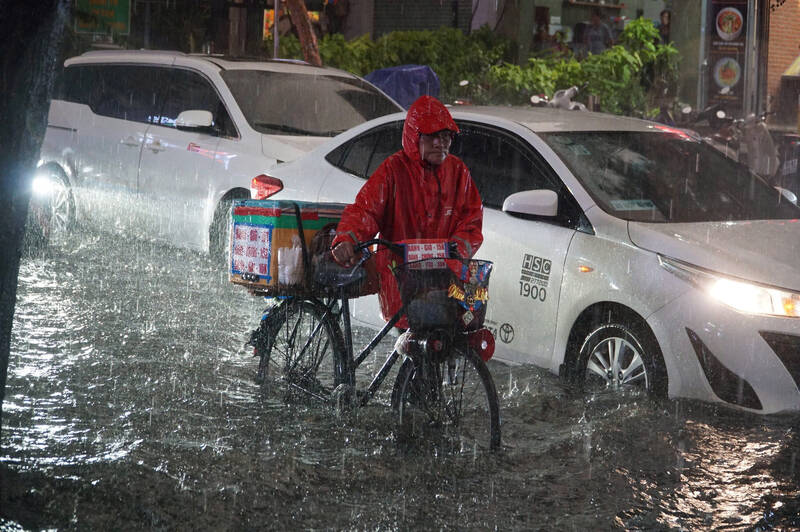
Finishing work right at the time of heavy rain, Mr. Nguyen Tung Duong (resident of An Khanh ward) said that he had to struggle to overcome a road section of less than 500m. "The water rose very quickly, sometimes flooding almost to the exhaust pipe. I didn't dare to drive fast because I was afraid the car would stall in the middle of the road" - Mr. Duong said.
The Southern Regional Hydrometeorological Station said that monitoring on satellite cloud images, weather radar images and lightning positioning shows that the convective cloud area is developing strongly, causing rain with thunderstorms and lightning in many areas in Ho Chi Minh City, Binh Duong and some neighboring localities.
Currently, thunderstorms are appearing in Tan Dinh, Cau Ong Lanh, Xom Chieu, Cho Quan, Binh Tien, Binh Phu, Tan Thuan, Phu Thuan, Tan My, Tan Hung, Chanh Hung, Phu Dinh, Dien Hong, Binh Thoi, Binh Thanh, Binh Loi Trung wards...
In the next 3 hours, convective clouds will continue to develop, causing showers and thunderstorms in the above-mentioned areas, then it is likely to expand to neighboring areas. Common rainfall is from 10 - 30 mm, in some places over 40 mm.
The meteorological agency warns that during thunderstorms there is a possibility of tornadoes, lightning, hail and strong gusts of wind at level 5 - 7 (8 - 17 m/s). Heavy rain can also cause localized flooding in low-lying areas.


