
Each bundle of newspapers still smelling of ink successively docks. Fixed ropes are untied, dozens of hands quickly classify according to each newspaper issue, each circulation route. Without anyone telling anyone, each person doing their own thing, rhythmically as programmed for decades.
Few people know that, for a Lao Dong Newspaper to reach readers every morning, that is the beginning of a new day for people who have been used to waking up since the whole city was still in sleep.
You can get wet, but not the newspaper
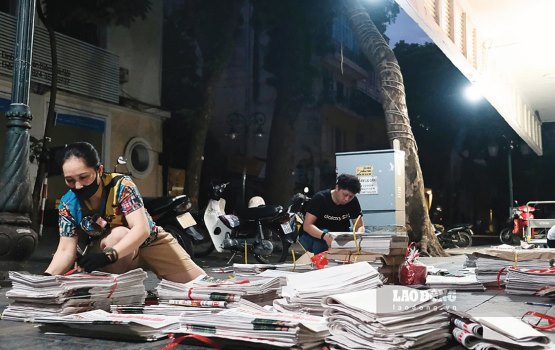
Leaving home at 3 am, Mr. Duong Trong Ha - a slender man, retired - has been regularly present at the newspaper receiving point on Dinh Le street for 32 years.
Doing this job requires hard work, diligence and perseverance. Waking up early 365 days a year. Even the rain goes, even the storm goes. People can be wet but the newspaper cannot be wet" - Mr. Ha said with a smile.
After arranging and classifying them into newspaper headlines, packing them into "square and sharp" volumes, clearly stating the names of units and recipients, each person quickly loaded newspapers onto trucks according to the correct number they had remembered and directly transported them in the inner city.
10 sheets is ten sheets. 100 sheets is 100 sheets. No surplus, no shortage, no confusion of newspaper titles, types and no delays" - Mr. Ha said.
Just like Mr. Ha, Mr. Dao Tien Phong - Director of Tien Phong Press Development Co., Ltd., who has 26 years in the profession - is most worried when it rains.
A newspaper only needs to get wet from the rain, the paper will become mushy, the edges will be torn, and the letters will be blurred. Even when dried again, the newspaper will blister. At that time, its value is almost gone" - Mr. Phong shared.
Therefore, on rainy and stormy days, the newspaper delivery person may be wet, but the stacks of newspapers are always wrapped in many layers, cherished like a special item. That is almost an unwritten principle of newspaper publishers.
More than 26 years of attachment to the profession, Mr. Phong always considers himself not only a newspaper delivery person, but also a person introducing the newspaper to readers. Speaking of Lao Dong Newspaper, he repeatedly mentioned the Golden Heart Fund, the closeness and role of representing the voice of workers. Every morning, before loading piles of newspapers onto the car, he takes the opportunity to look at the front page and browse through the outstanding news.
Readers often ask what is noteworthy about Lao Dong Newspaper today. We must know to introduce it, so that people like and accept the newspaper" - Mr. Phong shared.
For him, the paper newspaper publishing profession operates as accurately as a clock. Each newspaper has its own release schedule, and the newspaper deliverer must memorize each time milestone.
If this newspaper is closed, there are other newspapers, almost non-stop all year round, except for the 3 days of Lunar New Year. Every time it's time, I have to be there to get the newspaper and then transfer it immediately. Many readers only read Lao Dong Newspaper, so I have to deliver it on time. Some people didn't ask for anything else, just asked if Lao Dong Newspaper was available today" - Mr. Phong recounted.
Going through more than 2 decades, regardless of sun or rain, what keeps Mr. Phong in the profession is not the habit of waking up early, but the burning love for the profession. That love has kept him, quietly continuing the journey to be the last bridge to bring each paper newspaper to readers.
Whatever profession you do, you must love the profession to be attached for a long time. If you love the profession, you will be attached for 26 years, walk in the rain and wind without fear of difficulties" - Mr. Phong said.
Keep a habit, keep a cultural trait
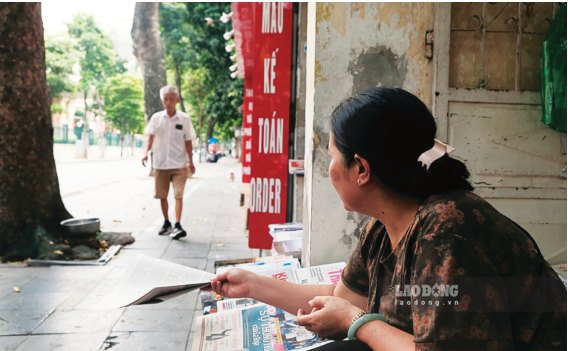
As one of the people who still maintains a rare paper newspaper stall in the heart of Hanoi, Ms. Nguyen Thi Phuong Oanh - who has more than 30 years of newspaper sales - is excited to see familiar customers. Looking at customers from afar, Ms. Oanh knew which newspapers they would buy.
Many elderly people have not arrived yet, I have prepared newspapers. Each person has their own preferences, I have almost learned them by heart" - Ms. Oanh said. She remembers days when at 5:30 am, when she had not yet finished clearing the stall, many elderly people exercising were already waiting. Ms. Oanh hurriedly said: "Slow down a bit and the elders will ask right away".
Looking at the street in front of her, Ms. Oanh talked about the period when print newspapers were booming: "In the 2000s, my store had to sell until 7-8 pm and was still crowded with customers. But now, selling newspapers is almost only limited to a few hours in the morning. Not as good as in the old days". "Customers coming to the newspaper stall now are mainly gray hair. Young people coming to buy print newspapers are very rare.
Surely in Hanoi, only I keep this newspaper stand, it's hot" - Ms. Oanh laughed heartily, her hands still skillfully stacking stacks of new newspapers, her eyes shining with the joy of a person who never thought he would leave the profession. If Ms. Oanh is the person who preserves the culture of reading paper newspapers, then Mr. Vu Quoc Doanh (Hoang Mai ward, Hanoi) is the one who quietly maintains that habit. He parked his old bicycle and stepped into his familiar newspaper stand.
Below me, there are almost no more newspaper stalls, so every morning I cycle to the street to buy a few newspapers" - Mr. Doanh said.
That habit has followed Mr. Doanh for nearly half a century. When he was working in the railway industry, often traveling by train, he did not know the news. Every time the train stopped, Mr. Doanh would take the opportunity to run quickly down to the newspaper stand, buy a copy and clamp it behind his back.
The newspaper is like breakfast. Old people like me still prefer to read paper newspapers. Seeing any good article or passage, we will stop to think about it" - Mr. Doanh said.
Mr. Doanh's wish is also very simple: "I just hope that in the future, print newspapers will still be published, for old people like me, like a habit, a pleasure of old age". Looking at today's piles of newspapers, from publishers, newspaper sellers to readers who have been attached for many years, they cannot hide their regret. For those working in distribution, the number of print newspapers is only about 30% compared to the prosperous period.
Perhaps, print newspapers have passed their golden age, but for those who have fallen in love with the smell of printing ink, love the feeling of flipping through each page of the newspaper every morning, it is still an indispensable part of life. Every morning on Dinh Le street, the smell of new printing ink still faintly smells. There are still people who wake up at 3 am to carry newspapers all over the streets. There are still readers who cycle kilometers just to buy a newspaper that is still warm from the printing house. And there are still people who think that print newspapers have never lost their mission.


