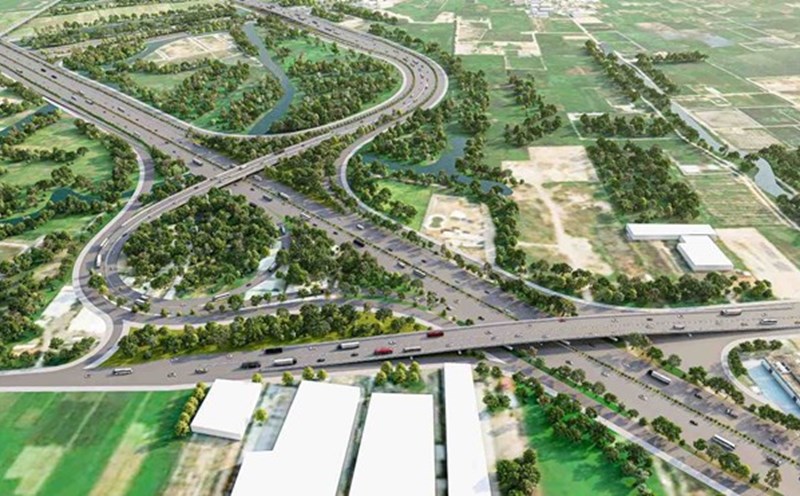
The Ho Chi Minh City Department of Construction has just submitted to the Ho Chi Minh City People's Committee a pre-feasibility study report for the East-West trunk road construction project (Vo Van Kiet extended road).
The Vo Van Kiet extended road project has its starting point at the National Highway 1 intersection (Tan Kien area, Tan Nhut commune) and its ending point at the border of Tay Ninh province (adjacent to Duc Hoa commune). The total length of the entire route is about 15.1 km.
In phase 1, the site clearance project according to the complete plan is 60 m wide but 6 lanes on both sides are built in advance; the land in the middle is reserved for later expansion.
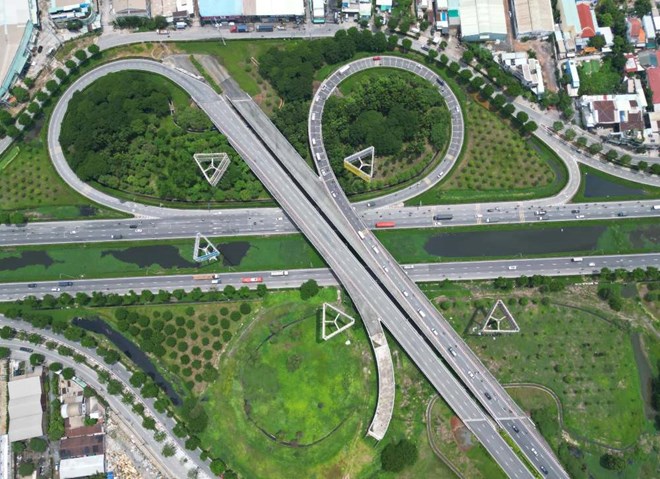
The route will have 6 intersections at different levels at important locations such as canal C, Vo Huu Loi (canal B), Ring Road 3, canal A, Xang An Ha canal and the end of the route (Xang Nho canal). Besides, there are 2 complete intersections at National Highway 1 and Vo Tran Chi.
On the entire route, it is expected to build 10 bridges (including bridges in intersections), along with 4 overpasses on roads along the canal.
In phase 2, the road will be upgraded to 10 lanes, including 6 main lanes and 4 parallel lanes on both sides. The project also adds intersections, increasing the total number to 8 intersections and building overpasses on Nguyen Cuu Phu street.
The project has a total land use area of about 148.5 ha, of which the compensation area is about 80.35 ha. It is expected that there will be about 710 affected cases, including households and organizations, of which 193 cases must be completely cleared.
Phase 1 of the Vo Van Kiet extended road project has a total capital of nearly 16,000 billion VND from the Ho Chi Minh City budget, divided into 3 component projects.
Two compensation and resettlement support projects in Tan Nhut and Binh Loi communes have a total capital of more than 6,700 billion VND; the construction of the main road accounts for about 9,200 billion VND.
According to the plan, the project will be implemented in the period 2026 - 2030. Specifically, the pre-feasibility study report is expected to be submitted for approval in April 2026, and the feasibility report will be completed in the fourth quarter of 2026. Compensation and site clearance work will be carried out from the second quarter of 2026 to the second quarter of 2027.
The project is expected to start construction in the third quarter of 2027 and be completed by the end of 2029.
According to the Department of Construction, this road is part of the East-West radial axis including Vo Nguyen Giap - Mai Chi Tho - Vo Van Kiet, with a total length of about 30.6 km. When completed, the route will directly connect with expressways such as HCMC - Trung Luong - My Thuan and ring roads, especially Ring Road 3 HCMC.
Investing in the route not only contributes to reducing congestion and traffic accidents in the western gateway area but also improves transport capacity, shortens travel time and reduces logistics costs.
Notably, the Duc Hoa - Hau Nghia area (Tay Ninh) currently concentrates many large industrial parks, the demand for connecting with Ho Chi Minh City to transport goods to seaports and airports is very high. However, existing connecting infrastructure such as Tran Dai Nghia and Tran Van Giau streets (Provincial Road 10) are often overloaded.
In that context, the extended East-West axis is considered an important solution to share traffic volume and complete the inter-regional connection network.
In particular, Tay Ninh is also investing in the Duc Hoa dynamic axis road, about 28.2 km long, with a scale of 10 lanes, deployed in the period 2026 - 2030. When the two projects are completed synchronously, the connectivity efficiency between Ho Chi Minh City and Tay Ninh will be significantly improved, creating motivation to promote socio-economic development for both localities.