
The Ho Chi Minh City - Moc Bai expressway has a total length of 51 km, of which the section passing through Ho Chi Minh City is about 24.7 km long, and the section passing through Tay Ninh province is about 26.3 km long. The starting point of the route connects to Ring Road 3 of Ho Chi Minh City in Phu Hoa Dong commune (Ho Chi Minh City), the ending point intersects with National Highway 22 in Ben Cau commune (Tay Ninh province).
The route is designed for cars running at a maximum speed of 120 km/h, with a scale of 4 lanes in phase 1 and will be expanded to 6 lanes according to the plan in the next phase.
According to the Ho Chi Minh City Traffic Construction Investment Project Management Board (Traffic Management Board - investor), the Ho Chi Minh City - Moc Bai expressway project has a total capital of nearly 20,000 billion VND, implemented according to 4 component projects.
Component project 1 is to invest in the construction of the expressway according to the BOT contract (build - operate - transfer), with a total investment of more than 10,400 billion VND. Of which, the investor mobilized about 9,943 billion VND (accounting for more than 95.4% of total capital), the remaining part of about 461 billion VND is participated by the Ho Chi Minh City budget.

This component project is organizing bidding to select investors from January to February 2026; appraisal and approval of results in February 2026; negotiation and signing of contracts in March 2026.
Construction is expected to start in April 2026 and be completed and put into operation in December 2027.
Component project 2 includes a system of people's service roads and overpasses across the expressway, using Ho Chi Minh City budget capital with a total investment of 2,422 billion VND.
According to the design, the project will build nearly 43.14 km of people's service roads on both sides of the expressway (the section through Ho Chi Minh City is about 19.66 km long, through Tay Ninh is about 23.48 km long), with a cross-section width of 5 m.
Along with that are 16 level overpasses (7 bridges in Ho Chi Minh City, 9 bridges in Tay Ninh) and 10 people's underpasses (7 underpasses in Ho Chi Minh City, 3 underpasses in Tay Ninh).

Previously, package XL02 of component project 2 was started on December 19, 2025. Packages XL01 and XL03 are being submitted for appraisal to soon deploy construction, striving to complete and put into operation in 2027.
Component project 3 is the work of compensation, support, and resettlement in Ho Chi Minh City, passing through 5 communes including Cu Chi, Thai My, Tan An Hoi, Nhuan Duc and Phu Hoa Dong. The affected land area is about 217.7 ha, with a total of 2,121 cases requiring land recovery.
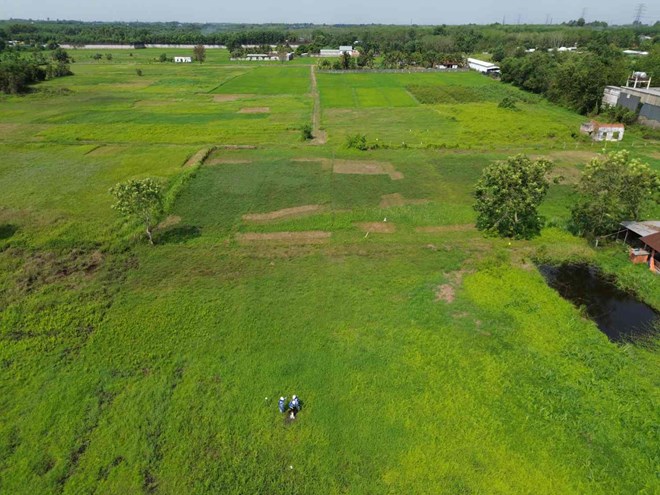
The total cost of compensation and support according to the approved plan is 5,439 billion VND (including temporary residence costs).
As of February 5, 2026, 1,594 cases (reaching 75.15%) have been paid, with an amount of 3,815 billion VND.
Component project 4 is implemented in Tay Ninh province, passing through 3 wards and 2 communes including An Tinh, Gia Loc, Go Dau, Phuoc Thanh and Ben Cau, with a total capital of more than 3,135 billion VND, recovering land for 2,260 households.
As of January 31, 2026, the locality has paid compensation of 2,859 billion VND (reaching 91.21%), equivalent to 2,115 households receiving money.
Previously, in November 2025, Ho Chi Minh City approved a policy to support Tay Ninh province with more than 1,800 billion VND to implement this component project.
When completed and put into operation at the end of 2027, the Ho Chi Minh City - Moc Bai expressway will reduce the load on National Highway 22, strengthen connectivity with the ring road system of Ho Chi Minh City, and form a high-speed and safe traffic axis between Ho Chi Minh City and Tay Ninh.
The project is not only meaningful in terms of transport infrastructure but also contributes to forming the Moc Bai - Ho Chi Minh City - Cai Mep Port - Thi Vai industrial - urban chain, associated with the Trans-Asia Economic Corridor, promoting socio-economic development throughout the Southeast region.


