
According to data from Ookla, as of the beginning of 2026, Vietnam's fixed broadband Internet has officially established a solid position in the top 10 leading countries globally. This is a lightning-fast step forward, because just a few years ago, our ranking was still above 30.
Behind this figure is not only the development of technology, but also a long-term, continuous investment process in infrastructure, and at the same time the strategic shift of the entire industry from the goal of "Internet access" to "high-quality experience".
From "Internet access" to "upgrading service standards
If previously, the goal of the telecommunications industry was to bring the Internet to every family, now the focus has shifted to a new stage: improving quality and personalizing user experience.
This shift is clearly shown in many aspects such as strong growth over the years, significantly improved stability, and also in the ability to meet increasingly better multi-device needs.
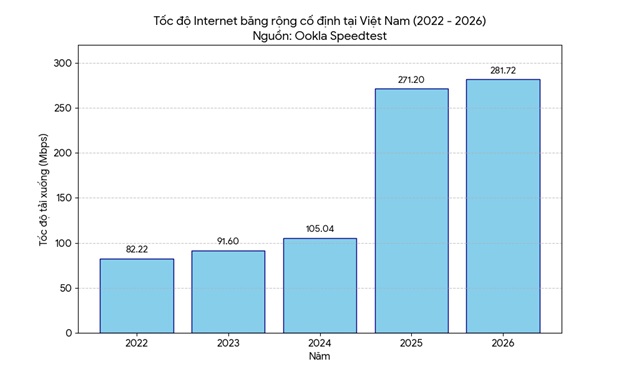
The Internet is no longer just an information access tool, but has become an essential infrastructure, or can be likened to "digital oxygen" – serving all activities from working, studying to operating a smart life.
Investments behind a stable connection
To reach the Top 10 in the world, Vietnam's Internet infrastructure must undergo extensive upgrades, even considered "breeding" in technology.
One of the most important changes is the expansion and upgrade of the submarine fiber optic cable system - the "backbone" of international connection. Network operators have proactively invested in new submarine fiber optic cable lines such as Asia Direct Cable with a capacity of hundreds of Tbps to reduce dependence on old lines, ensuring smooth international connection even in complex incident scenarios.
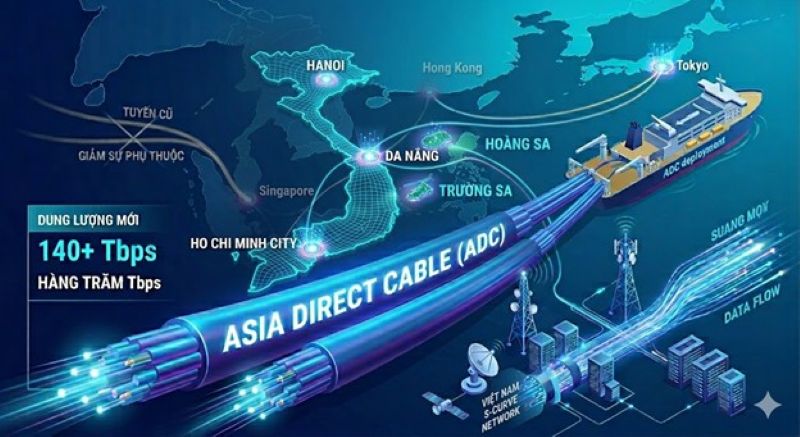
In the long term, with a strategy of owning at least 10–15 cable lines by 2030, Vietnam is gradually affirming its position as a digital hub of the region, reducing dependence on international transit points.
Parallel to this "backbone" is the investment in the "last mile" - the part that directly connects to each household. This cost is not only in the cable, but also in the deployment of modern Wi-Fi 6, Wi-Fi 7 modem devices to eliminate "dead points" in the house and ensure actual speed.
Especially, in the context of increasingly complex network security, a large part of resources is also invested in data protection systems, filtering malware right from the edge of the network, ensuring a connection environment that is not only fast but also "clean" and safe. This "last mile" is the decisive factor in the user's actual experience.
When each family becomes a "data center
The development of the Internet comes not only from infrastructure but also from changes in the way we use it. A household today not only has a phone, laptop but also a Smart Home system, security cameras, 4K/8K entertainment devices and real-time interactive AI applications. Each family has almost become a miniature "network button" in the digital ecosystem.
This poses a new challenge, low-speed packages that were previously suitable have gradually revealed limitations. When many devices operate simultaneously, especially during peak hours, upgrading bandwidth and terminals is no longer a choice, but a mandatory requirement to ensure the experience is not interrupted.
From "cheap price" to "real value
For many years, Vietnam has been known as one of the countries with the lowest Internet costs in the world. However, to maintain its position in the Top 10 global in the context of continuous increases in hardware, operating energy and high-tech personnel costs, telecommunications infrastructure needs a strong reinvestment cycle.
In fact, the Internet cost per Mbps in Vietnam is still significantly lower than the general level of countries in the region such as Thailand or Singapore.
In that context, the slight adjustment of tariff packages is seen as an inevitable step to balance costs and service value. This is not simply an additional cost, but a resource to reinvest in infrastructure, helping to maintain service quality, improve experience and continue to update the latest technologies.
Internet infrastructure – the foundation of national competitiveness
Today, the Internet is no longer a single utility service, but has become an essential infrastructure for the Digital Economy; Digital Society; Businesses and people's activities.
The explosion of AI and big data requires a connection system that is not only fast but also stable and has high load-bearing capacity for a long time.
Therefore, maintaining a strong, stable and constantly upgraded infrastructure is not only the story of the telecommunications industry, but also the foundation for the long-term development of the nation, the foundation for Vietnam not to miss the beat in the global competitiveness race.
Value behind a connection
From the Top 10 position in the world, it can be clearly seen that each Internet connection that users use today is the result of a large and continuous investment system behind. Therefore, the value of the Internet is not only in speed, but in the ability to ensure a stable, seamless connection and be ready for the digital future - where all experiences are seamless, safe and unlimited. Investing properly in the Internet today is the best preparation for a more quality digital life tomorrow.


