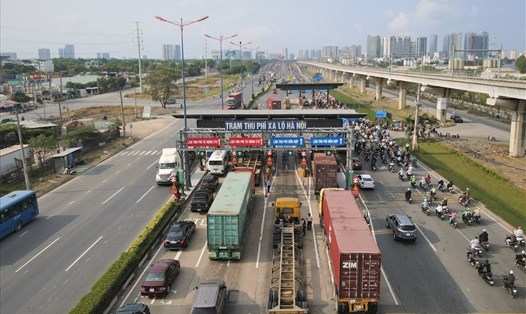
Hanoi Highway Investment and Construction Joint Stock Company (investor) has just submitted a report to the Ho Chi Minh City Department of Finance requesting appraisal of the feasibility study report adjusting the BOT project to expand Hanoi Highway and National Highway 1, the section from Tram 2 intersection to Tan Van intersection.
The project has a total length of 15.7 km, stretching from Saigon Bridge to Tan Van intersection, started in 2010 in the form of BOT (build - operate - transfer).
Initially, the project was approved by the Ho Chi Minh City People's Committee with a total investment of 2,516 billion VND. By 2016, the total investment was adjusted to more than 4,900 billion VND. According to the plan, the project would be completed after three years, but so far it has not been able to close the entire route due to problems in site clearance.
Currently, in Ho Chi Minh City, there were still 27 households that had not handed over land. Meanwhile, the section passing through Binh Duong province previously had about 136 cases that had not been cleared.
The inability to expand synchronously makes some locations on the route become "bottlenecks", often causing traffic jams and potential risks of accidents.
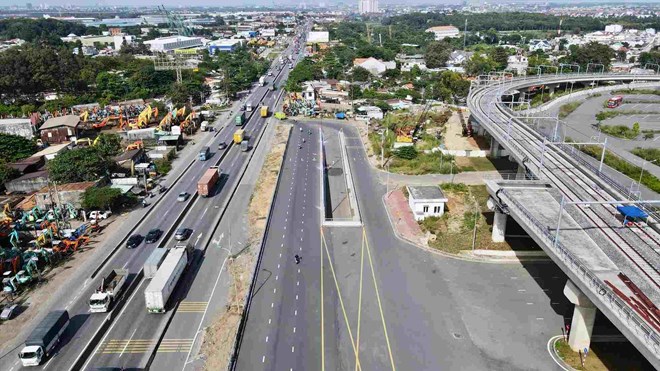
Hanoi Highway officially started toll collection from April 1, 2021. However, according to the investor, the current open toll collection method has revealed many inadequacies.
Vehicles traveling only a short distance still have to pay a fee equivalent to vehicles traveling the entire route. Conversely, some vehicles using the road but not passing through the toll station do not have to pay the toll.
According to investors, this not only causes injustice between user groups but also creates traffic pressure on nearby roads when many vehicles try to avoid toll stations, leading to local congestion. In fact, many questions and reflections from people living near the toll station area have also appeared recently.
To overcome the above inadequacies, the investor proposes switching to a closed toll collection method. Accordingly, the fee will be calculated based on the actual length of the vehicle used and the type of vehicle.
The toll collection system will apply non-stop toll collection (ETC) technology, automatically determining the travel distance of vehicles to calculate corresponding fees.
According to the proposed unit, this model will ensure greater fairness when people only pay fees for the actual infrastructure used. At the same time, toll collection data is recorded automatically, helping to increase transparency and convenience in information comparison.
Regarding the implementation plan, the project is expected to arrange 12 clusters of stations with a total of 60 toll collection points on the entire Vo Nguyen Giap - Hanoi Highway - National Highway 1 route. The system is built according to a closed toll collection model, centralized data, including toll collection systems at collection points, transmission systems and management and operation centers.
According to the adjusted report, the total investment of the project is proposed to be increased to more than 8,700 billion VND. The toll collection period is expected to end on October 31, 2046.