
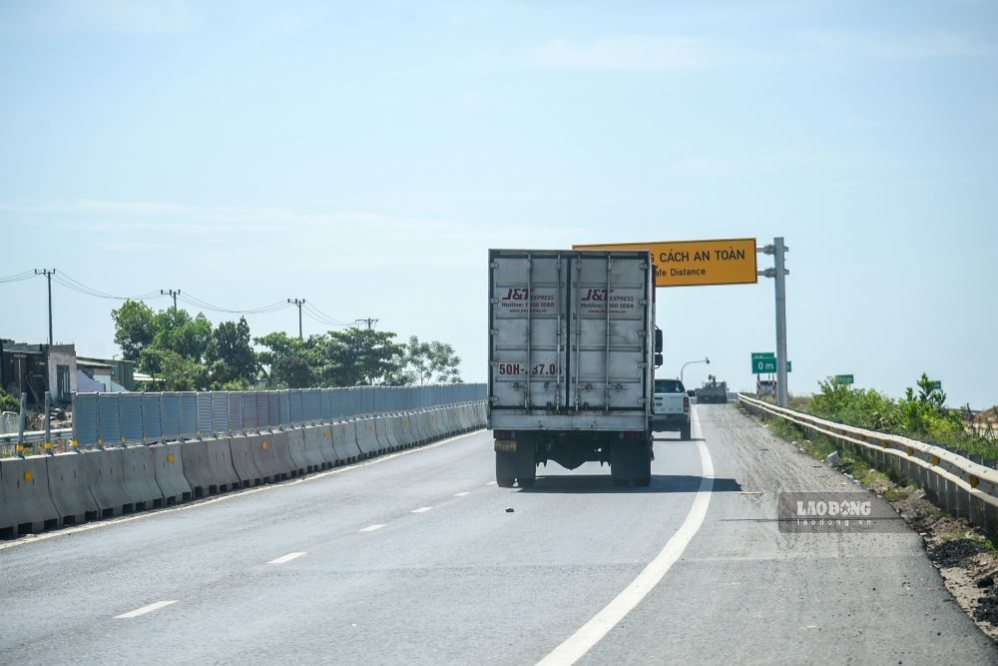
On the highway, drivers may encounter "Keep a safe distance" signs and lines arranged on the road surface. These are signs that help drivers have more basis to recognize and estimate the distance with the car in front.
Signs reminding of keeping distance, lines to help recognize distance
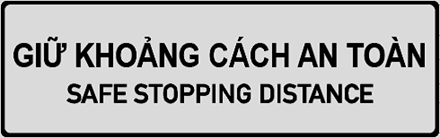
According to road sign standards, the IE. 471 sign is a sign indicating safe driving distance on the highway. The sign with the words "KEEP A SAFE DISTANCE" is arranged to remind vehicle drivers to maintain a suitable distance with the vehicle in front.
This is a visual reminder for drivers when traveling on the highway. However, license plates are not a tool for drivers to look at and accurately determine how many meters they are from the car in front.
Meanwhile, the standard for road signs also stipulates lines 7.8 - lines that determine vehicle distance on the road. This type of line is used to help drivers know when to extend the distance to the vehicle in front to ensure safety.
The line is in the form of pointed lines, white, running parallel to the center line. The line is often used on highways in places where accidents often occur due to overtaking or rear collisions, or locations with special requirements.
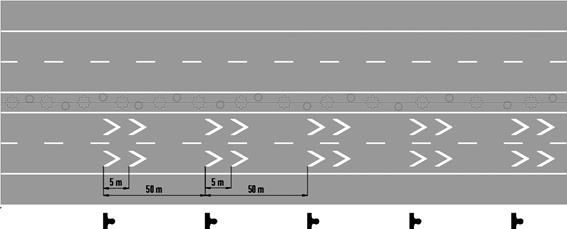
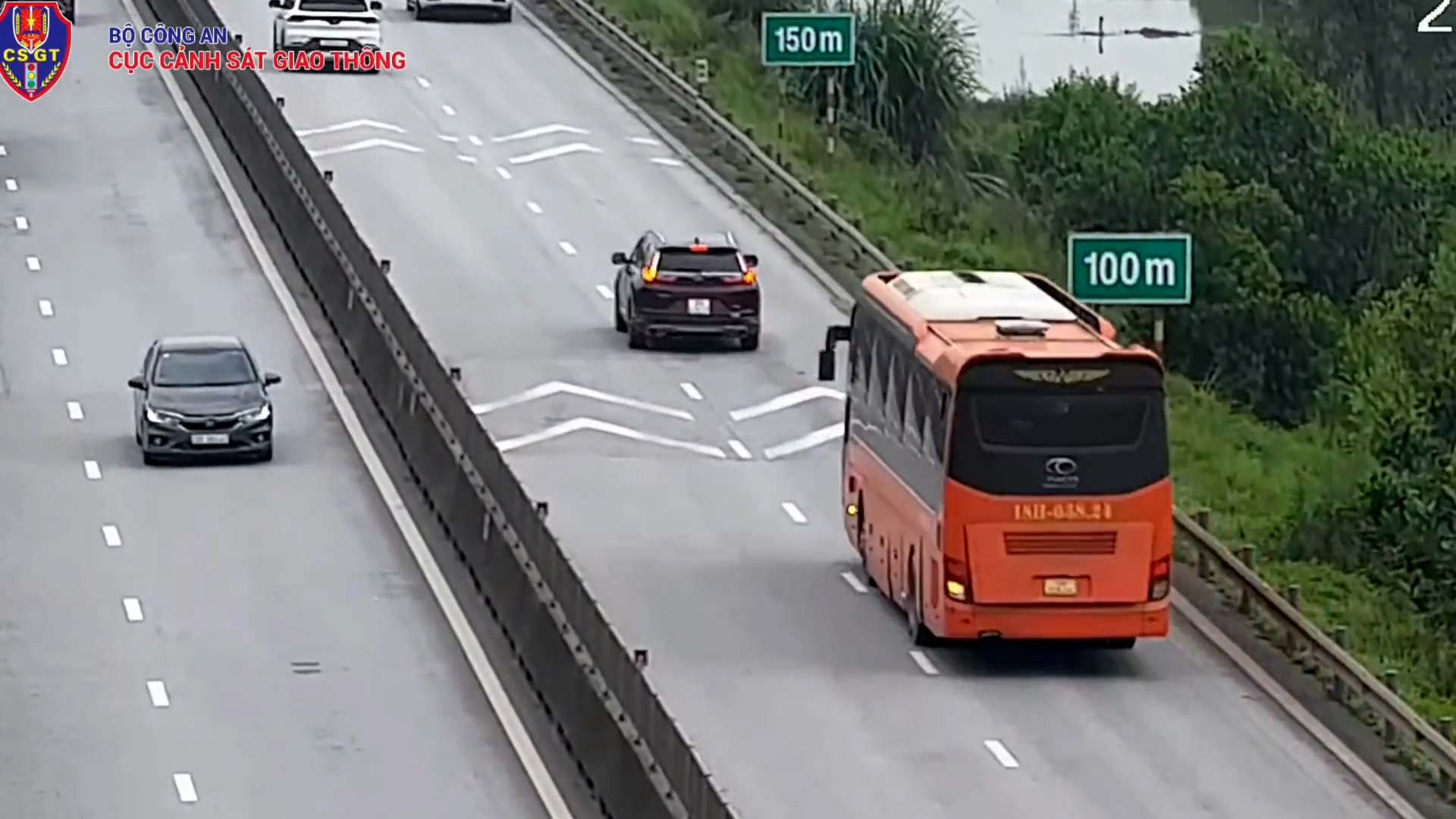
The lines are arranged in groups and use signs indicating the distance between the lines along the road. The groups of lines are 50m apart and are arranged over a length of 200m, thereby creating milestones for drivers to estimate the distance with the car in front.
For example, when your car is at 0m, and the car in front is at 50m, the driver can recognize the distance between the two cars is about 50m. If the car in front is at a further marker, the driver can also rely on these markers to estimate the distance.
Estimate the distance by speed, not just looking at the meter mark
Safety distance is not a fixed number applied in all situations.
According to current regulations, in conditions where the road surface is dry, without fog, the road surface is not slippery, the terrain is flat, the road is straight and visibility is guaranteed, the safe distance is determined corresponding to the vehicle speed.
When the car is traveling at a speed of 60km/h, the minimum safe distance is 35m. For speeds above 60km/h to 80km/h, the minimum distance is 55m; over 80km/h to 100km/h is 70m; over 100km/h to 120km/h is 100m.
In case the traffic volume increases or congestion occurs due to an incident in front, drivers driving at speeds below 60km/h do not have to maintain a fixed distance.
At that time, drivers must proactively maintain a safe distance suitable for the car running in front. This distance depends on the density of vehicles and the actual traffic situation to ensure traffic safety.
However, sharing with reporters of Lao Dong newspaper, some drivers said that determining a safe distance depends heavily on the driver's awareness, observation ability and judgment.
Where there is a sign, we look at the 100m, 150m, 200m markers to measure. And where there is no sign, we just estimate, but to measure absolutely accurately is difficult," Mr. Nguyen Van Hung (Hanoi) shared.
The Traffic Police Department (CSGT) - Ministry of Public Security previously also emphasized that keeping a safe distance is not a regulation to "make it difficult" for drivers, but to create a safety habit, helping to protect themselves, their families and the community.
In the coming time, the traffic police force will maximize the application of smart surveillance camera systems and professional technical equipment to focus on controlling, remote fines as well as direct handling of violations.
The Traffic Police Department recommends that vehicle drivers actively control their speed, observe distance signs and maintain the correct prescribed distance when participating in traffic on the expressway.


