
After the passenger car fire on National Highway 1 through Hung Thinh commune (Dong Nai city) that killed 7 people, escape skills on passenger cars continue to be of interest to many people.
Talking to Lao Dong Newspaper, Assoc. Prof. Dr. Do Van Dung - Chairman of the Ho Chi Minh City Automobile and Driving Equipment Association said that current passenger cars are equipped with many independent escape routes outside the main door. However, many passengers do not pay attention or do not know how to use them in an emergency situation.
Many alternative exits when the main door cannot be opened
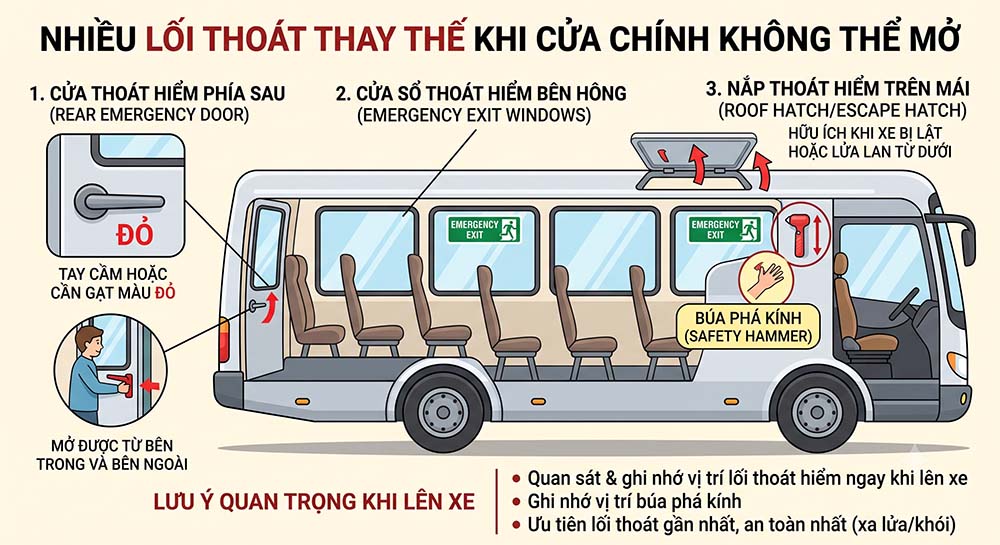
According to Assoc. Prof. Dr. Do Van Dung, for passenger cars with 16 seats or more, arranging independent escape routes is a mandatory requirement. The distance from the passenger's seat to the escape route is usually no more than 5-6 m to be able to access quickly in an emergency situation.
He said that when the main door cannot be opened, the rear emergency exit is the next option to be prioritized.
The rear emergency door is usually located at the rear of the car, with a prominent red handle or lever. It can be opened from both the inside and the outside with simple operations (pulling or pushing). This is the second priority choice after the main door".
In addition, many side windows are also designed for passengers to use when they need to get out of the car.
He shared: "Many side windows are designed as emergency exits (with'Emergency Exit' signs or running symbols). Glass is usually tempered glass. Nearby there is always a safety hammer fixed.
In case the car overturns or the fire flares from under the car, the emergency exit on the roof will be a very effective option.
He said: "Roof hatches usually have 1-2 on the ceiling of the car. This is a very useful escape route when the car overturns or the fire spreads from under the floor. Passengers only need to turn the lever or push it up to open.
Assoc. Prof. Dr. Do Van Dung recommends that as soon as passengers get on the bus, they should spend a few seconds observing the position of the rear door, emergency window, window breaker and emergency exit door on the roof to avoid losing direction when an incident occurs.
He emphasized: "As soon as you get in the car, quickly observe and remember the location of these escape routes along with the window breaker. Prioritize the nearest, safest route (far from the source of fire and smoke)".
Cars without power can still open doors with emergency mechanism
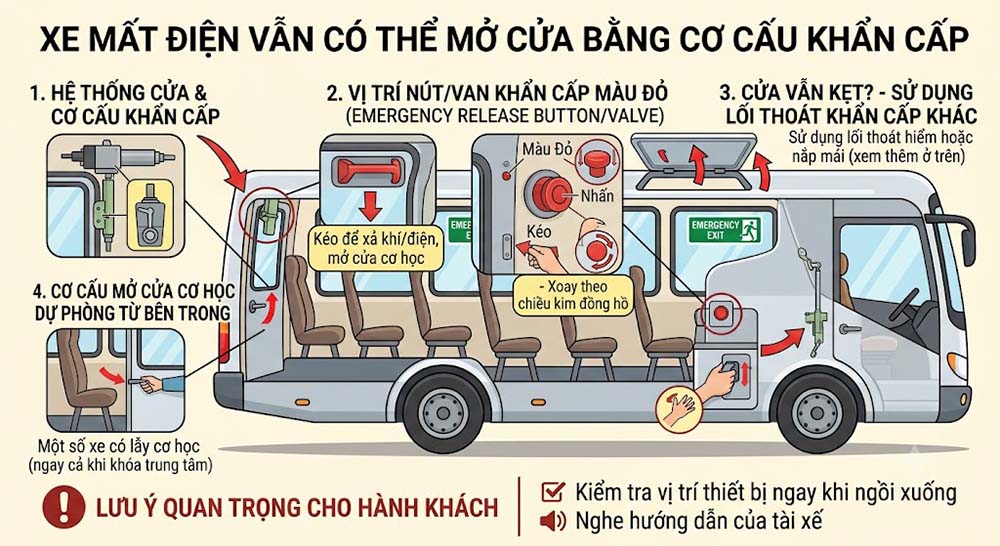
Many passenger cars currently use electric or pneumatic door opening and closing systems. However, when a power outage occurs, passengers can still open the door with a spare mechanism equipped by the manufacturer.
He said: "Many modern passenger cars use pneumatic or electric doors. When there is a power outage or the system is broken, find an emergency release button/valve that is usually located above or near the door. Press, pull or rotate the valve in the clock direction to mechanically open the door or release the air to push the door out.
In case the door still cannot be opened, passengers should not spend too much time trying to handle it but need to quickly switch to other escape routes.
He noted: "If the door is still jammed: Use emergency windows or roof lids as above. Some cars have spare mechanical door opening pads from inside even if the door is centrally locked.
Observing the location of emergency devices in advance will help passengers be more proactive if the car encounters problems. At the same time, drivers also need to quickly disseminate the location of escape routes before departure or when detecting unusual signs.
He emphasized: "Passengers should develop the habit of checking the location of these devices as soon as they sit down. Drivers are also responsible for providing quick guidance when there are signs of abnormality.
Breaking glass properly to escape
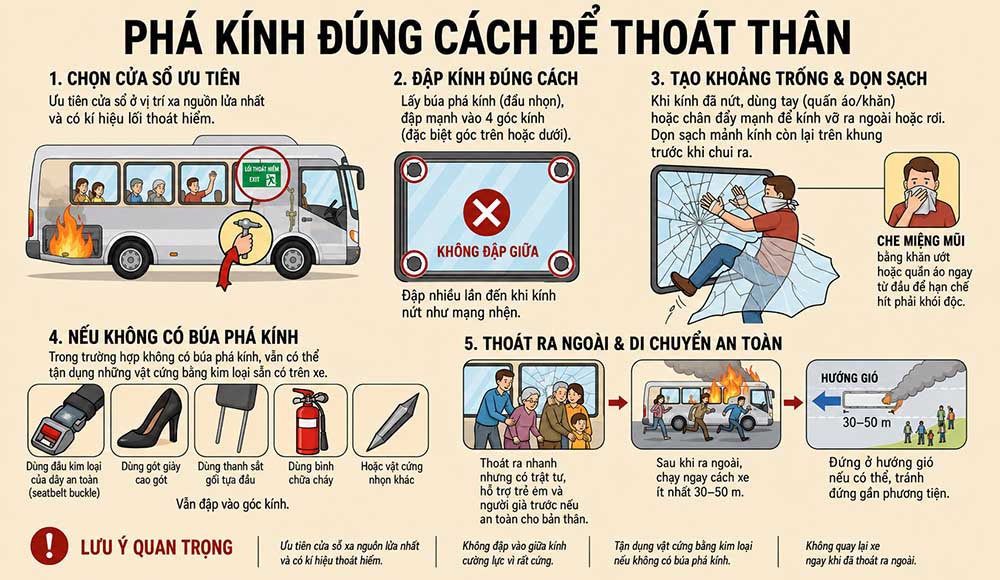
If you are forced to break the glass to escape, Assoc. Prof. Dr. Do Van Dung recommends prioritizing windows in the furthest from the source of fire and with escape route symbols.
He instructed: "Take a hammer to break the glass (sharp tip), hit hard at 4 corners of the glass (especially the top or bottom corner), do not hit in the middle because the center of the tempered glass is very hard. Hit many times until the glass cracks like a spider web".
When the glass is cracked, passengers need to quickly create space to crawl out, and limit direct contact with the remaining glass pieces.
Use your hands (you can wrap a shirt or towel) or feet to push hard to break the glass or drop it. Clean the remaining glass pieces on the frame before going out. Cover your nose and mouth with a wet towel or clothes from the beginning to limit inhaling toxic smoke.
In case there is no broken glass hammer, hard metal objects available on the car can still be used to break the glass.
He said: "If you don't have a hammer: Use the metal end of the seatbelt, high heels, headrests, fire extinguishers or other sharp objects. Still hit the corner of the glass.
After getting out of the car, it is important to quickly move to a safe area, avoid standing near the vehicle.
He recommends: "Escape quickly but orderly, support children and the elderly first if safe for yourself. After going out, run immediately at least 30-50m away from the car, standing in the wind direction if possible.
Mistakes that increase the risk of death
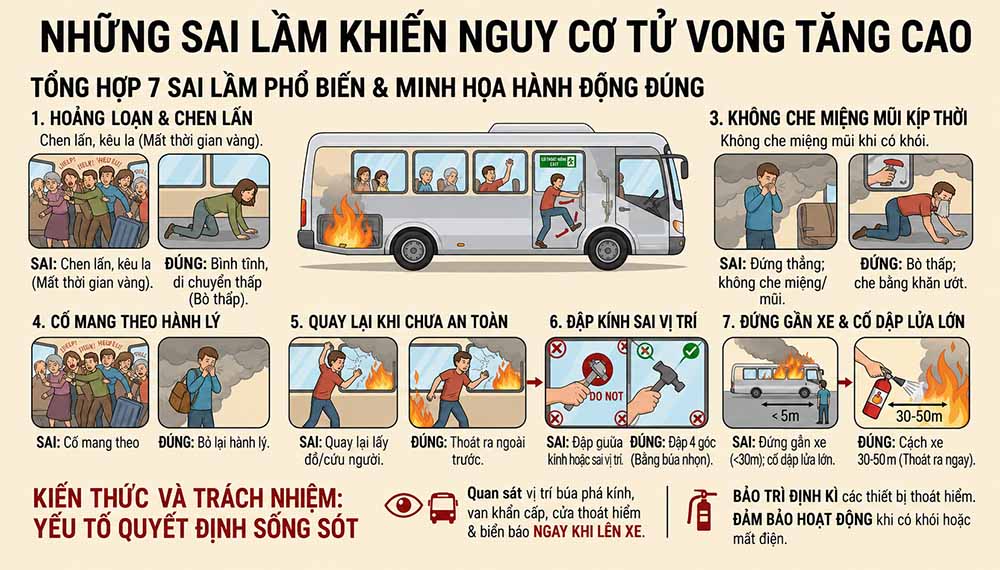
According to Assoc. Prof. Dr. Do Van Dung, through many passenger car fires, victims often make the same mistakes in the process of finding a way to escape.
He warned: "Panic, jostling, shouting leads to door jams, wasting golden time. Try to open the main door that is stuck for too long instead of moving to the back door, window or roof lid".
In addition, experts believe that many people also have the habit of trying to carry luggage, not covering their mouths and noses when there is smoke, standing upright in a smoky environment, returning to get things or rescue people when they have not escaped the dangerous area, smashing the glass in the wrong position or standing close to the car after escaping. These are all actions that reduce the chance of survival in fires.
He emphasized: "Knowledge and habit of observing right when getting on the bus are decisive factors for survival. Passenger car companies need to periodically maintain breakers, emergency valves, emergency exits and signs, especially ensuring operation in conditions of smoke or power outages.


