
Gastrointestinal cancer is a common cancer with a high mortality rate. According to Globocan 2022, in Vietnam, colorectal cancer ranks in the top 4, stomach cancer ranks in the top 5 of the most common cancers (data for both sexes). According to experts, the diagnosis and treatment of gastrointestinal cancer in the early stages increases the survival rate over 5 years to 90%.
At a workshop on the application of advanced techniques in digestive endoscopy organized by Thu Cuc health system on the afternoon of March 22, experts emphasized that digestive endoscopy is entering a stage of strong transformation thanks to artificial intelligence (AI) and high-resolution imaging technologies, opening up the possibility of detecting cancer very early – even at the level of microorganism damage.
Reduce the risk of missing injuries thanks to AI applications
According to Meritorious Doctor, Assoc. Prof. Dr. Vu Van Khien - Vice President cum General Secretary of the Vietnam Association of Gastrointestinal Sciences, one of the biggest concerns of digestive endoscopy is missing lesions, especially cancer. In fact, digestive tract cancer can be "ignored" if not detected within 3 years after the previous endoscopy.
The rate of omission is not small: upper gastrointestinal cancer ranges from 6–11.3%, while colorectal polyps can be omissioned up to 20–47%. The main causes come from small lesions, hidden locations, poor preparation quality and doctor experience" - Assoc. Prof. Khien said.
Notably, the rate of polyp detection (ADR) is directly related to the risk of cancer: every 1% increase in ADR will help reduce the risk of colorectal cancer by 3%. This poses an urgent requirement to improve the quality of endoscopy.
According to Assoc. Prof. Khien, the emergence of AI is creating a turning point in gastrointestinal endoscopy. According to reports, AI plays 3 main roles: finding lesions (CADe), supporting diagnosis (CADx) and quality control (CAQ).
In which, the CADe system has the ability to detect polyps and early lesions, helping to increase the ADR rate by about 10%, thereby reducing the risk of colorectal cancer. AI also shows higher sensitivity than doctors in early detection of esophageal cancer, and also supports more accurate assessment of invasive levels.
In stomach cancer, AI can reach a sensitivity of over 90% in detecting lesions through endoscopic image analysis. Not only detecting, AI also helps classify lesions, orient biopsies, and contribute to personalizing treatment.
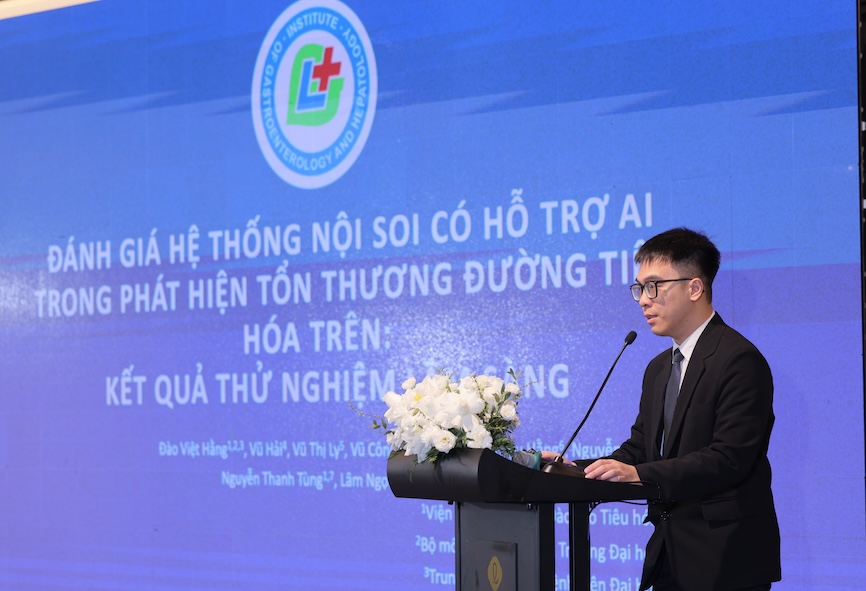
AI correctly identifies anatomical markers with an average accuracy of 95.32%
According to Dr. Nguyen Phuc Binh - Institute for Research & Training in Gastroenterology, Liver and Gallbladder, the AI-assisted endoscopic system has been clinically tested in Vietnam with a randomized design with control.
The results show that AI correctly recognizes anatomical markers with an average accuracy of 95.32%. In particular, the system achieves 100% accuracy in detecting esophageal cancer and stomach cancer in the research sample.
AI is also capable of detecting very small lesions under 1 cm - something traditional endoscopy easily overlooks. However, the study has not recorded a clear difference in the rate of lesion detection between groups with and without AI" - Dr. Nguyen Phuc Binh said.
According to doctors, a notable limitation is false positive status, commonly seen in areas with foam, blood, mucous membrane plies or bright images, which can cause interference during endoscopy.
Experts believe that for AI to truly be effective in gastrointestinal endoscopy in Vietnam, it is necessary to solve many challenges such as the lack of standardized databases, limitations in technology infrastructure and specialized human resources.
In addition, legal, ethical and guidance issues on the use of AI in healthcare also need to be improved to ensure safety and effectiveness in clinical practice.
At the conference, Thu Cuc TCI Health System announced Endocyto 520x ultra-amplified endoscopy technology - considered a new standard in early diagnosis of digestive cancer.


