
On March 21, the Vietnam Urban Planning and Development Association organized the scientific conference "New generation megacities: Momentum for economic growth and sustainable urban development in Vietnam in the new era".
At the workshop, Ms. Tran Thu Hang - Director of the Department of Planning and Architecture (Ministry of Construction) said that in recent years, urbanization in Vietnam has taken place at a fast, strong pace and with outstanding progress.
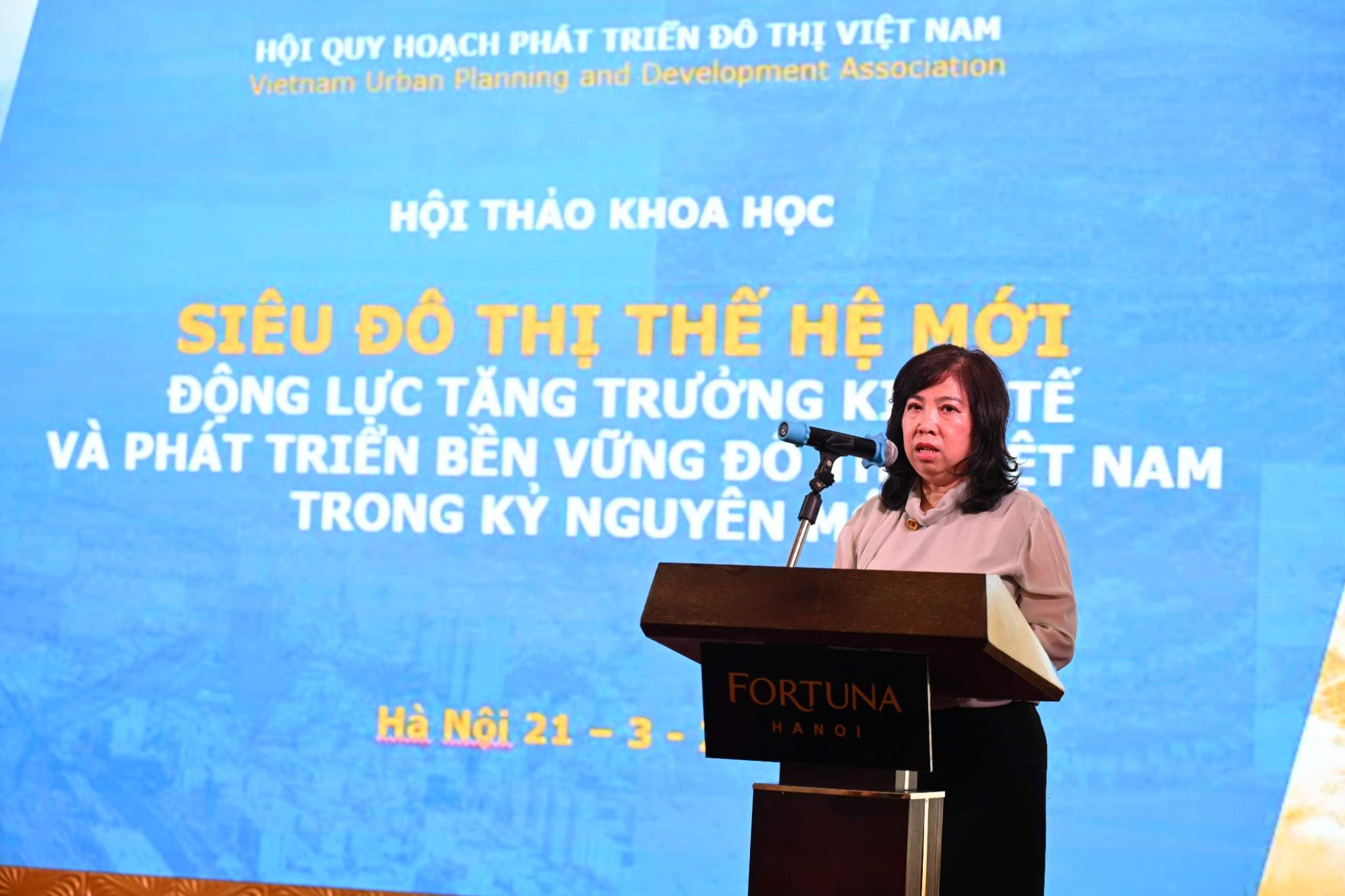
Vietnam's urban system is increasingly expanding, diverse in scale, form and function. Cities have become an important driving force in socio-economic development and a gathering place for knowledge, creativity, technology and innovation.
However, along with those achievements, Vietnamese cities are facing major challenges such as infrastructure pressure, environmental pollution, traffic congestion, regional disparities, climate change and new requirements for digital transformation.
World practice also shows that the traditional megacity model based on increasing scale and physical space is revealing many limitations and especially the issue of infrastructure overload, environmental quality degradation and increased social costs.
Resolution 306 of the Government also clearly defines the space organization according to network structure, forming dynamic zones and economic corridors, and urban systems with high connectivity.
The national master plan does not aim to form a number of extremely large concentrated cities but aims to build a reasonable urban system, with complementary functions and close links, maximizing the advantages of each region.
Vietnam is entering a new stage of development, requiring high and sustainable growth, the formation of new generation megacities is not just a trend but a strategic choice to create growth poles, promote innovation and enhance the position of Vietnamese cities as well as Vietnam in the regional and global economic network" - Ms. Hang emphasized.
Also at the workshop, Assoc. Prof. Dr. Luu Duc Hai - Vice President of the Vietnam Urban Planning and Development Association said that the mechanical population explosion in core cities such as Hanoi and Ho Chi Minh City has created great pressure on the transport infrastructure system.
Prolonged congestion, environmental pollution and breakdowns in spatial connection are becoming direct barriers hindering socio-economic growth momentum.
Faced with these challenges, many countries and international organizations such as UN-Habitat, OECD (Organization for Economic Cooperation and Development) and the World Bank... have shifted their research and development direction to the new generation megacity model, emphasizing multi-center structure, regional network linkage, smart governance and sustainable development.
The new generation megacity is a place where the modern standard of living is comprehensively redefined. This is not simply an expansion in terms of physicality or population size, but an inevitable shift towards synchronous planning, integrating green space, smart infrastructure and multi-layered utility ecosystems.
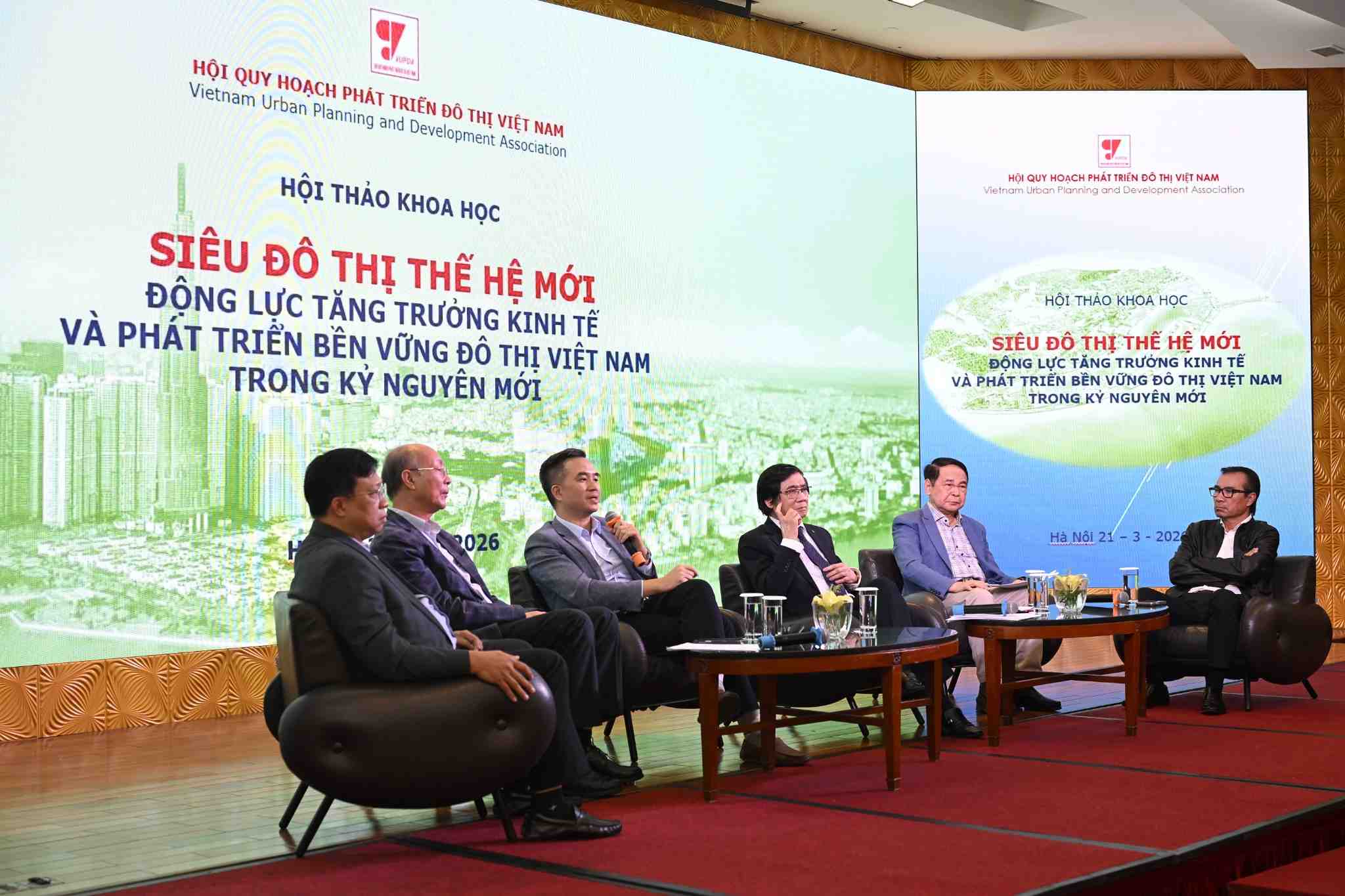
Sharing about the new generation mega-urban model, Dr. Architect Truong Van Quang - Deputy Secretary General of the Vietnam Urban Planning and Development Association (VUPDA) also said that he proposed a development model framework with the following viewpoints: shifting from population scale expansion to improving urban capacity; developing the national urban network; developing a multi-center structure; promoting digital transformation; economic development based on innovation; developing connecting infrastructure; urban governance innovation.
This model is based on 5 pillars: global economic function; infrastructure and network connectivity; innovation ecosystem; sustainable development; and smart urban governance.
This is a model suitable for the current context of Vietnam, when population size needs to be optimally selected, infrastructure is developing, territorial structure is extensive and a multi-center model is needed.
According to Mr. Quang, if developed in this direction, Vietnam will achieve values: economy, connectivity, quality of life, culture, environment and governance...


