
According to the Department of Construction, the prices of construction materials in the published list are determined based on a survey of the price level in Hanoi city in the second quarter of 2026, including taxes and fees according to regulations (excluding VAT).
Specifically for discreet materials (construction sand, construction stone), the survey price at mines, gathering points, transshipment points, and trading of construction materials according to inter-sectoral surveys is included, excluding VAT.
Notably, the group of sand materials continues to record clear differentiation between regions. In the second quarter of 2026, the price of yellow sand fluctuated commonly from about 550,000 - 850,000 VND/m3 (excluding VAT), while black sand was at a level of about 220,000 - 250,000 VND/m3. Compared to the first quarter of 2026, the general level of yellow sand prices tended to increase slightly at some supply points.
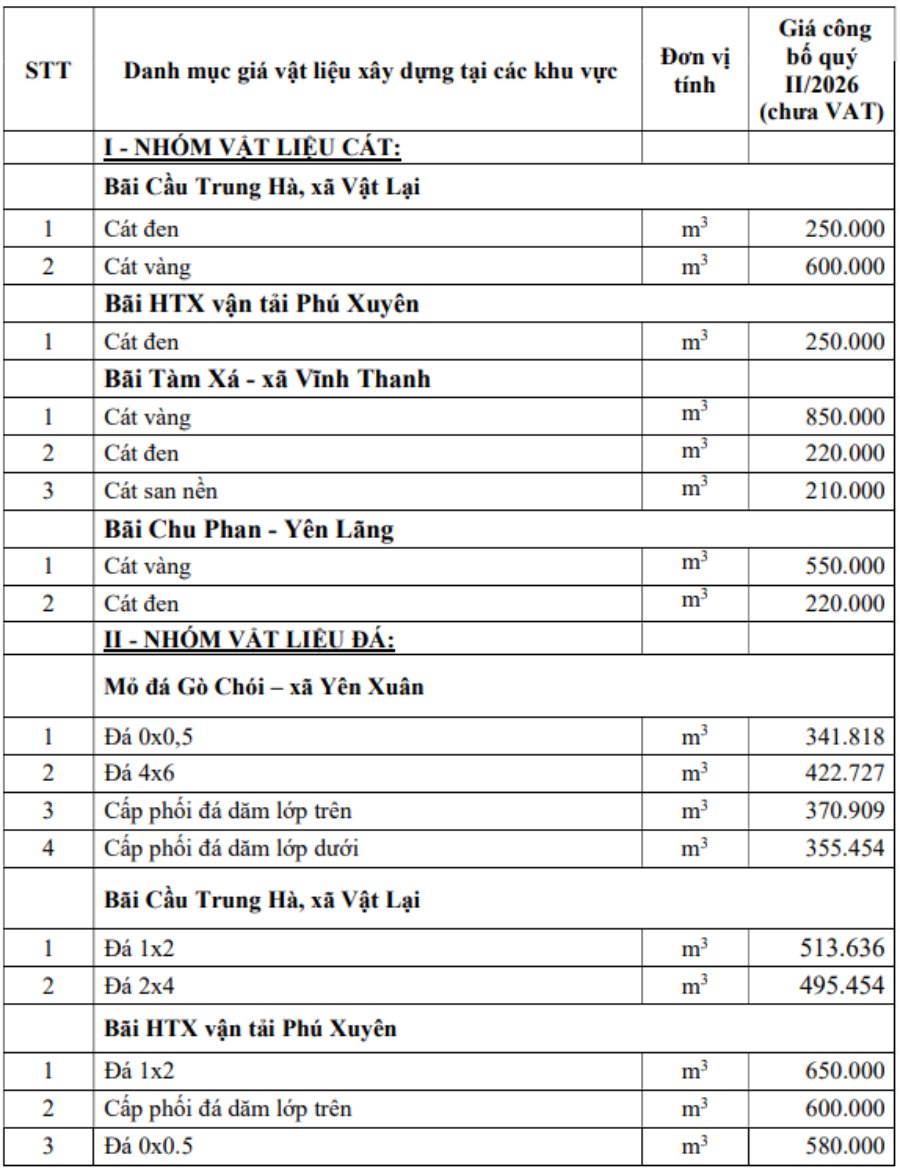

Similarly, the group of construction stone materials also recorded a slight increase compared to the previous quarter. Prices of all types of stone in the second quarter of 2026 fluctuated from about 341,818 - 750,000 VND/m3, depending on type and location.
Some common types of construction stone such as 1x2 stone, 2x4 stone have common prices from 495,454 - 750,000 VND/m3 in many areas.
In the cement material group, the price of all types of cement commonly ranges from about 1.1 to 1.87 million VND/ton (excluding VAT), depending on brand and type. Compared to Q1/2026 (ranging from 1.0 - 1.7 million VND/ton), cement prices in Q2 recorded a slight upward trend.
Hanoi Department of Construction notes that the list of construction material prices is only for reference for investors and consulting units to prepare and manage costs.
Investors and consulting organizations when using information on material prices to prepare and manage construction investment costs need to base on the location of the project, the location of supply of materials, distance, transport distance, volume of materials used, investment objectives, nature of the project, design requirements and regulations on construction quality management to consider and select types of materials suitable for design requirements and determine prices suitable for market prices, ensuring efficiency, meeting investment objectives, avoiding loss and waste.


