
Ring Road 3 West is messy before "G-hour
The Ho Chi Minh City Ring Road 3 project, the western section, passes through the areas of Cu Chi, Hoc Mon, Binh Chanh (old) with a length of about 32.6km. According to the initial plan, the route must be technically opened to traffic no later than December 31, 2025 and aims to put the entire route into operation on April 30, 2026. However, due to the implementation progress of the investor and contractors not meeting commitments, the completion milestone has been adjusted, with a new requirement to put the entire route into operation before June 30, 2026.
Although the deadline is only about 3 months, actual records show that many sections of the route are still messy. In the area near the Tran Dai Nghia - Thich Thien Hoa intersection, the main roadbed is often flooded, waiting to continue sand filling for loading. By the beginning of April, many sections had not completed loading sand filling - a key stage, lasting 6-9 months. After that, the next items will be constructed, taking another 1-2 months.
The biggest difficulty currently is the source of materials. A representative of a contractor in package XL8, XL10 said that the demand for stone alone is up to 88,000m3, but only about 26,000m3 has been supplied. Access to stone sources depends on many procedures such as proposals from localities, introduction letters from investors and allocation of "slots" for exploitation, making it impossible for contractors to be proactive, even though they have mobilized barges waiting.
According to the Ho Chi Minh City Traffic Construction Investment Project Management Board, the total demand for stone for 5 Western bidding packages in 2026 is up to about 1.2 million cubic meters. However, the supply from the current mines is still limited and does not meet the requirements of accelerating construction.
Tham Luong - Ben Cat - Nuoc Len canal project is also "exhausted
The lack of materials is directly affecting the project to renovate the Tham Luong - Ben Cat - Nuoc Len canal, with a total capital of more than 9,000 billion VND, started in February 2023.
To date, the construction volume has reached about 67%, but all 10 bidding packages are behind schedule compared to the contract. The project has just technically opened about 18km of asphalt roads out of a total of 64km of canal-side roads.
Real-world records show that many road sections have been paved with gravel but have not been paved with asphalt concrete; many sections, although the foundation has been paved, are still dirt roads.
The Ho Chi Minh City Urban Infrastructure Construction Investment Project Management Board (the investor) said that the goal of completing the entire project by the end of 2026 is being threatened. The reason is that sand and stone materials are still scarce and prices are increasing, affecting the construction plans of contractors.
Due to conflicts in some regions of the world causing oil prices to rise, leading to the supply of asphalt - the main raw material for asphalt concrete production - becoming scarce, directly affecting the construction progress. In fact, the project currently needs about 180,850 tons of asphalt concrete, but so far it has only met about 30% of the demand.
In addition to material factors, some contractors also revealed limitations when they have not proactively organized construction, lack coordination in joint ventures, and have not fully prepared human resources, equipment and supply of materials in the context of scarcity.
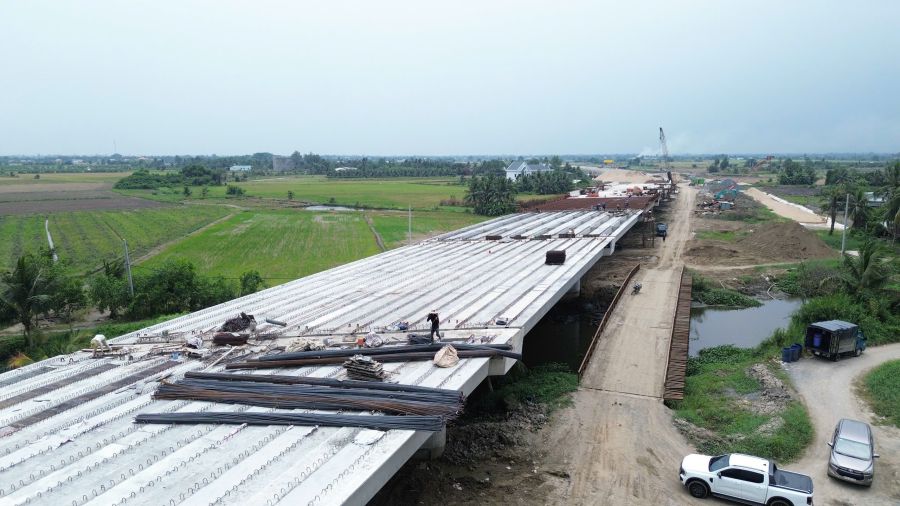
Ho Chi Minh City establishes working group to remove missing materials
Faced with the above situation, the Ho Chi Minh City People's Committee has established a working group to coordinate construction materials for key projects, headed by Vice Chairman of the Ho Chi Minh City People's Committee Bui Xuan Cuong. The working group is tasked with reviewing and coordinating material sources, and at the same time removing obstacles in the supply process for public investment projects.
Mr. Dau An Phuc - Director of the Ho Chi Minh City Urban Infrastructure Department - said that the unit has proposed to the Ho Chi Minh City People's Committee to support removing the material shortage situation, including considering appointing stone mines to ensure supply, and creating conditions for importing sand from Cambodia to serve construction.
In parallel with that, the Board strengthens urging and tightening management of contractors, especially slow and weak construction units. Many solutions have been implemented such as regular construction site inspections, detailed minutes at each location behind schedule, close monitoring of the ability to mobilize human resources, machinery and materials.
Contractors who violate the progress are continuously reminded, warned and summoned for direct meetings. If there is no change, they will be penalized according to the contract, and even have their volume transferred to another unit with better capacity in the same consortium.


