
High interest rates most clearly affect investors using leverage
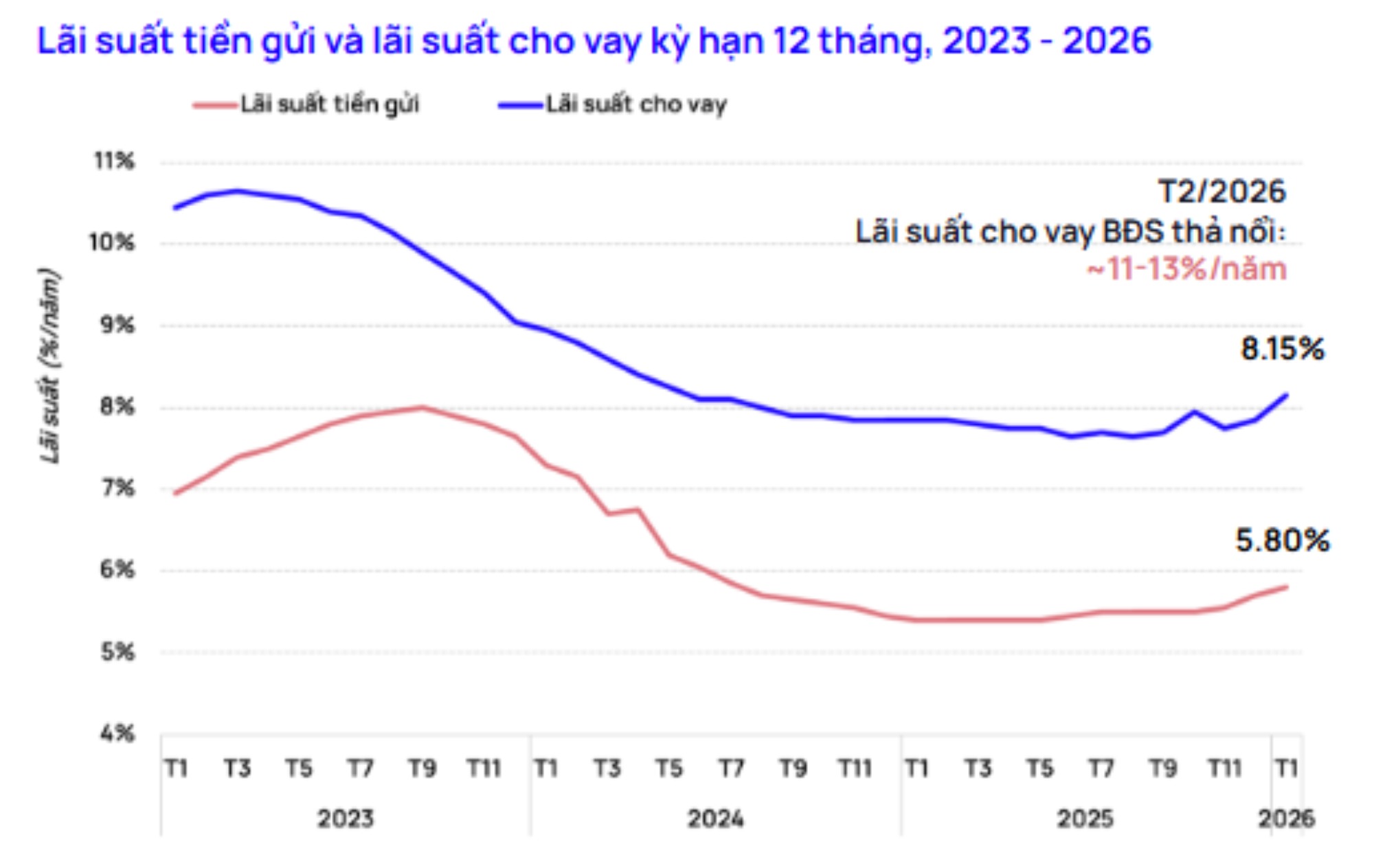
Sharing about the fact that home loan interest rates at many banks tend to increase recently, Mr. Tran Quang Trung - Business Development Director of OneHousing - said that this is a familiar cyclical development of the financial market.
According to him, at the end of the year and the beginning of the new year, credit institutions tend to promote capital mobilization to prepare resources for the growth cycle of the economy in the following year.
However, this year's context has some special factors. A series of large-scale infrastructure projects are being implemented, from transportation projects to projects serving national development strategies. Many businesses are assigned to implement projects with total investments of tens of thousands, even hundreds of thousands of billions of VND.
This creates a very large demand for capital mobilization from the commercial banking system. When the amount of capital to be mobilized increases sharply in a short time, pressure on the general level of interest rates is inevitable.
In the first quarter and possibly extending to the second quarter of 2026, the general level of interest rates will still be high. However, this is only a short-term pressure" - Mr. Trung assessed.
According to him, the Government is implementing many solutions to expand capital sources for the economy, from promoting the mobilization of resources from the people, putting gold into circulation, to building an international financial center in Ho Chi Minh City to attract foreign capital flows. These solutions are expected to help balance capital sources in the financial system.
However, the increased interest rate level still creates certain pressure on a part of real estate investors, especially the group using high financial leverage.
According to Mr. Trung, investors without reserve capital will face greater pressure when floating interest rates increase. In the context of slowing market liquidity, some short-term investors are forced to adjust their strategies, even accepting to sell assets with lower profits than expected.
Interest rate forecast may cool down from mid-year
From a long-term perspective, Mr. Trung believes that the current interest rate is still not too high compared to the history of the Vietnamese real estate market.
In the period from 2008 to now, the Vietnamese real estate market has developed many times in the context of interest rates of 13%, 14%, and even sometimes up to 18%. Only in the period 2023-2024 has such a low interest rate level appeared" - Mr. Trung analyzed.
According to him, the floating interest rate around the 10% threshold is still considered acceptable for the market. The interest rate threshold above 12% is just beginning to create stronger pressure on real estate investment activities.
Many projects currently also receive interest rate support in the early years, helping buyers reduce financial pressure in the early stages of the loan.
Although the high interest rate level may have a certain impact on the psychology of buyers and the overall liquidity of the market, Mr. Tran Quang Trung said that housing demand is essentially still a long-term need. Waiting for a "perfect time" of the market is not always the optimal strategy for homebuyers.

Mr. Trung believes that, besides housing needs, Vietnamese people also have a need to accumulate assets and transfer them to the next generation. In the context of strong urbanization, real estate is still an asset with sustainable value over time. Especially, during the market adjustment period, real homebuyers may have more opportunities to access good products at reasonable prices compared to the market hot growth period.
Regarding the upcoming prospects, Mr. Trung said that if there are no major external fluctuations, the general level of interest rates may begin to stabilize more from mid-2026.
When it passes around June 2026, factors related to capital sources and macroeconomic regulation may create more stability for the general level of interest rates. At that time, capital costs will become more comfortable than they are now" - Mr. Trung predicted.
In the long term, along with the process of urban restructuring, infrastructure development and increasing people's income, real estate will still play an important role in the asset portfolio of investors as well as homebuyers.


