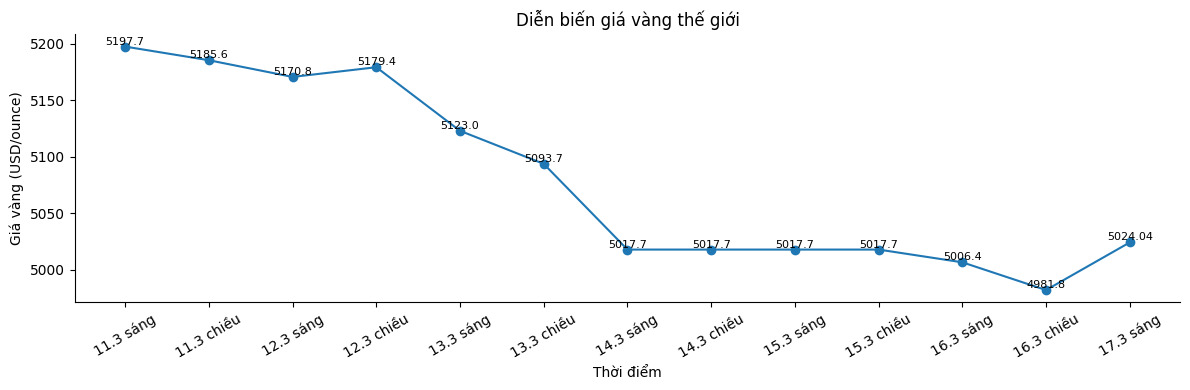
Gold prices fluctuated in a narrow range around the 5,000 USD per ounce mark as the Middle East conflict entered its third week, amid investors considering the inflationary impact of rising oil prices.
The precious metal once fell by 1% in the trading session on Monday after two consecutive weeks of decline. Crude oil prices remained at a high level due to the war between the US and Israel with Iran that put pressure on gold, as rising energy costs raised concerns about inflation and made the prospect of the US Federal Reserve (Fed) cutting interest rates distant. Brent oil fluctuated sharply and remained around $100 per barrel.
The inability to predict how long the conflict will last makes it difficult for traders to assess the impact on the financial market and the global economy. A senior aide to US President Donald Trump said the war could last four to six weeks, while signals from both sides are still mixed.
Last weekend, Iran launched more attacks across the Persian Gulf, disrupting transportation at an important oil hub in the United Arab Emirates. Tehran also rejected President Donald Trump's statement that it is seeking ceasefire negotiations. Transportation is still almost stalled in the Strait of Hormuz, a strategic route through which about one-fifth of global oil and liquefied natural gas is usually transported.
As the conflict drags on, the prospect of interest rate cuts is decreasing. Traders are now almost no longer betting on the possibility of the Fed cutting interest rates in this week's meeting. Higher borrowing costs are often detrimental to gold because the precious metal does not yield yields.
The war also pushed the USD up and weakened the attractiveness of gold. Despite a slight decline in Monday's session, the greenback still increased by about 2% since the US and Israel launched attacks on Iran.
Mr. Daniel Ghali - Senior Commodity Strategist at Toronto Dominion Bank believes that in this conflict, the USD is becoming the leading safe haven asset. This is detrimental to gold, because for most of the past year, the precious metal has played a role as the main refuge for investors.
Although the recent upward momentum has stalled, gold has still increased by more than 15% since the beginning of the year. Concerns about the risk of stagnation, i.e. a combination of slow growth and high inflation, may continue to encourage investors to turn to gold as a long-term value storage channel.
In a report released on Monday, UBS Global Wealth Management said that gold often plays a defensive role against the broad economic consequences of conflict rather than direct war risks. According to UBS experts, although rising energy prices and inflationary pressures may create short-term pressure, gold still mainly protects investors from monetary risks such as currency devaluation, increased budget deficits and economic recession, factors that often arise after geopolitical shocks.
At the close of the trading session in New York, spot gold prices fell 0.2% to 5.024 USD per ounce. Silver prices rose 0.3% to 80.85 USD per ounce. Platinum and palladium also simultaneously went up. The Bloomberg Dollar Spot Index fell 0.6% after rising more than 1% last week.