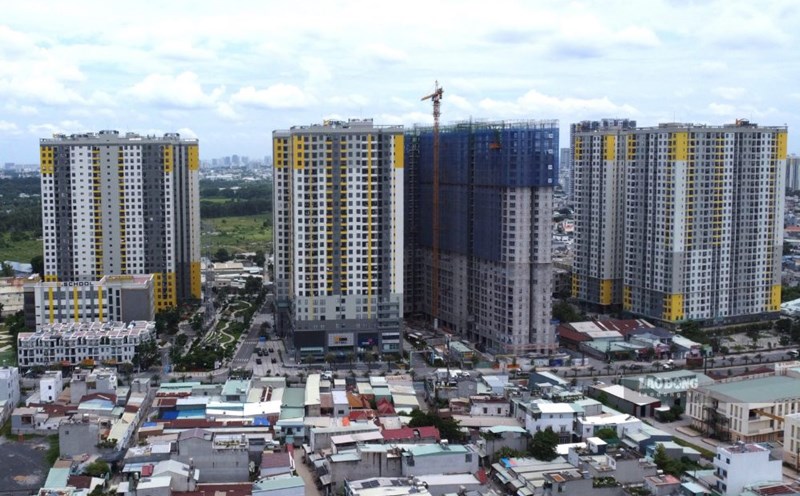
In a newly released report, the Ministry of Construction cited data from the State Bank of Vietnam showing that real estate credit maintained an increase in many segments. Specifically, outstanding loans in this sector reached more than 2.5 million billion VND in the second quarter of 2026, an increase of nearly 13% compared to the first quarter of 2026. In terms of structure, outstanding loans for urban area and housing investment projects continue to account for the largest proportion with more than 833,000 billion VND, an increase of more than 6% quarter-on-quarter.
The Ministry of Construction said that the capital demand of real estate businesses is still high, mainly to maintain operations, supplement working capital and implement projects, especially in the context of continuously increasing supply. In the second quarter, 113 commercial housing projects were licensed for new construction. The number of projects being implemented reached nearly 1,300 projects, an increase of 44% compared to the same period. However, the ability to access capital is clearly differentiated. Investors with stable financial capacity and cash flow have more favorable access to credit.
Meanwhile, most real estate businesses when asked said that many real estate projects have difficulty accessing loans due to high interest rates and being tightened limits, so there is a risk of slow implementation.
The leader of a project development enterprise in Ho Chi Minh City said that they are implementing a mid-range housing project in Binh Duong, but the project progress of his company is at risk of stalling when the loan committed has not been disbursed on time. Money flow is interrupted, causing construction to be sluggish, many sub-zones have to postpone progress, prolonging the completion time of the entire project.
According to this leader, real estate depends heavily on loan capital flows, so when credit is tightened, construction progress and sales are immediately affected. With a project of about 1,000 billion VND, businesses have to spend 300-400 billion VND for the initial phase, but before they can open for sale, they encounter difficulties in borrowing capital, forcing them to postpone progress.
Through exchanges with some investors in Ho Chi Minh City, not only new projects have difficulty accessing capital, but many projects that have been granted credit limits also face difficulties in disbursement, in some cases only receiving 20-30% of capital needs, making it difficult to accelerate progress.
Dr. Nguyen Duy Phuong, Senior Director of DG Capital Fund Financial Investment Division, said that if looking at the overall picture of the market, it can be seen that real estate credit flow is concentrated in some large-scale enterprises, projects with complete legal status or serving debt restructuring and bond repurchase activities, but has not really transformed into a new supply or spread to the affordable housing segment of real buyers.
This is clearly reflected when in the first 6 months of the year, the supply mainly came from high-end projects while affordable housing was absent. Tightening lending standards or prolonged phased capital flows will reduce the actual supply.
Meanwhile, for homebuyers, access to credit for this group is still a bottleneck. Real estate purchase loan interest rates are currently commonly at 12-14% per year, even many floating loans have reached 15-16%. In addition to high interest rates, low loan limits, and too strict procedures and income proof requirements make many people's dream of having a home temporarily put aside.
Many businesses are offering interest rate support packages to find customers, but also said that customers find it difficult to borrow capital, especially for groups with limited financial capacity, it is not easy to satisfy the conditions of the bank.
Real estate credit needs to be managed more flexibly instead of being tightened simultaneously, banks can choose effective projects to lend safely. Real estate credit does not mean risk if it is controlled by the right subjects and projects. In particular, it is necessary to "clear" capital flows in the right places for people with real housing needs," Dr. Phuong stated his opinion.