
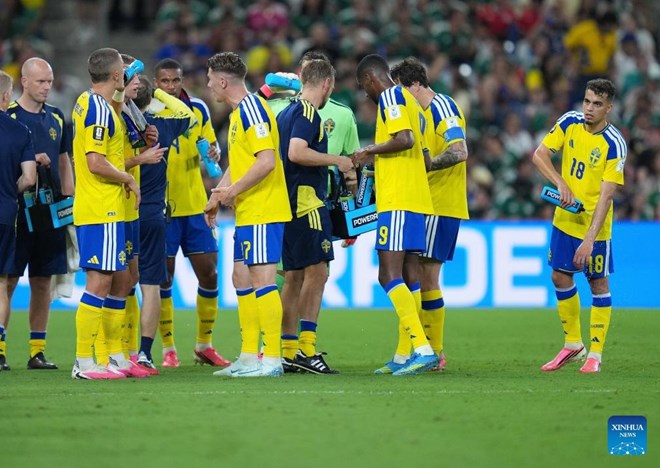
The 2026 World Cup brings many innovations to improve the experience of fans and support match management. However, the mandatory suspension of each half for players to drink water is considered the change that creates the most impact on the diễn biến on the field.
In December last year, FIFA announced that all 104 matches of the 2026 World Cup will have two 3-minute breaks, each half once, to help players replenish water in the context of the tournament taking place in the summer in the US, Canada and Mexico.
In previous World Cups as well as many other major tournaments, water breaks have been applied, but only when the referee sees that the weather conditions are too harsh or the temperature exceeds the prescribed limit.
This time, FIFA decided to apply the above regulations to all matches. According to the world football governing body, the decision was made after consulting with coaches and broadcasting units, with the aim of ensuring the health of players. However, many opinions believe that this decision also serves commercial interests.
Why does FIFA apply the drinking rest rule?
One of the big lessons from the 2025 FIFA Club World Cup in the US is the harsh hot weather conditions.
Many coaches and players have spoken out about the difficulties of playing in high temperatures. Chelsea and Argentina midfielder Enzo Fernandez said he once felt "really dizzy" and described the playing conditions as "very dangerous".
Chelsea's 3 matches at the FIFA Club World Cup took place in the context of local meteorological agencies continuously issuing hot weather warnings, advising people to limit outdoor physical activities.
Coach Enzo Maresca then admitted that Chelsea was forced to shorten training time due to the red-hot sun warning in Philadelphia.
Meanwhile, Marcos Llorente shared that he felt "terribly hot" after Atletico Madrid's 0-4 defeat to Paris Saint-Germain at Pasadena.
My toes hurt, my toenails also hurt. It's unbelievable" - the Spanish player said.
In the announcement of the new regulation, FIFA affirmed that this is part of efforts to ensure the best playing conditions for players, based on experience drawn from recent tournaments, especially the FIFA Club World Cup.
Why is this regulation controversial?
The point that many people debate is that FIFA applies water breaks in all matches, including matches held in roofed stadiums or in cool cities like Seattle.
Many opinions believe that dividing each match into four stages makes football increasingly resembling popular sports in North America.
Suspicions increased when FIFA allowed commercial television stations to broadcast advertisements during drinking breaks.
This move makes many people believe that, besides the goal of protecting players' health, FIFA's decision is also commercially motivated.
FIFA explained that the uniform application for all 104 matches is to ensure consistency in the organization, instead of depending on weather conditions at each location.
In fact, at the FIFA Club World Cup last summer, DAZN broadcast advertisements in the form of splitting screens during drinking breaks. Some other television stations, including Fox (USA), also temporarily cut off match footage to broadcast advertisements.
Advertising has already appeared densely in modern football, from electronic boards around the stadium, match uniforms to advertising frames before and after matches. However, interrupting live matches to insert advertising is still new and causes much controversy in many countries.


