
48: World Cup 2026 closes with the championship belonging to Spain, but what leaves an impression is not only the gold cup. For the first time with 48 participating teams, the tournament spans three host countries with a total of 104 matches and 308 goals, setting a series of new records in World Cup history.
2.96: One of the most prominent points is the number of goals scored. With an average of 2.96 goals per match, the 2026 World Cup becomes the World Cup with the second highest scoring efficiency since 1966. The level gap between teams is also greater than ever when the average FIFA ranking difference between the two teams in each match is 27.3 places, the highest level since FIFA applied the world ranking system.
That partly explains why the teams rated higher won 66.3% of the matches, the highest rate in modern World Cup history. However, the tournament still witnessed some notable surprises, such as Ghana drawing with England or Cabo Verde forcing Spain to draw in the group stage.
28 years and 132 days: Another notable trend is the age of the national teams. In contrast to the rejuvenation trend in club-level football, the 2026 World Cup recorded the starting lineup with the highest average age in history, up to 28 years and 132 days. Iran, Cabo Verde and Colombia all used main squads with an average age exceeding 30.
Besides the human factor, geography also becomes a big challenge. With three co-hosting countries, many teams have to carry out journeys stretching tens of thousands of kilometers between the headquarters and the competition venues.
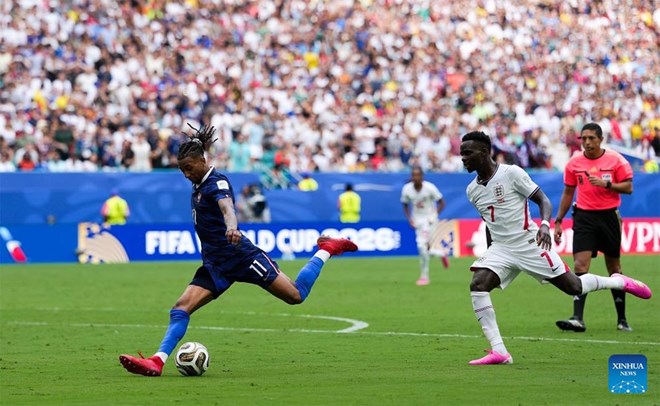
4 and 1: Fixed situations continue to play an important role when for every 4 goals scored at the 2026 World Cup, one goal originates from a dead ball. Argentina and England lead the tournament with 7 goals from fixed situations, while Bosnia & Herzegovina is the team most dependent on such plays.
Conversely, the Spanish champions are not too dependent on dead balls. Only 3 out of 14 goals of La Roja came from set pieces, showing that their strength lies in their ability to deploy the ball in an open game.
61%: The 2026 World Cup also witnessed the lowest penalty kick success rate in many recent tournaments. Only 66.1% of penalty kicks were converted into goals. Notably, players using the rush-off style only achieved a success rate of 53%, much lower than the 71% of normal rush shots.
20%: Team depth also becomes a decisive factor. About 20% of the goals in the tournament were scored by players who came on from the bench. Belgium is the team that best utilized this resource in the knockout round, while Spain benefited right in the final when Ferran Torres, who came on from the bench, scored the only goal to help their team defeat Argentina.
104: After 104 matches of the biggest World Cup in history, Spain has proven that in a tournament full of fluctuations due to the schedule, weather and differences in level, stability and control is still the most effective formula to conquer the peak. Their championship is not only the success of a team, but also proof of the sustainable value of controlled football in the World Cup open era.


