
Coach Pep Guardiola has tried many different tactical adjustments to exploit Manchester City's creativity this season. Some are due to circumstances, mostly from intention. Not all are effective, but they are enough to create many debates.
Man City used to use two attacking midfielders such as Matheus Nunes and Nico O'Reilly in the wing-back position, pushing wingers into the center, increasing the number of 10s on the field. And most recently, a two-striker formation with Erling Haaland pairing with Antoine Semenyo or Omar Marmoush.
These changes reflect the general trend of the Premier League, where many teams switch to direct, fast-paced play and focus on transitions. Fixed situations are also being exploited more and more.
However, Guardiola does not completely support this trend. Man City only scores 16.6% of goals from set pieces - the lowest in a total of 60 goals in the Premier League - but he admits the team is gradually moving in that direction.
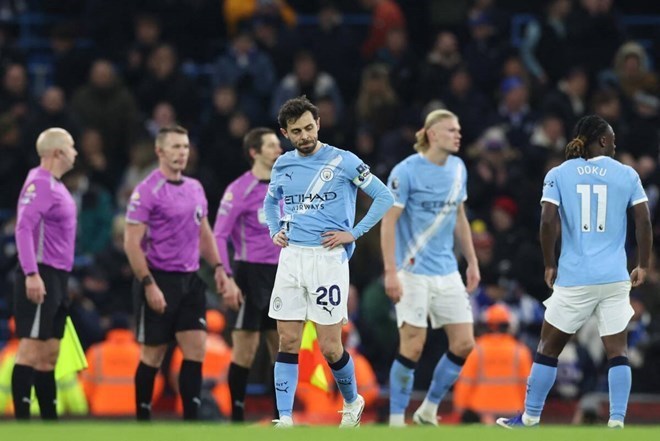
This change leads to changes in the way the squad is built. The recruitment of fast, strong players in tackles like Abdukodir Khusanov shows the increasing demand in direct confrontations.
Guardiola also acknowledged the value of fast attacking play. The ability to shorten the distance to the goal, reducing dependence on ball control has brought certain benefits to Haaland at some point in the season.
However, the performance of the Norwegian striker has decreased significantly. After scoring 25 goals from August to December, he only added 5 goals since the beginning of 2026. At the same time last year, this number was 11 goals.
Guardiola admitted that he has not found the perfect formula for the current squad - a team that has not reached the perfection of the period with David Silva or Kevin De Bruyne at their peak.
The key point is the imbalance between stability and attacking power. This explains why creative players like Rayan Cherki can be used and then eliminated from the squad.
Cherki possesses impressive technique and ability to create chances, but is limited in defense and tackles - factors that Guardiola always values when the team loses the ball. However, Haaland benefits more when there are such creative players to support him.
It is noteworthy that one of The Citizens' recent best performances - the 3-1 victory over Newcastle in the FA Cup - took place when Haaland was absent. Conversely, in another match against Newcastle, Guardiola praised Haaland not for scoring but for contributing to defense. However, that is not the main role of a center forward.
The question is whether Man City will become more balanced without Haaland? And will Guardiola dare to let the main striker sit on the bench in big matches?
Statistics show that Man City's winning rate increased from 55% to 75% when Haaland is not playing, although the number of matches without him is quite small. One reason for Haaland's performance decline is the quality of chances. In the last 15 shots in the penalty area, only 33% were considered clear chances. He is also often pulled away from the goal - where he does not maximize efficiency.
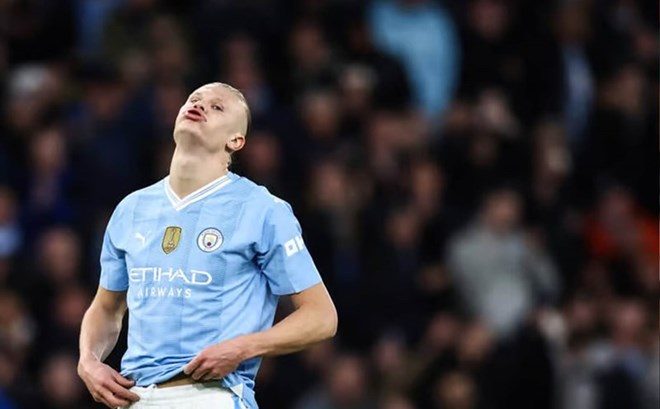
Haaland's chance conversion rate decreased to 10.5%, while the number of shots from outside the penalty area increased, leading to a significant decrease in the xG index.
In the immediate future, Guardiola must make an important decision on how to operate the attack: use Haaland as a support or prioritize fast players like Semenyo and Marmoush in a more flexible formation.
Man City is currently not perfect, but there is no shortage of personnel. What Guardiola needs is to find balance, so that Haaland, if used, always receives the ball in the most dangerous area. And finally, the responsibility also lies with the Norwegian striker himself when he has to overcome a difficult period to return to his true class.


