
Celebrating the full moon of the first lunar month is a ritual that is carefully prepared for a large number of Vietnamese people according to the custom of worshiping ancestors. Families often arrange a decent offering tray to show filial piety to ancestors. Besides, many people also go to pagodas to pray for peace and blessings, hoping for a peaceful and favorable new year.
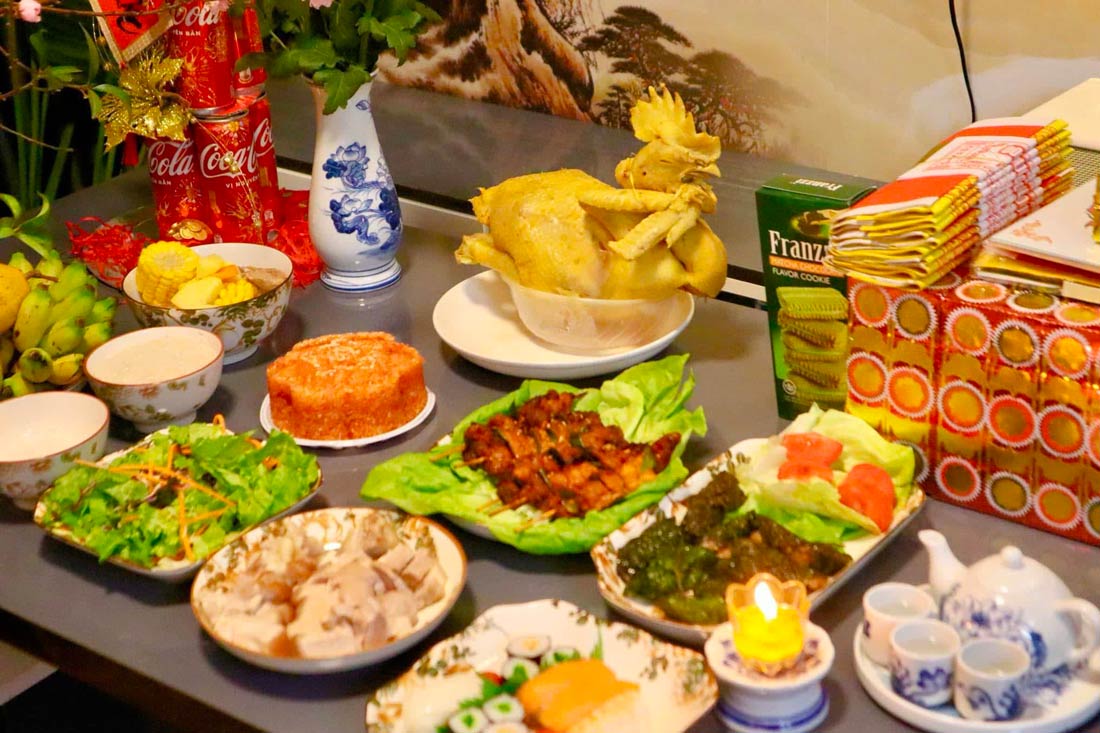
According to the National Archives Center I, in the "Tam nguyen" system (three major full moon days), there are also Trung nguyen Tet (July full moon) and Ha nguyen Tet (October full moon). Nguyen tieu Tet - the first full moon night of the year - is also known as Thuong nguyen Tet.
In the book "Cultivations of worship in Vietnamese families" (National Culture Publishing House, 2000), cultural researcher Toan Anh said that people believe that on the full moon day of the first lunar month, the Buddha descends to pagodas to witness the sincerity of Buddhists.
According to Buddhist beliefs, the 1st and 15th days of each month are considered Buddha's days, so believers often go to pagodas on these occasions. The 1st day, although it is the beginning of the month, is dark night, and the 15th moonlit night is fulfilling. Therefore, the 15th day of the first lunar month - the first full moon night of the year - is even more valued, attracting a large number of people to go to the Buddha's temple.
Researcher Toan Anh also said that in the past, Thuong Nguyen festival also had the ancient name of Trang Nguyen Tet. On this occasion, the king often held a banquet to treat the Trang Nguyen mandarins, inviting them to the Thuong Uyen garden to enjoy flowers, admire the scenery, and write poetry. Later, the name was changed to Thuong Nguyen Tet.
Thuong Nguyen Tet is also known as Nguyen Tieu Tet. During the ceremony night, the ancient capital and many localities often have activities of hanging lanterns and arranging flowers. Some places organize boat racing, martial arts performances, singing and dancing, riding horses... creating a vibrant festival atmosphere.
The full moon of the first lunar month is also the day of Thien Quan. Therefore, in many temples and pagodas, there is often a ceremony to offer stars to ward off bad luck to pray for eliminating disasters in the year. The offerings for star worship often include fruits, betel and areca, sticky rice, sweet soup, wine and votive paper.
In Southern culture, Thuong Nguyen festival is also the day of Thien Quan Dai De (Thien Quan Tu Phuoc festival). People perform the ceremony to thank the god for giving favorable weather and good harvests, and at the same time pray for blessings, fortune and peace after the harvest season, before the New Year.
Today, the way of celebrating the full moon of the first lunar month has changed a lot according to the modern rhythm of life, some old stories are gradually fading, but the meaning of praying for peace and good luck at the beginning of the year is still preserved.
Mid-Autumn Festival worshiping hour in January 2026
According to feng shui expert Nguyen Song Ha, burning incense to worship the full moon of the first lunar month of Binh Ngo year 2026 should be prioritized in the early morning. This is considered a time of prosperity, helping the family accumulate blessings and welcome positive energy.
Homeowners can also burn incense in the late afternoon to create a cozy and prosperous atmosphere. However, folk wisdom advises not to burn incense after 7 pm because it is believed that this is the time when wandering spirits are easily invited into the house.
Expert Nguyen Song Ha suggests the best hours for worshiping the full moon of the first lunar month of Binh Ngo 2026 as follows:
14th day of the 1st lunar month (March 2nd, 2026 solar calendar): Dragon hour (7am - 9am), Goat hour (1pm - 3pm), Rooster hour (5pm - 7pm).
15th day of the first lunar month - full moon (3. March 2026 solar calendar): Mao hour (5am - 7am), Ty hour (9am - 11am), Than hour (3pm - 5pm).
Depending on work and living conditions, homeowners can choose a suitable time to worship the full moon of the first lunar month.
On this day, homeowners should burn incense according to odd numbers such as 3, 5 or 9 incense sticks. Among them, 3 incense sticks called Tam Bao Huong have the meaning of praying for peace; 5 incense sticks are usually used when praying for fortune; 9 incense sticks are used to offer to Buddha.
However, according to folk beliefs, the home altar should not burn 9 incense sticks. Homeowners should only choose 3 or 5 incense sticks to suit the worship space in the family.


