
The Vietnam Labor Market Bulletin for the first quarter of 2026, published by the Institute of State Organization and Labor Science (Ministry of Home Affairs), shows many notable indicators on employment, unemployment, income and recruitment trends.
In the first quarter of 2026, the national labor force reached 53.6 million people, an increase of nearly 233,000 people compared to the previous quarter and an increase of nearly 688,000 people compared to the same period in 2025.
The number of people with jobs reached 52.5 million, an increase of 0.4% compared to the previous quarter and an increase of 1.3% compared to the same period last year. However, the rate of trained workers with degrees and certificates only reached 29.6%.
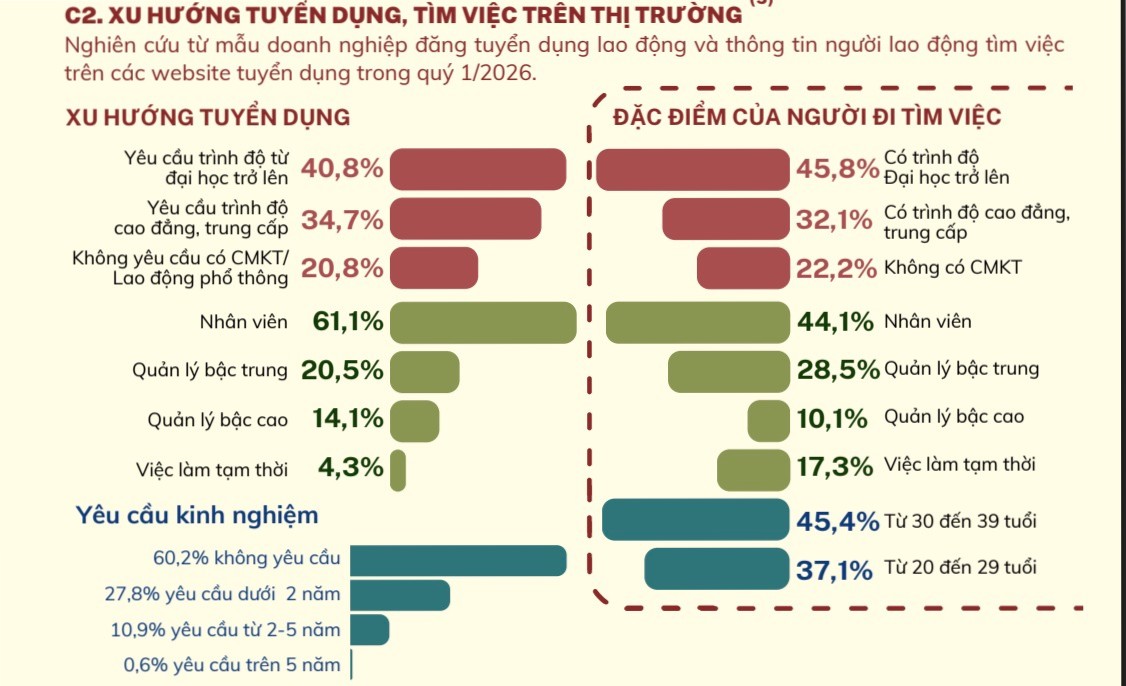
A survey from sample businesses posting recruitment and job seekers information on recruitment websites in the first quarter of 2026 shows that, in terms of recruitment demand, 40.8% of positions require university degrees or higher; 34.7% require college and intermediate degrees; 20.8% do not require technical expertise or general labor.
By job position, the group of employees accounted for 61.1%; middle management 20.5%; senior management 14.1%; temporary jobs 4.3%.
Regarding experience, 60.2% of recruitment positions do not require experience; 27.8% require less than 2 years; 10.9% require from 2 - 5 years; 0.6% require over 5 years.
For job seekers, 45.8% have university degrees or higher; 32.1% have college or intermediate degrees; 22.2% do not have technical expertise.
According to the desired job group, 44.1% look for jobs in employee positions; 28.5% middle management; 10.1% senior management; 17.3% temporary jobs.
Regarding age, the group from 30 - 39 years old accounted for 45.4%, the highest; followed by the group from 20 - 29 years old with 37.1%.
The 5 industry groups with the largest recruitment demand include processing and manufacturing industry; logistics - transportation; trade - retail; construction - real estate; information technology.
In the group of occupations with the highest recruitment demand, the top is sales staff, followed by marketing - communication, IT - programming, technical engineers, logistics - warehousing.
In the opposite direction, the 5 occupational groups most searched for by workers include administration - office - human resources; business - sales; marketing - communication; accounting - finance; information technology.
According to Mr. Ngo Xuan Lieu - National Director of the Employment Service Center (under the Department of Employment, Ministry of Home Affairs), workers who do not fully utilize their potential are not only those who are unemployed, but also those who are working, but have not reached the standard working time or have not done the right job for their capacity. This shows that the labor market still has gaps in the allocation and use of human resources.
He analyzed: "A clear manifestation is that the job search time for workers is still prolonged. When workers spend a lot of time looking for suitable jobs, it means that potential has not been effectively exploited. Prolonging the time will reduce the efficiency of using resources of the whole society.
Mr. Ngo Xuan Lieu said that first of all, it is necessary to strengthen the effectiveness of connecting labor supply and demand. "Building and operating an effective national online job exchange will help connect workers and businesses faster. When data is fully updated, the search and recruitment process will become more accurate and effective," Mr. Lieu emphasized.


