
Keeping the job is paramount
Ms. Le Thi Hoa (from Hoang Cuong commune, Phu Tho province) has been an accountant at a consumer goods manufacturing company in Phuong Liet ward (Hanoi) for 6 years. From a new employee with a salary of 6 million VND/month, by the beginning of 2025, Ms. Hoa had a salary of more than 11 million VND/month.
From July 2025, the company where Ms. Hoa works will have reduced orders. The first affected department is the group of direct production workers. According to Ms. Hoa, the company reduced 15% of personnel from factories; then, to indirect departments such as administration, business...
In September 2025, the company announced that Ms. Hoa's accounting department will cut from 7 people to 5; of which 5 employees will be retained and will have a 20% salary reduction from October 2025 to the end of 2025. From the beginning of 2026, depending on the business recovery situation, the company will increase salaries for officials and employees.
As one of the 5 people who are allowed to stay to work, Ms. Hoa said that she accepts a salary reduction of more than 2 million VND/month. "My salary from 11,300,000 VND/month decreased to 9,040,000 VND/month. I proactively discussed with my husband to cut spending to compensate for this shortfall. In this difficult job-seeking era, qualifications are not "genuine", I accept a salary reduction to preserve work and ensure family life," Ms. Hoa said.
Like Ms. Hoa, Mr. Tran Duc Hai, an IT employee of a software company in Cau Giay ward (Hanoi) also received a notice of a 10% salary reduction from the fourth quarter of 2025 due to the company's difficult business situation.
My salary is currently from 17 million VND/month reduced to more than 15 million VND/month. I am not in a hurry to find new job opportunities because I know starting a job in a new environment at this time is not easy," Mr. Hai shared.
At many manufacturing and service enterprises, the situation of reduced orders and increased costs forces businesses to tighten spending. One of the common solutions is to cut bonuses, allowances, and even adjust to reduce the basic salary.
Faced with a difficult choice between losing their jobs and reducing their income, many workers accept salary reductions to keep their jobs. For them, keeping a job means maintaining a steady income, even if it is less, rather than falling into prolonged unemployment in a context where job opportunities are not easy to find.
Many workers share that they are willing to work overtime, take extra jobs to compensate for the reduced income, as long as there is still official work to cover living expenses. In particular, families with large spending burdens find it even more difficult to accept the risk of losing their jobs. Wage reductions are seen as a "price to pay" in exchange for relative stability in the short term.
Risk of job quality declining
Mr. Tran Ngoc Anh - Director of Son Kim Metal Company (Hoang Mai ward, Hanoi) said that at this time many businesses are in a difficult position due to increased raw material prices, high capital costs, and slow consumption markets, causing profits to decrease. In that context, reducing personnel costs is the fastest solution to maintain operations.
At Mr. Ngoc Anh's company, labor income decreased by 10% from the second quarter of 2025 and shows no signs of recovery.
Instead of mass layoffs, we choose to negotiate with workers to temporarily reduce wages, waiting for the market to recover. This approach helps businesses retain experienced workers and reduce immediate financial pressure," said Mr. Ngoc Anh.
However, Mr. Ngoc Anh also admitted that prolonged wage reductions are causing many consequences. Reduced income while living expenses are constantly increasing, making workers' lives increasingly difficult. Many families have to cut essential expenses, postpone study plans, health care...
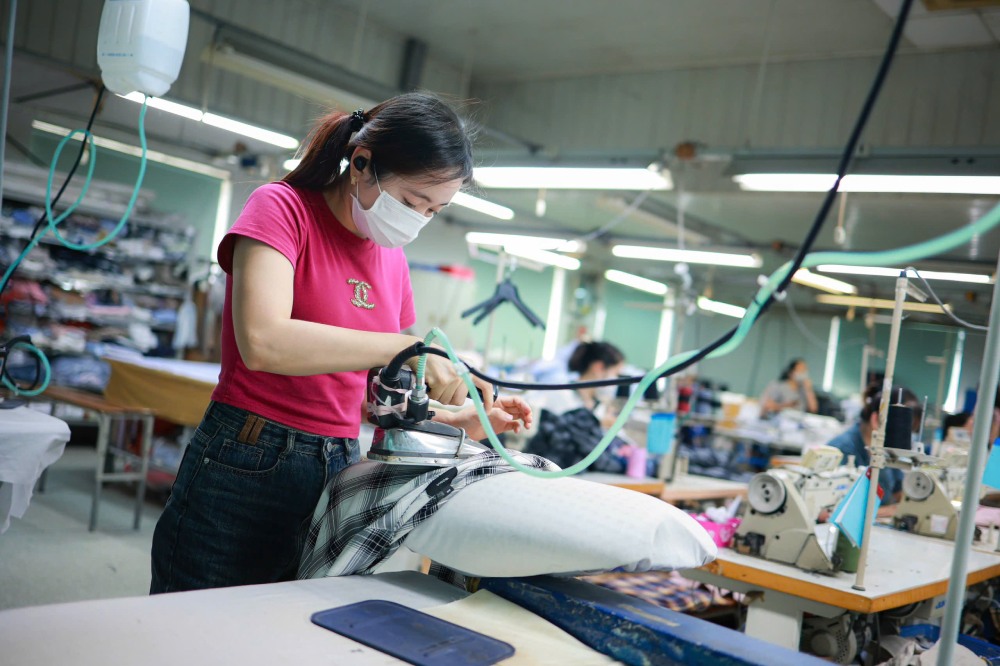
Ms. Nguyen Thi Lan Huong - former Director of the Institute of Labor Science and Social Affairs warned that if the trend of reducing wages to keep jobs lasts, the quality of jobs will be seriously affected. Work is formally stable but income is not enough to live on will cause workers to fall into the "low-income trap", making it difficult to improve their lives. In addition, when workers have to accept wages lower than the actual labor value, the motivation to work and long-term attachment to businesses also decreases.
To limit negative impacts, Ms. Huong believes that synchronous solutions are needed from the State, businesses and workers.
In particular, businesses need to be transparent about the production and business situation, negotiate fairly with workers about the roadmap for income recovery when the market improves, and avoid turning temporary wage reductions into long-term ones. Workers also need to proactively improve their skills, be ready to change positions or seek new opportunities to increase competitiveness," Ms. Huong said.


